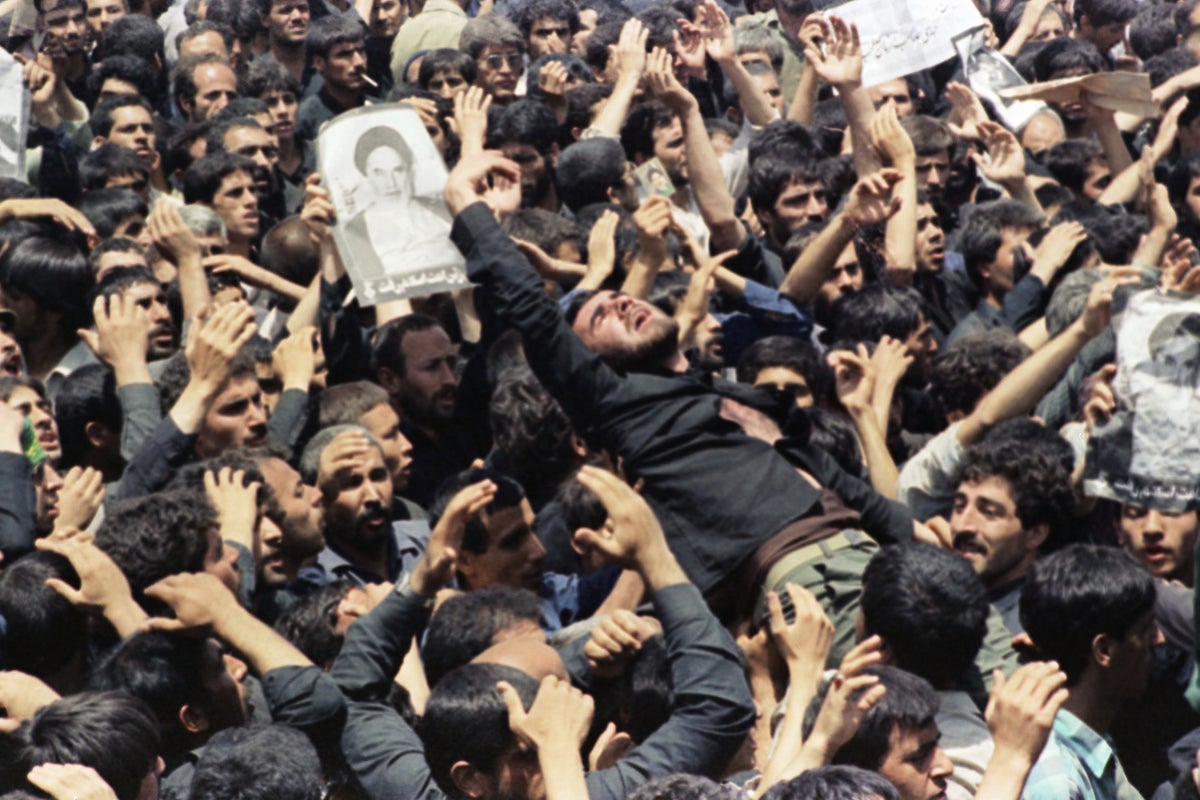
The Western press loves a monoculture narrative. When Ayatollah Ruhollah Khomeini died in June 1989, international news outlets rushed to report a single, terrifyingly uniform statistic: one-sixth of Iran’s entire population had allegedly gathered in Tehran to mourn. The Associated Press and its contemporary peers painted a picture of absolute, unyielding ideological conformity. They saw a sea of millions trampling each other, ripping at the shroud of the deceased leader, and interpreted it as a terrifying showcase of total public devotion to the Islamic Republic.
They got it completely wrong.
What the media witnessed in 1989 was not a unified demonstration of political allegiance. It was a massive logistical failure, a manifestation of deep socio-economic desperation, and a masterclass in state-managed crowd psychology. By viewing the chaos through a purely ideological lens, Western commentators missed the fracture lines that would define Iranian politics for the next four decades.
The Logistic Trap Parsing the Impossible Numbers
Let’s dismantle the "lazy consensus" of the ten million figure. For decades, the media has parroted the claim that between one and ten million people attended the funeral procession. Anyone who has ever managed large-scale urban infrastructure or studied crowd density knows these numbers are mathematically absurd.
To fit ten million people into the designated areas of Tehran and the Behesht-e Zahra cemetery, you would need a density of roughly eight people per square meter across every major highway, side street, and open dirt lot in a thirty-kilometer radius. That is not a crowd; that is a physical impossibility.
When you look at the raw data of the event, a different picture emerges:
- The Urban Funnel: Tehran’s infrastructure in 1989 was severely degraded by eight years of brutal war with Iraq. The public transportation system was practically non-existent.
- The State Mobilization: The regime utilized every state-owned bus, military transport truck, and train to ferry rural populations into the capital. Attendance for government employees and their families was not strictly voluntary; it was tied to food rations and employment security.
- The Open-Air Spectacle: By prolonging the event and failing to secure the route, the state turned a solemn burial into an anarchic, high-stakes spectacle where survival, not just mourning, became the primary driver of crowd movement.
I have spent years analyzing how state media apparatuses manipulate Western reporting. The playbook is always the same: create a visual so overwhelming that the foreign press stops asking mechanical questions. The AP report focused on the sensationalism—the body falling from the coffin, the hysteria, the heat. They failed to ask how a broke, war-torn state managed to concentrate that many bodies in one place without the whole city collapsing into a famine.
Ideology vs. Catharsis The Psychology of the Shroud Ripping
The most enduring image of the funeral is the crowd surging toward the wooden litter, tearing away pieces of Khomeini’s white burial shroud. To the casual Western observer, this was a fanatical display of religious ecstasy.
It was actually an expression of profound trauma and economic ruin.
By June 1989, Iran was a pressure cooker. The Iran-Iraq War had ended just a year prior, leaving a generation of young men dead, the currency in free fall, and the economy devastated. Khomeini had promised a utopian Islamic state where oil revenues would be delivered to the poor. Instead, he delivered a decade of austerity, conflict, and purges.
Imagine a scenario where a population has been stripped of every outlet for public expression, entertainment, and grief for ten years. Suddenly, the central figurehead of that restriction dies. The state opens the floodgates and invites everyone to scream in the streets. What you get is not pure grief for the dictator; it is a collective, hysterical release of pent-up societal trauma.
[Trauma / War Scarcity] + [Total Suppression of Outlets] + [State-Sanctioned Event] = Hysterical Crowd Dynamics
Tearing the shroud wasn't just about seeking a holy relic. For many in that crowd, it was a desperate attempt to grab a tangible piece of history, a chaotic reaction to the vacuum left by a man who had controlled every aspect of their daily existence. It was the frantic energy of a populace that knew a dark, uncertain chapter was opening, and the rigid stability of the last decade was vanishing in real-time.
The Mirage of Total Compliance
The biggest flaw in the historical coverage of the event is the assumption that everyone present was a true believer. This is the classic error of treating a crowd as a single mind.
In authoritarian regimes, presence does not equal compliance. For the millions of rural Iranians brought in on state-subsidized transport, the trip to Tehran was a rare opportunity to access goods, find family members, or simply witness an epochal event. To categorize every attendee as a devout follower of the velayat-e faqih (the guardianship of the Islamic jurist) is to erase the complex reality of survival under a totalitarian regime.
Furthermore, this narrative completely ignored the millions of Iranians who stayed home, locked their doors, or quietly celebrated the passing of a regime that had executed their children during the 1988 prison massacres. By training their cameras exclusively on the dust and frenzy of the cemetery, Western journalists allowed the Islamic Republic to dictate the terms of its own legitimacy. They validated the regime's claim that it held a total mandate over the Iranian soul.
The Real Legacy of June 1989
The hyper-focus on the scale of the funeral obscured the actual political mechanics taking place behind closed doors. While the international press was busy marveling at the chaos in the streets, the clerical elite were quietly orchestrating a constitutional coup.
They altered the requirements for the Supreme Leadership to allow Ali Khamenei—a man who lacked the necessary religious credentials at the time—to take power. The frantic energy of the crowd was used as a smokescreen. The state pointed to the streets to say, "Look how much they love us," while simultaneously tightening the security apparatus to ensure that love would never be legally questioned.
The conventional wisdom says that Khomeini’s funeral proved the absolute consolidation of the Islamic Revolution. The truth is exactly the opposite. It was the high-water mark of a specific type of charismatic authority. Once that body was finally lowered into the concrete vault, the era of genuine mass mobilization based on ideological fervor died with it. What followed was a regime reliant not on the willing ecstasy of millions, but on the cold, calculated violence of the Revolutionary Guards.
Stop looking at the old newsreel footage as proof of a nation's unified will. It was the final, desperate gasp of a decade of wartime hysteria, captured by Western journalists who couldn't tell the difference between a society in mourning and a society in shock.