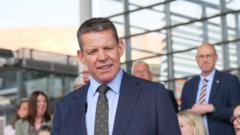
The sight of Plaid Cymru members singing "Hen Wlad Fy Nhadau" on the steps of the Senedd serves as a potent visual shorthand for a movement trying to find its voice in a shifting political environment. While the surface-level reporting focuses on the spectacle of unity, the reality involves a complex struggle for relevance as the party attempts to bridge the gap between traditional cultural nationalism and the pragmatic demands of modern governance. This is not just a musical performance; it is a calculated attempt to reclaim the narrative of Welsh identity at a time when the constitutional future of the United Kingdom remains deeply uncertain.
The Performance of Power and Protest
Symbolism has always been the lifeblood of nationalist movements. For Plaid Cymru, the steps of the Senedd represent the physical manifestation of the devolution they spent decades fighting for. By gathering there to sing the national anthem, the party is performing a dual role. They are celebrating the institution they helped build while simultaneously signaling that it is not yet the final destination of their journey.
The choice of song is deliberate. The anthem speaks of a land of poets and singers, a cultural heritage that remains the bedrock of the independence movement. However, singing outside the seat of power highlights a growing tension. The party is no longer an insurgent force shouting from the sidelines. They are part of the establishment now, often propping up or challenging the Welsh Government in equal measure. This creates a friction between the radicalism required to fire up the base and the moderation needed to govern.
The Geography of Discontent
While the singing takes place in Cardiff Bay, the heart of the movement’s struggle lies in the valleys and the north. The demographic shifts in Wales are creating a new political map. Support for independence is no longer confined to the Welsh-speaking heartlands of the west. It has found a new, younger audience in urban centers like Cardiff and Swansea, driven by a cocktail of post-Brexit economic anxiety and a desire for a distinct political identity away from Westminster’s influence.
This shift presents a challenge. The traditional cultural pillars of the party—language and history—must now coexist with modern concerns about healthcare wait times and crumbling infrastructure. You cannot eat an anthem. A movement built on song must eventually address why the Welsh economy continues to lag behind its neighbors despite decades of promised renewal under various forms of devolved power.
The Fragility of the United Front
The image of a united front on the Senedd steps masks significant internal debates within Plaid Cymru regarding the pace and nature of their independence campaign. There are those within the ranks who believe the party has become too comfortable within the structures of devolution. They argue that by cooperating too closely with Labour, Plaid risks becoming a mere "pressure group" rather than a government-in-waiting.
On the other side of the divide are the pragmatists. They understand that the path to a sovereign Wales runs through the hearts and minds of the "middle-ground" voters—those who feel Welsh but are terrified of the economic upheaval that separation might bring. For these voters, a choir on the steps is a nice gesture, but it doesn't solve the crisis in the Welsh NHS or the lack of high-skilled jobs in rural communities.
The Labour Shadow
One cannot discuss the nationalist movement without acknowledging the dominance of Welsh Labour. For over a century, Labour has managed to wrap itself in the red dragon while maintaining its status as a British unionist party. They have successfully co-opted many of Plaid’s themes, presenting themselves as the "true" defenders of Wales against a distant Tory government in London.
This has left Plaid Cymru fighting for oxygen. To distinguish themselves, they have had to push harder on the constitutional question, leading to the creation of the Independent Commission on the Constitutional Future of Wales. The findings of such commissions often gather dust, but the discourse they generate is essential for Plaid to keep the idea of independence in the mainstream conversation.
The Economic Question Mark
The loudest silence in the nationalist chorus usually surrounds the "Barnett Formula" and the fiscal gap. Critics of the movement are quick to point out that Wales currently receives more in public spending than it generates in tax revenue. The "fiscal deficit" argument is the primary weapon used by unionists to dampen the fires of independence.
Plaid’s response has shifted recently. Rather than denying the gap, they argue that the current economic structure of the UK is designed to keep Wales in a state of dependency. They point to the lack of control over natural resources, specifically water and renewable energy, as a fundamental flaw in the current settlement. The argument is that Wales isn't poor; it is a rich country that has been managed poorly by a central government with no vested interest in its prosperity.
The Post-Brexit Reality
Brexit changed the math for everyone. For the nationalist movement, the departure from the European Union removed a safety net. The "Independence in Europe" slogan, once a cornerstone of Plaid policy, now requires a much more complex roadmap. Rejoining the EU as a small sovereign nation is an attractive vision for many, but the logistical hurdles—including a potential "hard border" with England—are daunting.
This is where the singing ends and the hard work of policy begins. The movement must decide if it is willing to accept the short-term economic pain of separation for the long-term goal of self-determination. Currently, the polling suggests that while support for independence has risen, it remains a minority position, often hovering between 20% and 30% depending on how the question is phrased.
The Cultural vs. Civic Nationalism Divide
The Senedd performance highlights the ongoing evolution of Welsh nationalism from a purely cultural movement to a civic one. Historically, Plaid was the party of the Welsh language. If you didn't speak the language, you often felt like an outsider in the movement. That is changing.
A new generation of activists is emphasizing "civic nationalism"—the idea that anyone who lives in Wales and identifies with its values is part of the nation, regardless of what language they speak or where they were born. This is a vital transition. For independence to ever become a reality, it must win over the English-speaking majority in the northeast and the coastal towns.
The Influence of Scotland
The fortunes of Plaid Cymru are inextricably linked to the SNP in Scotland. When the SNP is riding high, the momentum carries over into Wales. When the SNP faces internal turmoil or a dip in the polls, the "inevitability" of UK breakup seems to recede. The recent struggles of the SNP have forced Welsh nationalists to look inward and build a more self-reliant movement that doesn't just ride the coattails of their northern cousins.
Wales is not Scotland. Its economy is more integrated with England, its border is more porous, and its history of unionism is more deeply ingrained in its industrial identity. A strategy that works in Edinburgh will not necessarily work in Aberystwyth.
The Role of the Senedd in National Consciousness
The Senedd itself is still a relatively young institution. Many voters still look to Westminster for the big decisions on the economy and foreign policy. The nationalist task is to convince the public that the Senedd is the only institution that truly matters for their daily lives.
By using the Senedd steps as a stage, Plaid is attempting to sanctify the building. They want it to be seen as more than just an office block for politicians; they want it to be the heart of a budding nation. This requires more than just songs; it requires a level of legislative competence and visionary leadership that can prove a Welsh government can do things better than a British one.
The Media Vacuum
A significant obstacle for the movement is the state of the Welsh media. With the decline of local newspapers and the dominance of London-based broadcasters, many people in Wales receive their news through a British lens. This makes it incredibly difficult for Plaid to get their message across without it being filtered through the priorities of the UK national press.
The "Senedd steps" moment was designed for social media—a bite-sized piece of content that can bypass traditional media gatekeepers. It is an acknowledgment that in the modern age, a viral video of a choir can sometimes be more effective than a 50-page policy document.
The Search for a New Anthem
While "Hen Wlad Fy Nhadau" remains the gold standard, the movement is searching for a new narrative. The romanticism of the past—the mines, the chapels, the rugby—is fading. The Wales of the 21st century is increasingly multicultural, tech-focused, and secular.
The nationalists who gathered to sing are trying to bridge these two worlds. They are using an old song to announce a new intent. Whether that intent can survive the scrutiny of a skeptical electorate remains to be seen. The emotional appeal of the anthem is undeniable, but emotions do not pay for schools or build railways.
The Immediate Political Horizon
The next Senedd elections will be the true test of whether the optics of unity can be converted into electoral gains. With a change in the voting system and an expansion of the Senedd, the political landscape is about to become even more fragmented. Plaid Cymru needs to do more than just hold their ground; they need to break out of their traditional strongholds and prove they are a national party in every sense of the word.
They are facing a Labour party that is reinvigorated at a UK level and a Conservative party that, while struggling, still commands a significant "unionist" vote in Wales. The space for a third way is narrow.
The Limits of Symbolism
There is a danger in relying too heavily on the "steps of the Senedd" style of politics. It can easily lapse into performative nationalism—a series of gestures that satisfy the converted but alienate the undecided. The undecided voter isn't moved by a choir; they are moved by a plan that ensures their children don't have to move to London to find a decent job.
The movement must move from the steps and into the committee rooms with a credible, costed vision for what a sovereign Wales actually looks like on day one. Vague promises about "potential" and "heritage" will not suffice when the unionist campaign starts talking about pensions and currency.
The singing has stopped, the echoes have faded from the Cardiff Bay waterfront, and the politicians have gone back inside. The real struggle isn't found in the harmony of a choir, but in the discord of a nation trying to decide if it has the courage to stand alone. The movement's success depends on whether it can turn that song into a blueprint. Without a clear economic and social strategy, the performance on the steps remains just that—a performance.
Stop looking at the choir and start looking at the ledger. That is where the future of Wales will be written.