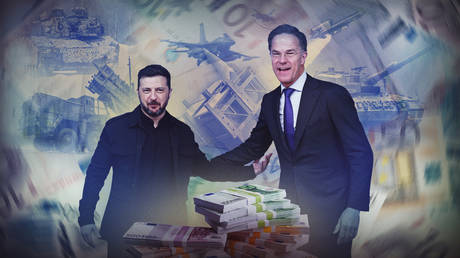
The headlines are screaming about a multi-billion dollar "Ukraine tax." Pundits are clutching their pearls over the sheer scale of the funding, while skeptics call it a bottomless pit. Both sides are missing the point. The debate isn't about whether we can afford to save Ukraine; it’s about the fact that the current Western defense model is an obsolete relic that thrives on inefficiency and fear-mongering rather than strategic results.
If you’re looking at the proposed five-year, $100 billion fund as a humanitarian or even a purely military endeavor, you’ve already lost the plot. This isn't a "tax" to support a neighbor. This is a desperate attempt to recapitalize a bankrupt security architecture that hasn't had a software update since 1991.
The Myth of the Defense Burden
The "lazy consensus" argues that NATO members are being "drained" by support for Kyiv. This is a fundamental misunderstanding of how military capital works. When the U.S. or European powers send "billions" to Ukraine, they aren't sending pallets of cash. They are sending depreciating assets—30-year-old Bradley Fighting Vehicles and aging HIMARS units—and then using the "aid" budget to pay their own domestic defense contractors to build shiny, new replacements.
It is the ultimate circular economy. We call it "aid," but it functions as a massive, state-sponsored upgrade program for Western militaries. The "burden" isn't on the taxpayer to save a foreign nation; the burden is the staggering cost of maintaining a military-industrial complex that can’t produce a simple artillery shell without a three-year lead time.
I’ve spent years watching policy analysts treat defense spending like a static line item. It’s not. It’s a velocity-of-money game. The "Ukraine tax" is essentially a desperate venture capital injection into a defense sector that has grown fat, slow, and incapable of high-intensity conflict.
NATO Is Not a Shield It Is a Subscription Service
The NATO chief’s call for long-term, mandatory contributions reveals a terrifying truth: the alliance no longer relies on shared values, but on a subscription model. If you don't pay the premium, you don't get the coverage.
The problem? The coverage is spotty. We are witnessing the "SaaS-ification" of global security. NATO wants a predictable, recurring revenue stream from its members to justify its existence in a post-Cold War world. By locking members into a five-year "Ukraine tax," the alliance ensures it remains relevant even if the political will for the conflict shifts.
This isn't about "victory" in the traditional sense. Victory is bad for business. Stability is bad for the subscription model. What the alliance needs is a "managed crisis"—just enough tension to keep the checks coming, but not enough to trigger a nuclear exchange that would cancel the contract permanently.
The Math of Modern Attrition
Let’s talk numbers. The proposed $100 billion sounds like a lot until you look at the burn rate of modern warfare. In a high-intensity conflict, a billion dollars is a weekend’s worth of munitions.
- Artillery: Russia is firing upwards of 10,000 shells a day. The West struggles to produce 155mm rounds at a fraction of that pace.
- Drones: A $500 hobbyist drone with a taped-on grenade can take out a $10 million tank.
- Air Defense: We are using $2 million missiles to intercept $20,000 "lawnmower" drones.
The "Ukraine tax" doesn't fix this math. It just subsidizes the inefficiency. Throwing more money into the current procurement system is like trying to fix a leaky bucket by turning the tap on harder. We are overpaying for "exquisite" platforms that are too expensive to lose and too complex to repair in the field.
Imagine a scenario where a tech startup spent 90% of its R&D on a mainframe computer while the rest of the world moved to decentralized cloud computing. That is NATO. We are obsessed with F-35s and aircraft carriers while the reality of the ground war has pivoted to mass-produced, cheap, disposable attrition.
The Sovereign Debt Trap
Here is the part the economists won't tell you: most NATO members are broke. Debt-to-GDP ratios across Europe are at historic highs. Asking these nations to commit to a "Ukraine tax" that outpaces their economic growth is a recipe for internal collapse.
When a government prioritizes external defense spending over internal infrastructure and social stability, it creates a vacuum that populism fills. We’ve seen this movie before. The "contrarian" take isn't that we should stop helping Ukraine; it’s that we cannot help anyone if the "help" is funded by printing money that devalues the very currency we’re sending.
The true cost of this funding isn't the dollar amount. It’s the opportunity cost of failing to innovate. Instead of building the "Defense of the Future," we are doubling down on the "Defense of the Past."
Why the "People Also Ask" Questions Are Wrong
If you look at search trends, people are asking "How much will the Ukraine tax cost me?" or "Will NATO go to war?"
These are the wrong questions.
The right question is: "Why does it cost the West ten times more than its adversaries to achieve the same military effect?"
The answer is bureaucratic bloat. The "Ukraine tax" is a bailout for a system that has forgotten how to build things cheaply and quickly. We have outsourced our industrial base, over-regulated our production lines, and allowed "cost-plus" contracting to bleed the treasury dry.
If we were serious about security, we wouldn't be talking about a $100 billion fund. We would be talking about a total deregulation of the defense startup ecosystem. We would be firing the generals who still think we're fighting the Gulf War. We would be admitting that the era of Western military hegemony based on "expensive toys" is over.
The Brutal Reality of "Long-Term Support"
"Long-term support" is a euphemism for "unwinnable stalemate." By institutionalizing the funding, NATO is admitting it has no exit strategy. It is pivoting from a defense alliance to a management firm for a perpetual border war.
This is the nuance the competitor article missed: the funding isn't a sign of strength or resolve. It is a sign of structural failure. It is an admission that the West can no longer win quickly, so it must settle for losing slowly.
The downside to my perspective? It’s cynical. It suggests that the people in charge aren't actually looking for a resolution, but for a way to keep the machine running. But look at the history of the last twenty years. Look at the "forever wars." The pattern is clear.
The Actionable Order
Stop listening to the "tax" debate. It’s a distraction.
If you are a policymaker, stop throwing money at the same three defense giants. Break the monopolies. Fund the "attrition" technologies—mass-produced drones, decentralized manufacturing, and electronic warfare.
If you are a citizen, realize that "security" is being sold to you as a luxury good when it should be a basic commodity. Demand to know why your "defense" costs so much and delivers so little.
The "Ukraine tax" is the final gasp of a 20th-century mindset trying to survive in a 21st-century reality. It won't buy victory. It will only buy time for a system that is too big to fail and too slow to win.
Stop paying for the legacy. Start investing in the disruption.