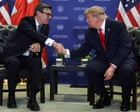
International relations under a protectionist, transactional American hegemony force middle powers into an uncomfortable analytical bind. When executive power shifts in Washington toward unilateralism, states structurally tied to the transatlantic security architecture face an acute strategic trilemma: full alignment at the cost of domestic economic autonomy, strategic divergence that fractures defensive guarantees, or transactional hedging that satisfies neither camp. Analyzing how a newly installed administration in London navigates this friction reveals the operational limits of modern statecraft when traditional multilateral norms are systematically bypassed by the dominant global superpower.
The Structural Mechanics of Transatlantic Asymmetry
The fundamental driver of friction between a transatlantic middle power and a nationalist United States is an imbalance in structural leverage. The United States under a transactional architecture operates via bilateral pressure points, treating historical alliances as variable-sum ledgers rather than fixed institutional assets. For London, this creates an immediate resource allocation puzzle.
Security guarantees provided through collective defense frameworks rely implicitly on Washington's nuclear and logistical umbrella. Consequently, any divergence on secondary fronts—such as trade tariffs, technology transfer restrictions, or sanctions enforcement against third-party states—triggers disproportionate retaliatory exposure for the junior partner.
- Trade Vulnerability: Export exposure to the United States market dwarfs reciprocal dependency, leaving regulatory policies exposed to extraterritorial pressure.
- Intelligence Interdependence: Deep structural integration within signals intelligence and defense procurement limits the feasibility of independent operational postures.
- Regulatory Divergence: Attempts to establish sovereign standards in emerging technological sectors collide directly with American extraterritorial compliance mandates.
The Cost Function of Diplomatic Hedging
To evaluate whether a distinct national path is mathematically viable, one must analyze the opportunity cost of diplomatic deviation. Hedging strategies assume a middle power can extract security goods from Washington while cultivating commercial architecture elsewhere, specifically within alternative multilateral trading blocs. However, this assumes the global economy remains partitioned into permeable compartments.
In a fragmented global order, neutrality or multi-alignment carries a severe penalty function. When Washington demands binary alignment on critical supply chains, semiconductor restrictions, or energy corridors, refusal or slow-walking results in immediate friction coefficients within financial clearing systems and defense supply chains.
A government attempting to chart an independent course must absorb these friction costs internally. This manifests as depressed capital investment, delayed defense modernization schedules, and diplomatic isolation within multilateral forums where American veto power or financial leverage remains absolute. The pursuit of divergence is therefore bounded strictly by domestic economic resilience; a state experiencing sluggish domestic growth lacks the fiscal buffer required to absorb external economic coercion.
Strategic Realities of Bilateral Engagement
Initial diplomatic interactions between new executive leadership and a transactional White House typically follow a predictable behavioral model. Early engagements prioritize superficial rapport—often leveraging cultural touchstones or defense procurement announcements—to secure a temporary exemption from systemic volatility.
However, surface-level diplomacy fails to alter underlying structural incentives. The American apparatus operates on enforceability and immediate concessions. Long-term strategic convergence requires institutional predictability, a commodity scarce when executive decision-making is personalized and mercurial.
The mechanism for managing this asymmetry relies on compartmentalization. Middle powers must isolate operational security cooperation from broader macroeconomic strategy, accepting subservience in commercial standard-setting while preserving tactical autonomy in regional defense initiatives where American interest is minimal or waning.
The Institutional Limits of Multilateral Forums
Global governance structures designed in the post-war era now function primarily as friction rather than coordination mechanisms. When multilateral summits convene under conditions of great power competition, consensus paralysis becomes the default state.
Efforts to utilize international forums to anchor a rules-based order against American unilateralism repeatedly founder on the veto power or strategic absenteeism of major stakeholders. Without enforcement mechanisms, declarations regarding climate frameworks, trade equity, or digital sovereignty remain declarative rather than binding.
States attempting to lead these consensus blocs without hard power backing discover that diplomatic capital depreciates rapidly. Authority in a transactional global order derives from market size and military projection, neither of which a mid-tier European economy can scale independently of its continental neighbors.
Executing a Bounded Strategic Response
A realistic assessment of the current geopolitical configuration yields a narrow operational blueprint for leadership in London. Complete isolation from American strategic mandates is economically impossible; uncritical subordination is politically unsustainable.
Leadership must abandon the aspiration of orchestrating an alternative global order and instead execute a policy of calculated friction reduction.
- Optimize Defense Integration: Maintain strict interoperability where it directly secures national territorial defense, while quietly diversifying procurement away from single-source American dependencies where substitution is logistically feasible.
- Anchor Regional Blocs: Rebuild commercial and regulatory alignment with adjacent continental economies to enlarge the domestic market baseline, thereby increasing bargaining mass against external trade shocks.
- Pragmatic Compartmentalization: Separate public rhetoric from operational compliance, prioritizing bilateral economic stability over ideological signaling in international forums.
The trajectory of statecraft under these conditions is not about rewriting global rules, but about minimizing exposure to systemic shocks while preserving maximum internal maneuverability within a constrained perimeter.



