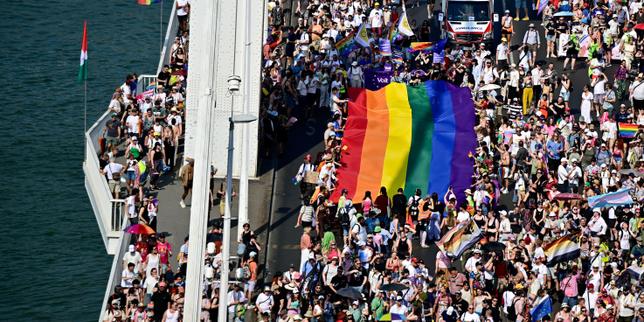
The heat radiating from the pavement of Andrássy Avenue always carries the scent of exhaust and fried dough. But on this particular Saturday, the air smelled different. It smelled like sweat, cheap glitter, and an electric, collective intake of breath.
For more than a decade, walking down this street with a rainbow flag wasn't just a political statement. It was a calculation of risk. You checked over your shoulder. You sized up the police presence. You wondered if the counter-protestors behind the metal barriers were going to throw eggs, or worse.
This year, the barriers are gone. The suffocating weight that sat on the chest of Budapest for years has shifted. Viktor Orbán, the architect of Hungary’s self-proclaimed "illiberal democracy," is no longer in power. His government, which spent years systematically codifying hostility toward the LGBT+ community into national law, has collapsed or been voted out. What remains is a country blinking in the sudden, bright light of a new political era.
This is the story of the first Budapest Pride in the post-Orbán era. It is not just a celebration. It is a massive, national exhalation.
The Architecture of Erasure
To understand why people are crying on the streets of Budapest today, you have to understand what it felt like to live under the laws that came before.
Imagine a hypothetical teenager named András. He is sixteen, living in a small town three hours outside the capital. Under the 2021 anti-LGBT+ laws passed by the Orbán government—frequently compared to Russia's "gay propaganda" laws—András was legally invisible. A school counselor could not talk to him about his identity without risking their job. A bookstore could not sell a novel featuring a gay protagonist unless it was wrapped in opaque plastic and kept away from the youth section. TV shows depicting same-sex couples were relegated to late-night slots, slapped with horror-movie age ratings.
The law did not just censor media; it weaponized loneliness. It told an entire generation of young Hungarians that their existence was a contagion from the West, something to be quarantined and hidden from view.
The political strategy was brilliant in its cruelty. By turning a vulnerable minority into an existential threat to "traditional family values," the ruling Fidesz party created a permanent scapegoat. It was a distraction from crumbling hospitals, underfunded schools, and systemic corruption. Every time the government faced a scandal, it turned up the heat on the culture war. They banned legal gender recognition for transgender people. They effectively banned adoption for same-sex couples by altering the constitution to define family strictly as the union of a man and a woman.
Living through that era felt like watching a slow-motion tightening of a vise. You adjusted. You grew cautious. You watched your friends pack their bags for Berlin, Vienna, or London, unable to bear the psychological toll of being a political target in their own homeland.
The Day the Vise Snapped
But political regimes, no matter how entrenched they seem, are ultimately built on sand. Economic stagnation, fatigue with endless culture warring, and a revitalized, unified opposition eventually broke the monopoly on power. The post-Orbán government came to office with a monumental task: dismantling a decade of institutionalized prejudice.
Legal frameworks can be rewritten with the stroke of a pen. Hearts and minds take much longer.
That brings us back to the pavement of Budapest. The crowd today is massive, easily eclipsing the turnouts of previous years. There is an absence of the heavy, militaristic security that used to turn Pride into a cage match. Instead of being funneled through designated, fenced-in checkpoints like prisoners being moved to a courtyard, participants are spilling onto the avenues from every side street.
Parents are here with toddlers on their shoulders. Elderly couples stand on balconies, waving dish towels in solidarity. The music coming from the flatbed trucks isn't just pop; it's a defiant, thumping heartbeat.
Consider the sheer logistics of joy after a period of state-sponsored shame. For years, organizers had to fight court battles just to secure the right to march down the city's main thoroughfares. The police would routinely try to ban the route, citing traffic concerns, a transparent excuse to hide the community away from public view. Today, the mayor’s office is actively supporting the event. The rainbow flag flies from the City Hall building, not as a radical act of rebellion, but as an official statement of human dignity.
The Invisible Scars
Yet, beneath the euphoria, there is a palpable sense of caution. The scars left by a decade of state hostility do not vanish because a prime minister loses an election.
"We are happy, yes, but we are also exhausted," says Luca, a thirty-two-year-old teacher marching near the front of the parade. She refuses to give her last name. Old habits die hard. "For years, I had to watch what I said in the staff room. I had to worry if a parent saw me with my partner at a restaurant. That fear doesn't just go away because the government changed. It’s in your bones."
The real problem lies elsewhere, far from the glittering avenues of Budapest. While the capital celebrates a new dawn, the rural provinces of Hungary remain deeply conservative. The state media apparatus, which spent a decade pumping out homophobic and transphobic rhetoric into every village and farmhouse, has left a toxic legacy.
Change is asymmetrical. It happens first in the cafes and plazas of the city, while the countryside watches with a mix of confusion and lingering suspicion. The new government faces the delicate task of repealing discriminatory laws without triggering a fierce backlash from voters who were thoroughly conditioned to fear the rainbow flag.
The 2021 law restricting LGBT+ content for minors is currently being reviewed and dismantled piece by piece. Bookstores are quietly removing the plastic wrapping from translated young adult novels. Broadcasters are rescheduling programs. But the psychological damage inflicted on the youth who grew up under that law cannot be undone by a legislative decree. A generation was taught to hide. Now, they must learn how to stand up straight.
The Global Stakes in a Local March
What is happening in Hungary right now is a crucial test case for the rest of the world. For years, Budapest was the Mecca for Western national-conservatives. Populist politicians from Washington to Rome visited Orbán, studying his tactics, praising his family policies, and viewing Hungary as a blueprint for how to build a modern, illiberal state.
If Hungary can successfully reverse this slide into state-sponsored bigotry, it provides a counter-blueprint. It proves that the erosion of human rights is not an irreversible, one-way street.
But the transition is messy. It is uncertain. It requires confronting the fact that a large portion of the population genuinely supported those restrictive policies. The dialogue that needs to happen now cannot be fought with slogans; it must be built on thousands of quiet, painful conversations across kitchen tables.
A Single, Vivid Moment
As the sun begins to dip below the Buda hills, casting long, golden shadows across the Danube, the parade culminates in a massive rally near the parliament building—the very building where the discriminatory laws were once drafted and passed.
An old man stands on the edge of the square. He isn't wearing glitter or carrying a sign. He is just watching. His hands are rough, the hands of someone who has worked manual labor for a lifetime. He watches a group of teenagers laughing, their faces painted in bright pastel streaks, unbothered by the world around them.
A passerby asks him what he thinks of the crowd.
The man takes a drag from a cigarette, exhales a cloud of grey smoke into the warm evening air, and looks toward the massive neo-Gothic parliament dome.
"They spent so much money trying to make us hate each other," he says, his voice low and gravelly. "Look at them. What a waste of billions."
He turns and walks away into the gathering dusk, leaving the square to the music, the lights, and the heavy, sweet scent of freedom.