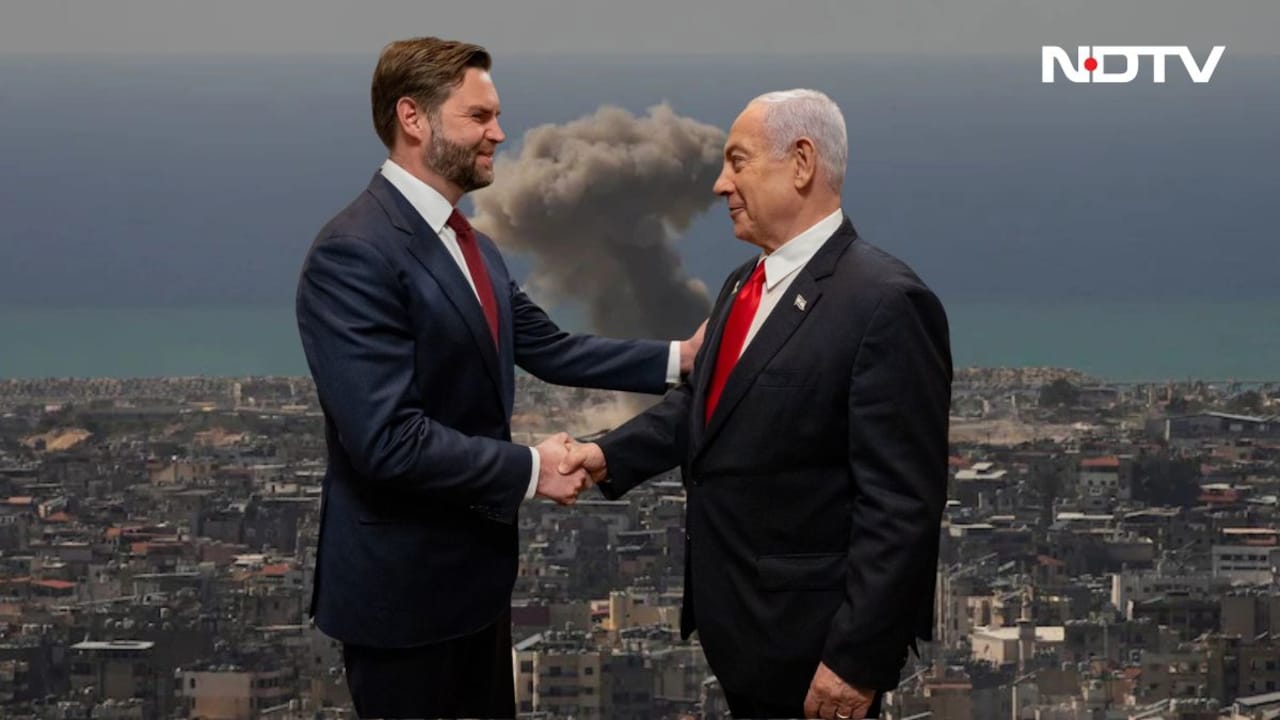
Everyone in the foreign policy press is hyperventilating over the optics of Benjamin Netanyahu and JD Vance sitting down for what polite headlines call direct and frank talks. The narrative being peddled across cable news and policy blogs is simple: a growing rift, a widening chasm between an aggressive Israeli administration and an isolationist American vice president over a looming war with Iran.
It is a clean, lazy narrative. And it is entirely wrong.
The media wants you to believe this is a classic diplomatic brawl over strategy, timetables, and red lines. They are missing the structural reality. Netanyahu and Vance are not arguing over how to handle Tehran. They are operating inside completely different political universes with irreconcilable definitions of risk. When Washington talks about stability, it means avoiding domestic inflation and oil shocks before a midterm cycle. When Jerusalem talks about stability, it means ensuring a genocidal proxy network cannot lob another ten thousand ballistic missiles across its borders tomorrow morning.
This is not a rift. It is a collision of timelines.
The Myth Of The American Security Umbrella
Let us strip away the diplomatic theater. For decades, the conventional wisdom in Washington has been that Israel is a client state dependent on American permission for its strategic survival. I have sat in rooms where career State Department lifers whisper about leash-holding as if geopolitics were a canine obedience class.
That mindset is obsolete. It belongs in the archive alongside rotary phones and the Bretton Woods consensus.
Israel does not need American permission to strike Iran. It needs American logistical depth and diplomatic cover at the UN Security Council. Those are two entirely different commodities. When Vance expresses caution about an expanded regional war—echoing the traditional America First skepticism toward open-ended Middle Eastern entanglements—he is speaking to a domestic electorate exhausted by two decades of botched nation-building.
Netanyahu hears that domestic anxiety and treats it as background noise. From Jerusalem's perspective, the luxury of strategic patience expired on October 7, 2023. If you are standing in a burning building, you do not debate the homeowner about the cost of the fire extinguisher. You grab the hose.
Decoding The Vance Doctrine
To understand why the media misreads Vance every single time, you have to look past the cable news soundbites and examine the structural logic of the new conservative foreign policy.
Vance represents a faction that views traditional neoconservatism as a bankrupt enterprise. The argument goes like this: American power is finite. Industrial capacity is strained. China is the primary pacing threat in the Indo-Pacific. Therefore, bleeding resources into a Middle Eastern quagmire is strategic malpractice.
On paper, that sounds airtight. In practice, it collapses under the weight of regional realities.
Imagine a scenario where the United States completely cuts off diplomatic cushioning for Israeli military actions against Iran's nuclear enrichment facilities. Does that stop Jerusalem from acting? History suggests the exact opposite. Cornered states do not become more compliant; they become more reckless. If Israel believes its existence hangs in the balance, it will act unilaterally, regardless of what the White House tweets out on a Tuesday afternoon.
The irony is thick. The very isolationists who want to extricate America from the Middle East are the ones most likely to be dragged back in by the catastrophic fallout of a half-baked containment strategy that fails to neutralize the Iranian threat.
Why Direct And Frank Means Total Impasse
When diplomats brief reporters using terms like frank talks, translate it accurately: they yelled at each other behind closed doors because neither man can afford to back down.
Netanyahu’s domestic political survival is tethered to a maximalist victory over Iran's axis of resistance. If he settles for a ceasefire that leaves Hezbollah fully armed and Tehran's nuclear program intact, his coalition collapses, and his political career ends in disgrace. He has zero incentive to listen to Washington's pleas for de-escalation when every intelligence brief crossing his desk points to an accelerating existential threat.
Vance, meanwhile, answers to a base that views foreign entanglements with deep suspicion. Every dollar spent on Middle Eastern defense postures or ammunition restocking is a political liability in Rust Belt towns where voters care about the price of groceries, not the balance of power in the Levant.
So what happens when an immovable object meets a politician running for his political life? You get leaks to preferred journalists about a rift. You get the illusion of drama. You get headlines designed to placate both domestic audiences.
The Unspoken Reality Of The Iranian Calculus
Let us address the elephant in the room that neither Washington nor Jerusalem wants to state plainly in public: the Iranian regime is playing a multi-decade game of attrition, and conventional deterrence is dead.
For forty years, Western policymakers have operated under the assumption that the mullahs in Tehran are rational actors who can be deterred through economic sanctions and diplomatic isolation. That is a comforting fantasy. Religious millenarianism combined with ballistic missile technology does not respond to cost-benefit analyses written by economists at the IMF.
When Vance urges caution, he is applying a rational-actor framework to an irrational actor. When Netanyahu demands decisive action, he is recognizing that deterrence only works if you are willing to pull the trigger before the gun is pointed at your head.
The tension between the White House and the Israeli Prime Minister’s Office is not about tactics. It is about a fundamental disagreement over whether the West still has the stomach for existential fights.
The Actionable Truth
If you are an investor, a strategist, or a citizen trying to make sense of where global markets and security are heading, stop looking for a patched-up compromise between Washington and Jerusalem. There isn't one coming.
Expect Israel to decouple further from American strategic oversight when the next major escalation hits. Expect Washington to issue stern public rebukes while quietly supplying the backend logistics required to keep the regional balance from tipping entirely out of control.
The rift is real, but it is not a temporary diplomatic hiccup. It is the permanent new baseline of Western geopolitics. Stop waiting for them to agree. Prepare for the moment they stop pretending they do.