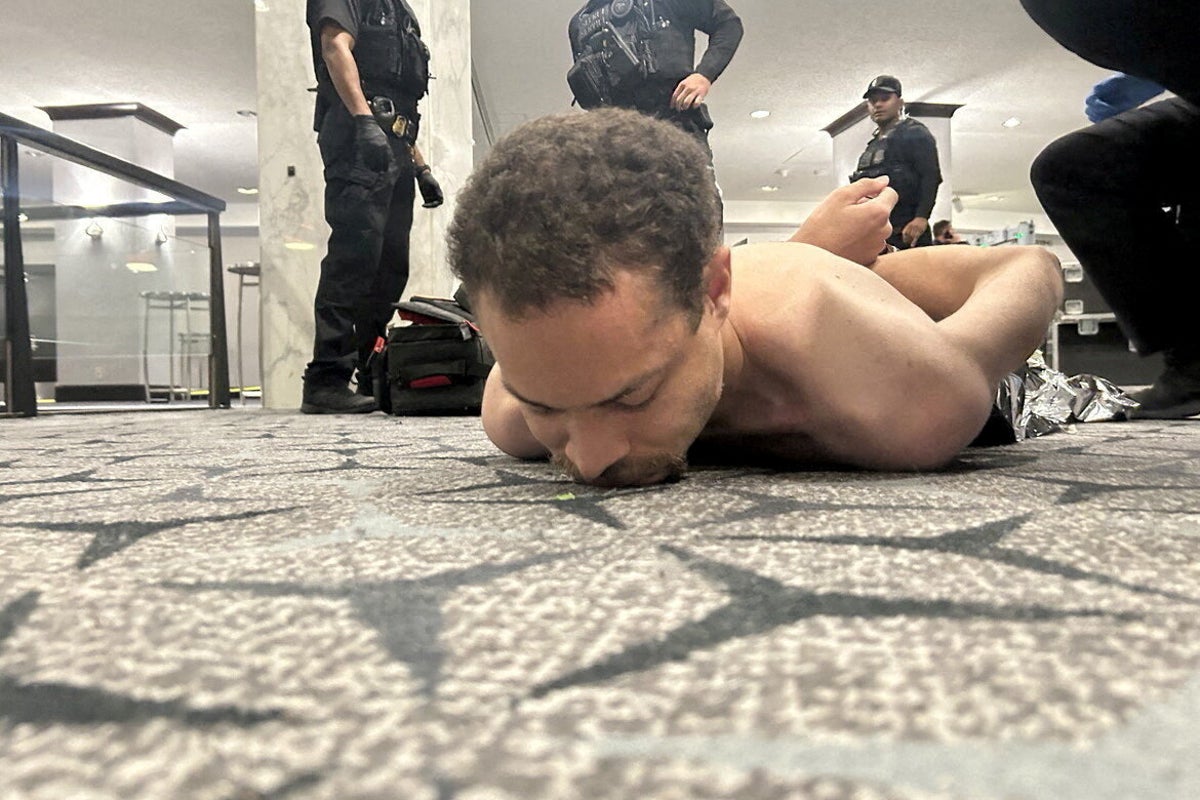
The chaos outside the Washington Hilton during the White House Correspondents’ Dinner wasn't just a random scuffle. It was a violent confrontation that nearly cost a federal agent his life. Recently released footage and court documents paint a much darker picture than the initial headlines suggested. Prosecutors now have video evidence they say shows the moment the suspect opened fire on a Secret Service officer. This isn't just about a high-profile party getting crashed. It's about a total breakdown of security in one of the most heavily guarded cities on earth.
Prosecutors are moving fast. They've highlighted specific frames where the suspect, identified in court records as 31-year-old Shadi Najjar, allegedly draws a weapon and fires. This isn't grainy Bigfoot footage. It’s clear. It’s disturbing. It shows how quickly a protest or a gathering can turn into a crime scene. If you think D.C. is always the safest place to be because of the badge-to-civilian ratio, this incident proves otherwise.
The evidence that changed the narrative
For weeks, the public only had snippets of cell phone video from bystanders. Those clips showed people running and the sound of pops that could've been anything from fireworks to backfires. Now, the government has provided what they call "the smoking gun" in the form of surveillance and body-cam footage. The prosecutors aren't mincing words. They claim Najjar didn't just have a gun; he actively targeted law enforcement.
The Secret Service officer involved was hit in the leg. It could’ve been much worse. Think about the location. You're steps away from the President of the United States, the Vice President, and basically every major media figure in the country. A bullet traveling through that crowd has no name on it. The fact that only one person was wounded is a miracle of physics, not a lack of intent. Najjar is facing charges that could keep him behind bars for decades, including assault with a dangerous weapon and possession of a firearm during a crime of violence.
What the video actually shows
The footage captures a sequence of events that feels like it’s out of a movie, but the stakes are very real. You see the suspect moving through a crowd of protesters. There's tension in the air. You can feel it through the screen. Suddenly, he reaches toward his waistband. Law enforcement argues this movement is deliberate. It’s a tactical draw.
Then come the muzzle flashes. The Secret Service officer drops. The crowd scatters like marbles on a hardwood floor. What strikes me is the lack of hesitation. According to the court filings, Najjar didn't shout a warning. He didn't engage in a verbal dispute first. He just fired. This suggests a level of premeditation or at least a hair-trigger willingness to use lethal force that should terrify anyone who attends public events in the capital.
The defense is trying to argue a different angle, of course. They're looking at "confusing perspectives" and "chaotic environments." But it’s hard to argue with high-definition video that follows a suspect from the moment they pull the trigger to the moment they're tackled by a sea of black suits and tactical gear.
Security failures and the aftermath
How did a man with a loaded handgun get that close to an event featuring the highest level of government protection? That’s the question nobody in the Secret Service wants to answer right now. We’re talking about the "Nerd Prom." Security is supposed to be impenetrable.
I’ve seen how these perimeters work. There are checkpoints, sniffing dogs, and plainclothes agents everywhere. Yet, Najjar allegedly walked right up to the line and started shooting. This points to a massive gap in how "soft perimeters" are managed during protests. While the interior of the Hilton was a fortress, the exterior was a vulnerable mess.
- Initial reports underestimated the proximity of the shooter to the actual entrance.
- The response time was fast, but the prevention was nonexistent.
- Coordination between D.C. Metropolitan Police and federal agencies seemed strained under the pressure of the protest crowd.
The fallout is already hitting the agency. Expect more "re-evaluations" of security protocols. We’ve heard it before. Every time there’s a breach, they promise to do better. But when a Secret Service officer is bleeding on the sidewalk while the President is cracking jokes inside, something is fundamentally broken.
Why this case is different from standard D.C. violence
Washington D.C. has a crime problem. Everyone knows it. But shooting a federal agent at a sanctioned, high-security event is a different league of criminality. It’s a direct challenge to the state. Prosecutors are treating it as such. They aren't offering easy plea deals here.
Najjar’s background is being scrubbed by every three-letter agency you can think of. They’re looking for links to extremist groups or "lone wolf" radicalization. So far, the public filings focus on his actions that night. But the subtext is clear: the government wants to make an example out of him. They need to send a message that you can't hunt the people who protect the Commander-in-Chief.
The legal uphill battle for the defense
Najjar’s lawyers have their work cut out for them. When you have a victim who is a federal officer and video that shows the act, your options are limited. They’ll likely lean into mental health or "mob mentality" defenses. They might claim he felt threatened by the surging crowd or the police presence.
It’s a tough sell. Most juries don't have much sympathy for someone who brings a gun to a protest and uses it. The prosecution's strategy is to keep the focus on that specific moment of the draw and fire. They want to keep the jury's eyes on the video. If the video is as clear as they say, the "chaotic environment" excuse won't hold much water.
Watching the fallout in real time
The city is on edge. Every time a major event happens now, the "Najjar Incident" will be the benchmark for what could go wrong. You'll see more fences. More barricades. More distance between the public and the people they want to be heard by.
This shooting didn't just hurt an officer; it killed a certain type of access. The Correspondents’ Dinner used to have a bit of a "street party" vibe for those outside. That’s gone now. Security is going to be tightened to the point of suffocation. You can thank the guy in the video for that.
If you’re following this case, keep an eye on the pre-trial motions regarding the admissibility of the full, unedited tapes. The prosecution wants the whole story told. The defense wants to pick it apart frame by frame to find a second of ambiguity.
Stay updated by checking the public court dockets for the District of Columbia. The next few hearings will determine if this goes to a full trial or if a deal is struck to avoid the public spectacle of the footage being played on a loop in a courtroom. Either way, the Secret Service has some serious soul-searching to do about how their "impenetrable" bubble popped so easily.
Watch the headlines for the upcoming ballistics reports. Those will confirm if the shell casings found at the scene match the weapon recovered near Najjar. Once that link is solidified, the video evidence becomes nearly impossible to beat. It’s a textbook case of how modern surveillance has changed the legal landscape. You aren't just being watched; you're being recorded in 4K. If you decide to pull a trigger in D.C., you're essentially auditioning for a life sentence.
Keep your eyes on the Department of Justice press releases. They usually drop the most damning evidence there first. It’s a grim situation, but it’s a necessary look at the reality of security in 2026.