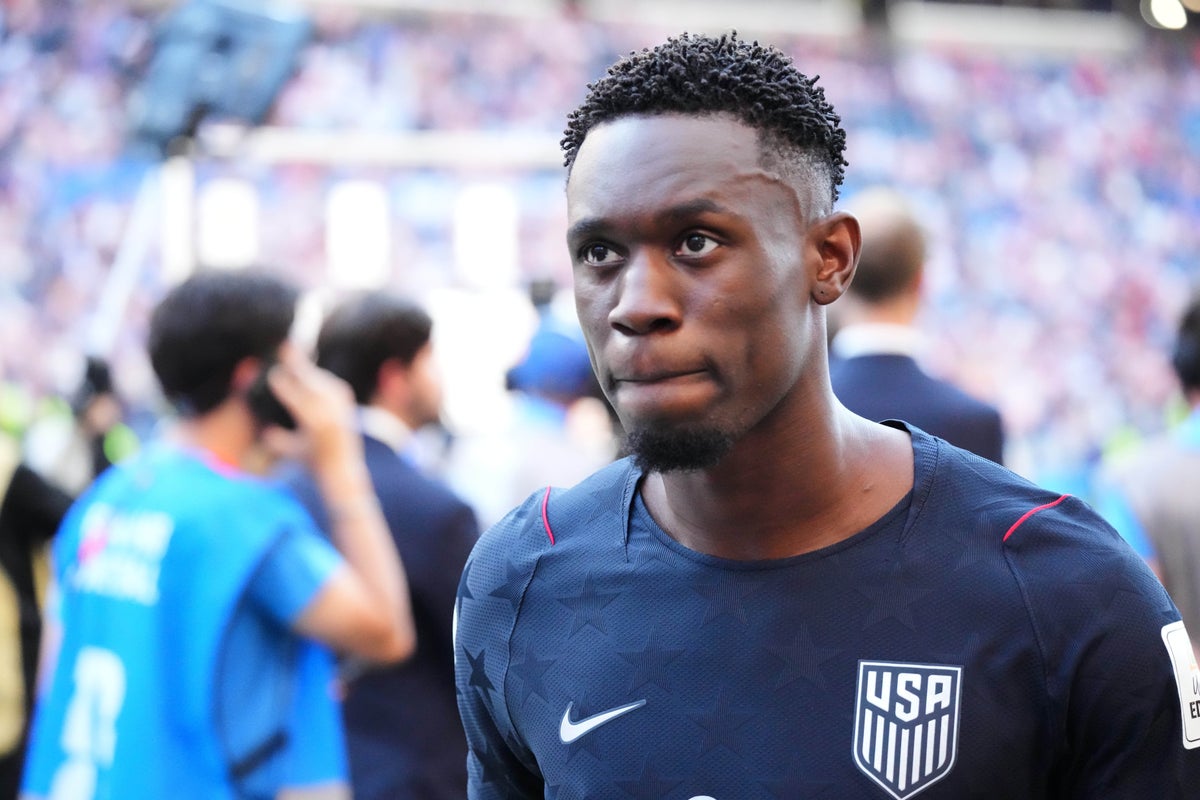
The locker room in Seattle did not feel like a World Cup stage. It felt like a high-stakes deposition.
For three weeks, the young, hyper-athletic men of the United States Men’s National Team had lived in a cocoon of pure sporting merit. They ran. They sweat. They won. They were building the most glittering, defiant World Cup run in modern American history, step by hard-fought step.
Then, the phone rang in Zurich. Three times, to be exact.
By the time Folarin Balogun laced up his boots to face Belgium in the Round of 16, the air in the camp had turned heavy. A weird, ominous weight hung over the squad, as if a puffy, sleeping giant of American politics had managed to drift into the stadium and block out the sky.
The young Monaco striker, only twenty-five, was supposed to be a spectator. Five days earlier, during a chaotic, physical clash against Bosnia and Herzegovina, he had lunged for a ball and caught defender Tarik Muharemović’s ankle. The red card was instant. The subsequent suspension was supposed to be ironclad. Under FIFA’s standard, unyielding protocols, there was no avenue for appeal.
But then, the Oval Office got involved.
Consider what happens to an athlete's mind when the normal laws of gravity suddenly cease to apply. You are prepared to pay the price of a mistake. You have accepted the tragedy of a tournament cut short. Then, the President of the United States publicly claims he watched the tape, decides "that wasn't a foul," and makes three direct phone calls to FIFA President Gianni Infantino.
Behind closed doors, a single member of FIFA's disciplinary committee bypassed the other seventeen members to replace the ban with a year-long "probation." It was a piece of jurisprudential magic that made the global football community gasp. It looked like the athletic equivalent of a mayor getting his brother out of a parking ticket.
For Balogun, the reprieve did not bring relief. It brought a strange, suffocating pressure.
"My initial reaction was I was happy to be back," Balogun admitted later, his voice carrying the exhaustion of a man who had spent forty-eight hours in the center of a political hurricane. "But when I started to reflect, I knew it was going to cause a lot of controversy."
He could see it on the faces of his teammates. Nerves. Tension. This was no longer just a soccer game; it was a referendum on American exceptionalism, backroom deals, and the privilege of power. The organic, underdog chemistry that had fueled their run was suddenly replaced by a cold, calculating spotlight.
The sport, at its highest level, is a fragile ecosystem of focus and rhythm. It requires an empty head and a full heart. But as the American players warmed up in Seattle, the stadium felt infected by the outside noise. Some American fans, disgusted by the blatant favoritism, openly declared they would rather root for Belgium than accept a tainted victory. The Belgian players, meanwhile, arrived with their teeth bared, fueled by a righteous, burning anger.
The match itself felt like a slow, inevitable reckoning.
Belgium did not just beat the United States; they systematically dismantled them. The game plan, so crisp in earlier rounds, dissolved into a series of hesitant, disjointed movements. Balogun chased ghosts up front, receiving only eight passes in ninety minutes. The team that had played with joy now played like men wearing lead boots, paralyzed by the fear of validating the storm around them.
When Charles De Ketelaere sliced open the American defense in the ninth minute, the silence in the stadium was absolute. By the time Romelu Lukaku hammered in the fourth goal in stoppage time to seal a brutal 4-1 defeat, the humiliation was complete.
After the final whistle, the Belgians did not just celebrate; they targeted the intervention itself. On social media, the Belgian federation posted a simple, devastating message next to the scoreline: "Overturn this."
The young Americans walked off the pitch with their heads bowed, eliminated not by a lack of talent, but by the crushing weight of a favor they never asked for. They had wanted to prove they belonged among the world’s elite through grit and grass. Instead, they were left to wonder how a game of inches became a game of telephone.