The smell of melting rubber has a specific, oily weight that hangs in the back of your throat long after the smoke clears. It stays in the fabric of your jacket. It settles into the steering wheels of the cars that pass the perimeter days later.
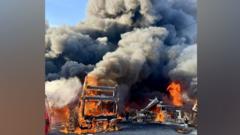
At 2:00 AM on a Tuesday, most people are locked in the deep, silent rhythm of REM sleep. But in the gravel yard of a municipal transit depot, thirty-six yellow school buses were dying.
Fire does not care about the logistics of a Tuesday. It eats what it is given. Aluminum warped under a thousand degrees of localized heat. Safety glass didn't just crack; it pulverized, raining down into the engine bays like artificial hail. By 4:00 AM, the fleet that carried three thousand children to school every morning was reduced to a row of blackened, skeletal ribs, steaming under the high-pressure spray of local fire crews.
The headlines the next morning were clinical. Fire that destroyed 36 buses started deliberately. It is a standard piece of police-blotter copy. It treats the event like a math problem: subtract thirty-six vehicles, add an arson investigation, wait for the insurance payout.
But a fleet of buses is not just an asset column on a city ledger. It is the invisible connective tissue of a community. When you burn the buses, you do not just destroy steel and diesel engines. You burn the morning routine of three thousand working-class homes.
The Physics of a Deliberate Inferno
Arson is an act of cowardice wrapped in a display of spectacle. To understand why thirty-six buses could go up in a single evening, you have to understand how these yards are designed.
Imagine a row of dominoes, but each domino is fifteen tons of steel packed with fifty gallons of highly combustible fuel. To optimize space in a municipal lot, buses are parked tight. Flank to flank. Bumper to bumper. A gap of barely two feet separates the driver’s side of one vehicle from the passenger door of the next.
When an accelerant is introduced to a single vehicle in the center of that grid, the timeline accelerates with terrifying speed.
- Minute 1: The vinyl of the driver’s seat ignites. This is not a slow burn; modern synthetic materials are essentially solid petroleum. They turn to liquid fire within sixty seconds.
- Minute 3: The heat inside the cabin reaches a flashover point. The windows blow outward from the pressure, throwing superheated gases directly against the side panels of the neighboring buses.
- Minute 5: The fuel lines soften. Once the diesel tanks catch, the fire becomes self-sustaining, a feedback loop of radiant heat that conventional fire extinguishers cannot touch.
By the time the first emergency call rings through to dispatch, the yard is already a furnace. The investigator who steps through the ash the next afternoon is not looking for a mystery. They are looking for the point of origin. They look for the V-pattern of charring on the ground that indicates where the liquid fire ran before it climbed. They look for the absence of electrical faults in the wiring harnesses.
When those boxes are checked, the conclusion is as cold as the ash: someone walked into that yard with the explicit intent to watch the morning burn.
The Human Collateral of an Empty Grid
Let us look past the yellow police tape. Consider a hypothetical resident of this town, someone we can call Marcus.
Marcus does not own a car. He works the 6:00 AM shift at a distribution center seven miles away, a job that requires two transfers and an absolute reliance on the 5:15 AM line. His daughter, seven years old, relies on Bus 42 to get to her regional special education program across the district lines.
On Wednesday morning, Marcus stands at a street corner in the dark. The bus does not arrive.
He checks his phone. The notification from the school district is a wall of passive text: Due to an incident at the depot, routes will experience significant delays. Parents are encouraged to seek alternative transportation.
Alternative transportation is a phrase invented by people who have three vehicles sitting in a suburban driveway. For Marcus, alternative transportation means a forty-dollar rideshare surge fee that eats his entire morning's wages, or a walk through the cold that guarantees he will be written up before he even punches his timecard.
This is the real weight of the crime. The person who struck the match in that yard likely thought they were striking a blow against an institution, a company, or a local council. Maybe it was an insurance fraud scheme gone wrong, or maybe it was just the chaotic impulse of a broken mind on a Tuesday night. But the blow did not land on the executives or the politicians.
It landed on Marcus. It landed on the parents who had to call out of work, losing a day's pay they needed for groceries. It landed on the children who sat on curbs for two hours, watching the sky turn from grey to blue, wondering why the big yellow machine that structures their day never showed up.
The Anatomy of Vulnerability
We live in an era obsessed with digital security. We worry about firewalls, data breaches, and the integrity of our cloud storage. We encrypt our messages and put double-factor authentication on our bank accounts.
Yet the physical infrastructure that keeps our physical lives functional is often protected by nothing more than a rusted chain-link fence and a security guard earning minimum wage who is currently staring at a smartphone screen half a mile away.
Think about the vulnerability of the average mid-sized city. The water treatment plants, the electrical sub-stations, the transit hubs—they are often tucked away in the industrial zones where the land is cheap and the lighting is poor. They are places we drive past without looking. We treat them like the plumbing in our walls; we only acknowledge their existence when they burst.
When an investigator stands in a burned-out lot, they are looking at more than just the residue of fuel. They are looking at a failure of societal imagination. We simply assume that the things we need tomorrow will be there because they were there yesterday.
But the logistics of replacing thirty-six specialized vehicles are brutal. You cannot simply go to a dealership and buy three dozen school buses off the lot. They are built to order. They require specific safety certifications, specialized communication rigs, and distinct municipal branding. The lead time on a fleet replacement can stretch into months, even when the insurance company cuts the check without a fight.
In the interim, the system strains. Older, retired buses are pulled out of mothballs—vehicles with stiff suspensions and temperamental heaters. Routes are consolidated. A bus that used to carry forty children now carries sixty, packed three to a seat, its engine groaning under the weight of an optimized schedule that leaves zero room for traffic or bad weather.
The View from the Driver’s Seat
There is another group of people left in the wake of the smoke, those who see these vehicles not as infrastructure, but as an office.
A school bus driver develops a strange, intimate relationship with their rig. They know the exact spot on the brake pedal where the pressure changes. They know the rattle in the left window frame that starts at forty-five miles per hour. They know which seat has the torn vinyl that they patched with yellow duct tape three weeks ago to keep a kid from catching their backpack on it.
When a driver walks onto that lot the morning after an arson, they aren't just looking at property damage. They are looking at the destruction of their workspace.
The interior of a bus is a theater of small human dramas. It is where a driver spent years checking mirrors, singing along to the low volume of a country radio station, and watching a generation of neighborhood kids grow from kindergarteners who could barely climb the first step into middle schoolers who think they are too cool to say hello.
To watch that space get melted down to the steel frame because someone wanted to see something burn is a quiet, specific kind of violation. It shatters the unwritten contract of the town: that the things we build for our children are sacred, or at least exempt from the random malice of the night.
The ash eventually turns to mud when the rain comes. The tow trucks arrive, pulling the blackened husks out one by one, their axles groaning, their tires flat and charred down to the steel belts. The gravel is swept. The chain-link fence is patched with a new length of shiny wire.
The news cycle moves on within forty-eight hours, replaced by a political scandal, a weather warning, or a new tragedy three towns over. The word deliberate disappears from the conversation, leaving behind only the lingering smell of burnt oil and the long, slow complication of a disrupted spring.
On Thursday morning, the replacement bus—an old transit model with faded blue paint and a missing hubcap—pulls up to Marcus's corner. It is twenty-two minutes late. The brakes squeal with a high, piercing note that makes the waiting children cover their ears.
The door folds back with a heavy hiss of pneumatic air. The driver looks down from the high seat, their eyes tired, their jacket still smelling faintly of the yard.
The children climb the steps anyway. They sit down on the cold green vinyl, adjusting their backpacks, their voices rising into the morning air as the old engine roars, moving forward through the gears, trying to reclaim the minutes that were stolen in the dark.