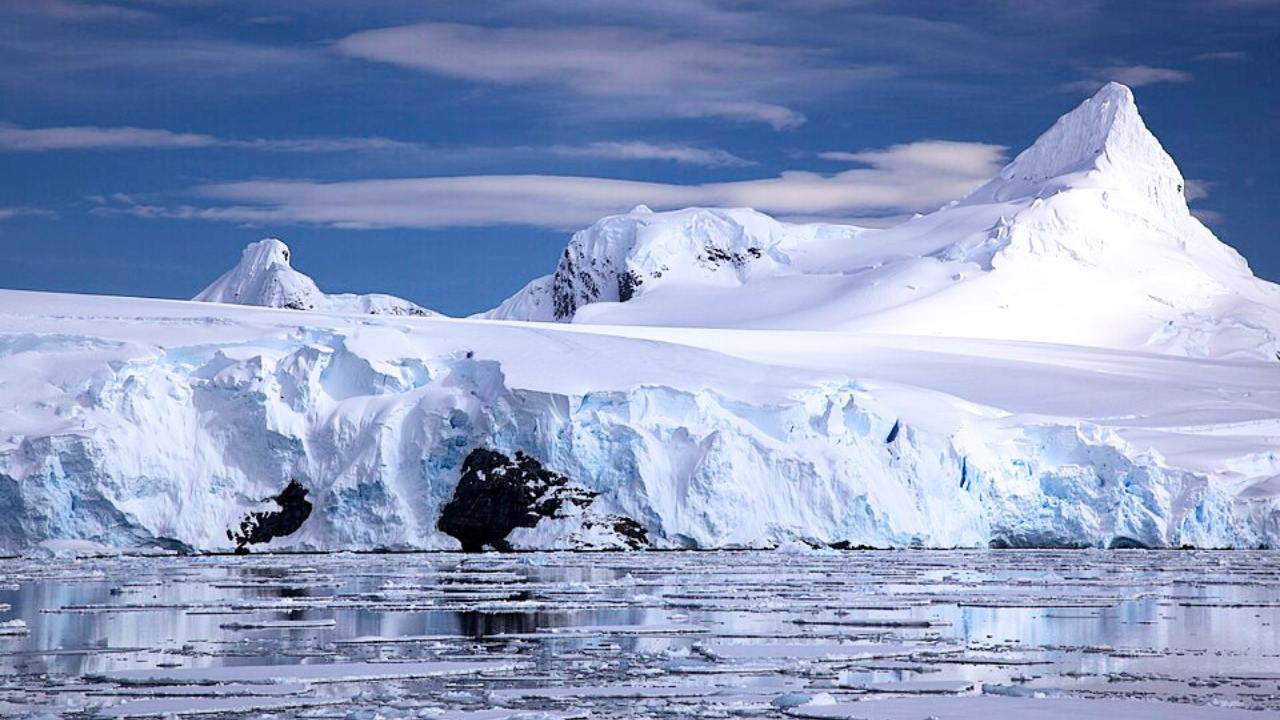
The wind off the Southern Ocean does not merely blow. It bites, carrying the scent of frozen salt and the crushing weight of an isolated world. For generations of polar researchers, the rhythm of Antarctica was as reliable as a heartbeat. Summer melted the fringes; winter locked the continent in an impenetrable, white fortress.
But during a recent polar winter, the fortress gates remained wide open.
Dr. Thomas Vance, a fictional composite of the breathless scientists currently staring at satellite monitors in Hobart and Boulder, remembers checking the data telemetry three times on a Tuesday afternoon. He thought it was a software glitch. Outside his window, the world was spinning normally. On his screen, an area of sea ice the size of France had simply vanished. It had not melted away in the sun. It had failed to form in the first place, swallowed by a dark ocean that was running twenty degrees Celsius above its normal temperature.
Imagine standing on a coastline where the ice should extend to the horizon, but finding only black, lapping water. It feels wrong. It feels like watching water run uphill.
To understand what happens when the bottom of the world stops freezing, we have to look past the cold spreadsheets of climate observatories and step onto the shifting ice itself. The missing ice is not just an abstract statistic or a distant ecological footnote. It is a fundamental tear in the planetary engine that keeps our global weather from spiraling into chaos.
The Great White Mirror
The system relies on a simple mechanism called albedo. When sunlight hits the massive, blindingly white expanses of Antarctic sea ice, the ice acts like a giant mirror. It bounces up to eighty percent of that solar energy straight back into space. The planet stays cool because the heat never penetrates the surface.
When that ice fails to form, the mirror shatters.
Instead of a white reflective shield, incoming solar radiation meets a vast, dark ocean. The water does not reflect the heat. It drinks it. The ocean absorbs nearly ninety percent of the sun’s energy, warming the water columns from within. This creates a terrifying feedback loop. The warmer the water gets, the harder it is for new ice to form the following winter. The less ice that forms, the more heat the ocean absorbs.
This is not a gradual drift. It is a sudden, violent gear shift in the earth's climate system. Scientists who have spent thirty years studying the poles describe the current data with words that sound less like academic prose and more like emergency dispatches. They speak of variances so far outside the statistical norm that they are measured in "sigma events"—occurrences so rare they should theoretically happen only once every few thousand years.
Yet, here we are, staring at an open ocean where an icy subcontinent should be.
The Invisible Currents at Your Doorstep
It is tempting to look at a map, see the vast distance between the Southern Ocean and a suburban neighborhood in Ohio or a coastal town in Devon, and assume the distance offers protection. It does not. The global ocean is a single, interconnected circulatory system, and Antarctica is the heart that pumps the deep, cold water driving global currents.
When freezing sea ice expels salt, it creates incredibly dense, cold brine. This heavy water sinks to the ocean floor, acting as a massive piston that pushes the global conveyor belt of ocean currents. This movement regulates everything from the Gulf Stream to the monsoon seasons that feed billions of people across Asia.
Consider what happens next when that piston loses its power.
As the deep water formation slows down, the entire global circulation sluggishly responds. The heat that would normally be distributed evenly across the globe pools in tropical regions. Storm systems, denied their traditional steering currents, stall and intensify. The supercharged atmospheric rivers that battered the coastlines of North America and Europe last year are directly linked to these shifting gradients of polar energy.
A farmer in Iowa struggling with unprecedented drought might never think about the winter sea ice in the Weddell Sea. But the missing ice changed the pressure ridges that guided the rain clouds away from his fields. A homeowner in a low-lying coastal city might see her insurance premiums skyrocket due to unprecedented tidal flooding, oblivious to the fact that a warmer Southern Ocean is expanding, physically taking up more space, and pushing global sea levels higher.
The stakes are entirely human. They are measured in the price of a loaf of bread, the viability of a home loan, and the stability of municipal water supplies.
Life in the Shadow Zone
Beneath the surface of that unseasonably warm water, a quiet catastrophe unfolds for the creatures that call the ice edge home. Sea ice is not just a frozen platform; it is a biological nursery.
Algae grow on the underside of the ice sheets, providing the primary food source for krill. These tiny, shrimp-like organisms form the absolute foundation of the Antarctic food web. They feed the whales, the seals, and the penguins. When the ice disappears, the algae nurseries vanish. The krill populations crash.
Biologists monitoring emperor penguin colonies have already documented the heartbreaking results. In areas with early sea ice breakup, entire generations of chicks drowned or froze to death because their fluffy down feathers had not yet been replaced by waterproof adult plumage. They need the stable platform of winter ice to survive until they are ready to swim. Without it, the colony simply ceases to exist.
The loss of these species is more than an ecological tragedy. It represents the unraveling of a biological system that has remained stable for millennia. We are removing the structural pillars of a house while still trying to live on the top floor.
The Friction of Uncertainty
The most unsettling aspect of this shift is the sheer speed of the transition. For decades, climate models suggested that while the Arctic was losing ice rapidly, Antarctica was relatively stable, perhaps even gaining slight amounts of ice in certain sectors due to changing wind patterns.
That comfort zone has evaporated.
The current collapse has outpaced the predictions of the most conservative models, leaving researchers scrambling to update their algorithms. It forces a confrontation with an uncomfortable truth: our understanding of the earth's tipping points is imperfect. We are running a high-stakes experiment on the only home we have, without a control group, and the variables are changing faster than we can record them.
This creates a profound sense of dislocation for the people studying the data. They find themselves in the position of modern Cassandras, shouting warnings into a world distracted by short-term political theater and economic news cycles. They are looking at a planetary emergency written in the quiet language of anomaly graphs and satellite telemetry.
The Long Horizon
The dark water at the bottom of the world is a mirror reflecting our collective choices. The missing ice is not a problem that can be solved with a quick fix or a localized engineering project. It requires an honest assessment of how we generate energy, how we consume resources, and how we value the long-term stability of our environment over short-term convenience.
The ocean has a long memory. The heat absorbed by the Southern Ocean this winter will remain trapped in the deep currents for decades, if not centuries, slowly making its way north. The choices made today will resonate through the global climate system long after the current generation of policymakers has left the stage.
As the polar night finally gives way to the return of the spring sun, the waters around Antarctica will begin their seasonal melt from an already diminished baseline. The ocean is warmer, the winds are weirder, and the buffer zone is gone. The world's great southern shield has thinned, leaving a vulnerability that cannot be hidden by distance or indifference.
The ice did not just fail to freeze. It left behind an open, dark expanse of ocean, watching the sky, waiting for what we do next.