The glass doors of the Berlaymont building in Brussels don't just open; they hiss. It is a sound of expensive climate control and guarded secrets. Inside, the air tastes like metallic coffee and high-stakes anxiety. Mark, a fictional but representative mid-level diplomat whose hair has turned gray in direct correlation with the rise of populism, stares at his phone. The notification is brief. Donald Trump is meeting with the NATO Secretary General.
For the average person scrolling through a news feed in Ohio or Manchester, this is a headline to be skimmed. It’s "politics." It’s "defense spending." But for Mark, and for the millions of people living in the shadow of the Suwalki Gap, this meeting isn't about a budget. It is about the fundamental architecture of the floor they are standing on. If the United States exits NATO, the floor doesn't just creak. It vanishes.
The reality of the North Atlantic Treaty Organization has always been less about tanks and more about a psychological contract. Article 5—the "one for all, all for one" clause—is a ghost in the machine. It only works if everyone believes the ghost will show up when the lights go out. For decades, that belief was the cheapest security money could buy. Now, the price is being renegotiated in real-time, and the currency is no longer just dollars. It’s loyalty.
The Arithmetic of Fear
Think of NATO as a neighborhood watch. For seventy-five years, the biggest, toughest guy on the block—the one with the massive flashlight and the heavy boots—has promised to come running if a window breaks. Because he’s there, nobody breaks windows.
Donald Trump’s argument is essentially that he’s tired of paying for the flashlight batteries while the neighbors spend their money on better landscaping and universal healthcare. It is a transactional view of history. To him, the alliance is a club with membership dues. If you don't pay 2% of your GDP on defense, you’re "delinquent."
But geopolitical security isn't a Netflix subscription. You can't just cancel it and expect the shows to stop playing; when you cancel security, the house burns down.
Consider a hypothetical mother in Narva, Estonia. Let's call her Elena. From her kitchen window, she can see Russia. For Elena, NATO isn't a dry policy paper. It is the reason she feels safe sending her daughter to ballet practice. It is the reason the local currency has value. If the U.S. signals a departure, Elena doesn't just read a news alert. She looks at her suitcase and wonders if it’s time to pack.
The "cold facts" of the meeting are these: Trump and the NATO chief are discussing the burden-sharing of defense costs. The "human facts" are that every word uttered in that room ripples across the Baltic Sea, turning a quiet Tuesday into a frantic search for a backup plan.
The Cost of the Empty Chair
If the United States leaves, the remaining European powers are left holding a shield that was never meant to be used alone. The numbers are staggering. The U.S. accounts for roughly two-thirds of the total defense spending of all NATO members combined.
But the math gets grimmer when you look at logistics. European militaries are a patchwork. They have different radios, different calibers of ammunition, and different command structures. The U.S. is the glue. It provides the satellite intelligence, the heavy-lift transport, and the nuclear umbrella. Removing the U.S. from NATO isn't like removing a brick from a wall; it’s like removing the mortar from a skyscraper.
The silence that would follow a U.S. exit would be deafening. It would be the silence of a vacuum, and history teaches us that vacuums are always filled.
Critics of the alliance often point to the "forever wars" or the bloat of the military-industrial complex. They aren't entirely wrong. There is a valid conversation to be had about why Europe has remained so dependent for so long. Why, decades after the Cold War, are the continent’s largest economies still struggling to field a functional tank division?
The frustration is real. It’s a tension that has simmered for years, but now it has reached a rolling boil. The problem is that the "correction" being proposed isn't a gradual hand-off. It’s an eviction notice.
The Weight of a Handshake
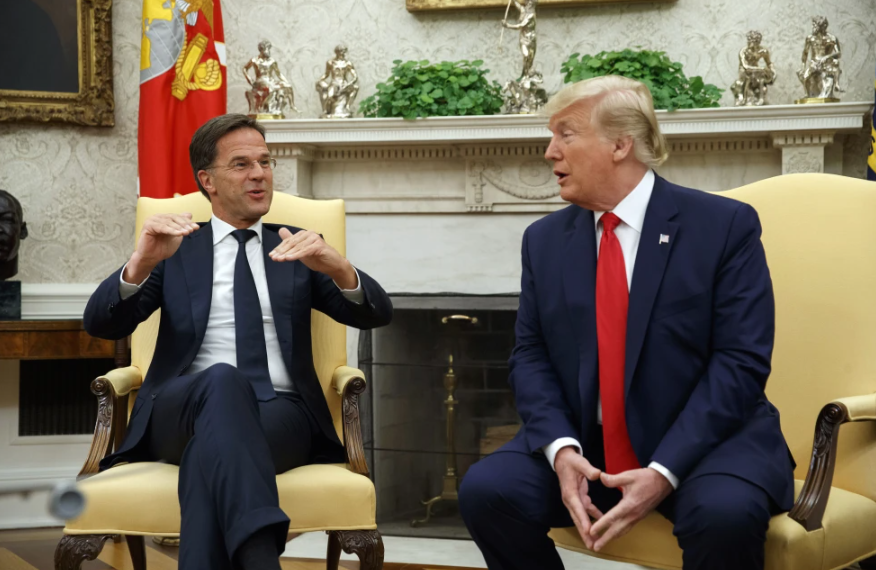
When Trump sits across from the Secretary General, the body language tells the story. It’s the posture of a landlord and a tenant.
The Secretary General’s job is to prove that the neighbors are finally buying their own flashlights. He brings charts. He brings spreadsheets showing that defense spending across Europe is at an all-time high. Eighteen of the thirty-two members are expected to hit that 2% target this year. In 2014, only three did.
But facts are rarely enough to move a narrative built on the idea of being "taken advantage of." For the Trump base, NATO represents a globalist entanglement that drains American resources for foreign benefit. For the European allies, NATO is the only thing standing between them and a return to the 19th-century chaos of shifting borders and ethnic conflict.
Two different worlds are sitting at that table.
One world views a treaty as a contract with an expiration date.
The other views it as a blood oath.
The Invisible Stakes
If the alliance fractures, the first things to go won't be the borders. It will be the markets.
Global stability is the invisible infrastructure of the modern economy. When you buy a shirt or a smartphone, you are benefiting from the fact that the sea lanes are open and the major powers aren't at each other’s throats. NATO has been the guarantor of that stability in the West.
An American exit would trigger a massive rearmament race. Germany, Japan, Poland—countries that have spent the last half-century focusing on commerce—would be forced to pivot to total militarization. The social contracts of these nations would tear. Money meant for schools and green energy would be diverted to missile silos.
We would return to a world of "spheres of influence." In that world, small countries are merely lunch for large ones. The rules-based order, as flawed and hypocritical as it often is, would be replaced by the law of the jungle.
The Long Shadow of the Meeting
As the meeting concludes and the motorcades pull away, the press release will likely be vague. It will mention "productive talks" and "commitment to shared goals."
But the damage is often done in the "weighing." The mere fact that exiting the alliance is a viable topic of conversation changes the chemistry of global relations. Adversaries see a crack in the armor. Allies see a friend with one foot out the door.
Mark, our diplomat in Brussels, puts his phone away and looks out at the gray European sky. He knows that trust is a resource that takes decades to build and minutes to incinerate. You can't put the toothpaste back in the tube. Once you tell your friends you might not show up to help them, they never look at you the same way again, even if you decide to stay.
The meeting isn't just a political check-in. It is a stress test for the very idea of Western unity. It asks a question that most of us aren't ready to answer: What happens when the world’s most powerful nation decides that it no longer wants to be the world’s most powerful nation?
The lights in Tallinn are still on tonight. The streetlights in Riga and the shop windows in Vilnius are glowing. But for the first time in three-quarters of a century, the people walking beneath them are looking up at the sky, wondering how long the power will last.
The ghost in the machine is flickering.