The coffee at the press desk was cold, tasting faintly of chicory and regret. Outside the cavernous halls of Porte de Versailles, October in Paris was doing what it always does: turning the pavement into a mirror of slate-gray skies and wrapping the city in a damp, melancholy chill. Inside, however, the air smelled of hot rubber, fresh carpet adhesive, and the quiet, desperate electricity of a multi-billion-dollar industry trying to remember why anyone should care.
Car shows used to be riots of horsepower. They were places where teenage boys with grease under their fingernails went to posture, and grown men went to escape. You walked the aisles counting cylinders like rosary beads. V8s. V12s. The bigger, the louder, the more defiant.
Those days are dead.
The Paris Motor Show is no longer a monument to combustion. It is a clinic for survival. Every manufacturer here this week is walking a tightrope stretched over a canyon of electrification, shifting consumer habits, and regulatory cliffs. But numbers on a spec sheet do not warm a cold room. Algorithms do not break your heart.
To understand what is happening to the automobile, you have to look past the lithium-ion battery packs and the aerodynamic wind-tunnel metrics. You have to look at the people who design them—the ones standing by the velvet ropes, biting their cuticles, watching the eyes of strangers to see if their three years of sleepless nights mean anything at all.
Consider Elena, a fictional senior color and trim designer for Citroën who stands in for the hundreds of creators behind these concepts. She has spent eighteen months staring at color swatches under varying intensities of artificial daylight. To her, a shade of mustard yellow isn't just paint; it is an emotional anchor. It is an argument against the sea of silver and charcoal crossovers currently choking every urban thoroughfare on the planet.
When Citroën pulls the sheet off its latest conceptual vision in Paris, Elena is standing three rows back, her hands shoved deep into the pockets of a wool coat. She isn't looking at the car. She is looking at the front row. She wants to see if anyone smiles.
They do. Because Citroën did something dangerous this year: they refused to take themselves too seriously.
The concept cars sitting under the harsh exhibition lights are not just rolling laboratories of autonomous technology. They are confessions. They are proof that the electric transition does not have to feel like an enforced march into a sterile, gray utilitarianism.
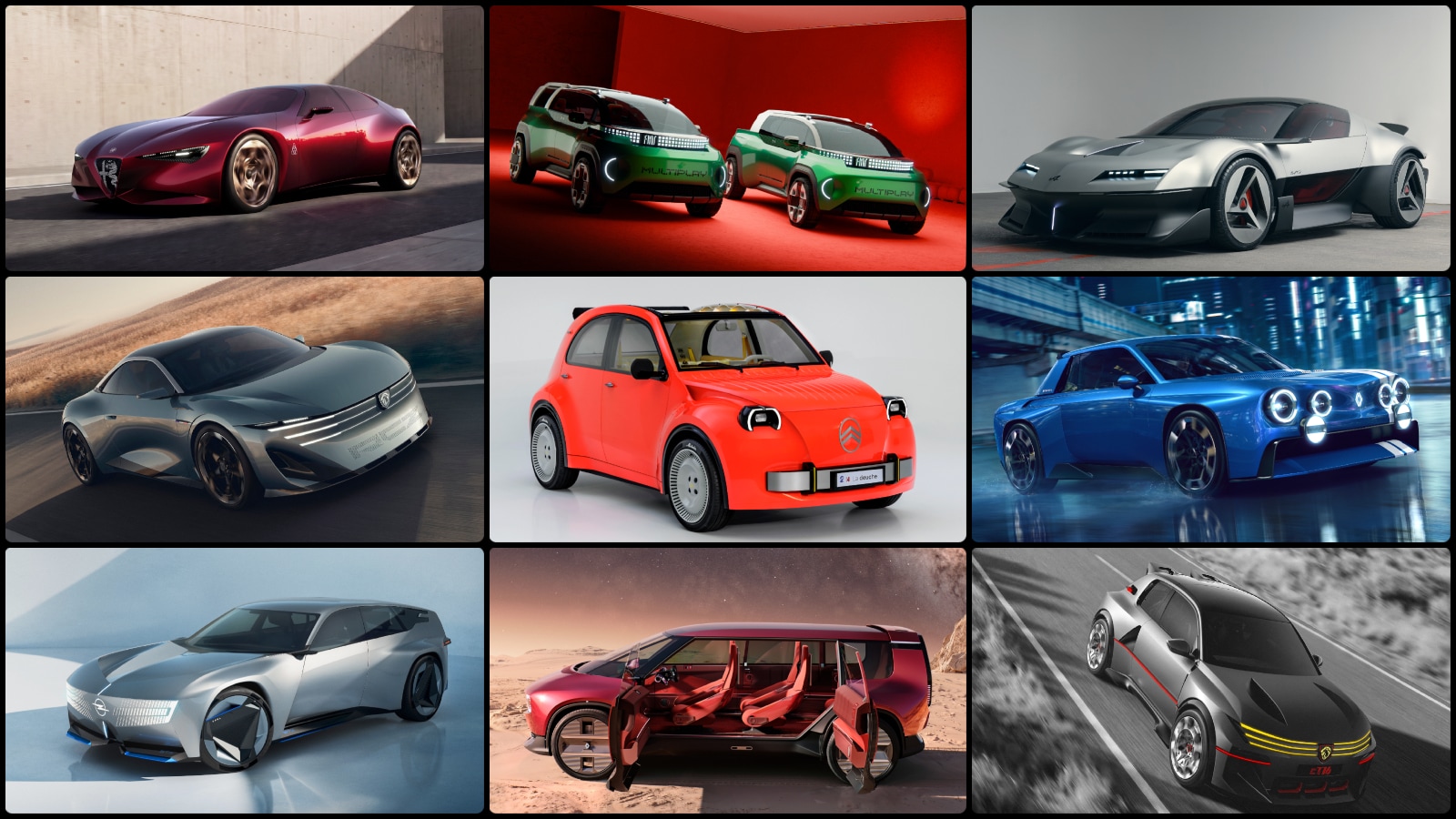
Look at what Peugeot brought to the floor. Their design language has evolved over the past few years into something predatory, feline, almost intimidating. Yet, their newest conceptual exploration strips away the aggressive posturing and leans into organic minimalism. It asks a radical question: What if your car felt less like a smartphone on four wheels and more like an extension of your living room?
We have spent the last decade building cars that isolate us. We added more screens, more insulation, more digital buffers between the driver and the asphalt. We turned the cockpit into a fortress against the outside world.
Yet, walking the floor in Paris, the prevailing current reverses. The designers are pulling down the walls.
Alfa Romeo occupies a corner of the exhibition hall that feels deliberately warmer, bathed in deep crimson lighting that pays homage to a century of racing heritage. But sentimentality alone cannot pay for a multi-platform EV architecture. Alfa knows this. The Italian brand is caught in that most agonizing of modern corporate trysts: honoring a legendary, smoke-filled past while engineering software-defined vehicles for a generation that views car ownership as an expensive hassle.
Their concept car is a study in proportions. It is low, wide, and aggressive, but it whispers of a future where performance is measured in kilowatt-hours and torque vectoring precision.
An old journalist next to me—a man who has smelled two-stroke oil since the seventies—shakes his head. "It doesn't idle," he mutters, as if discovering a betrayal.
"It doesn't need to," I tell him.
He grunts, unconvinced. And he has a point. There is an auditory grief that comes with the death of the internal combustion engine. The concussive thrum of a cold start on a Sunday morning, the mechanical crescendo of a manual gear change, the smell of unburnt fuel baking under a hot hood—these are sensory anchors of a bygone century. When you take them away, you leave a vacuum.
The ten concept cars dominating Paris this week are attempts to fill that vacuum with something entirely new.
Renault understands this psychological tightrope better than most. Positioned proudly on their home turf, Renault has leaned hard into a wave of retro-futurism that plays directly on collective nostalgia. They are taking icons from their past—shapes that grandparents drove to country markets and students drove to university strikes—and breathing silent, battery-electric life into them.
It is a clever trick. It lowers our defenses. We look at the familiar silhouette, and instead of seeing a terrifying leap into an unknown technological epoch, we see an old friend wearing a modern jacket.
Nostalgia is a powerful narcotic. But designers use it here as a bridge, not a parking brake. Underneath those nostalgic skins lie modular platforms, recycled composite materials, and battery chemistries that would have looked like science fiction a decade ago.
Let us be honest about the discomfort of this moment.
The automotive industry is undergoing the most violent restructuring since Henry Ford bolted together the Model T. Every legacy automaker is bleeding capital into EV development while trying to figure out if consumers actually want what they are building. Range anxiety, charging infrastructure gaps, high initial purchase prices, and shifting political winds create a fog of uncertainty that no marketing department can entirely clear away.
When you walk past these ten concept cars, you are not looking at the future. You are looking at ten different guesses about what the future might forgive us for wanting.
Some are absurd. Some are impossibly utopian, featuring interiors made from mushroom mycelium and reclaimed ocean plastics, configured like Parisian cafes rather than driving compartments. You know, with absolute certainty, that the production version will have none of these things. The regulators will demand crash structures, the accountants will demand cost reductions, and the marketing teams will demand cup holders.
And yet, these concepts matter.
They matter because they establish the emotional boundaries of what is acceptable. If the concept is bold, weird, and human, the eventual production car—even after it is sanded down by the realities of mass production—keeps a fraction of that soul.
By late afternoon, the crowds thicken. School groups spill into the aisles, their teachers shouting instructions over the ambient drone of electronic music pulsing from corporate display stands.
A twelve-year-old boy with a smartphone held high at arm's length stops dead in front of a low-slung, copper-colored concept. He doesn't care about the drag coefficient. He doesn't know what a kilowatt-hour is. He just stares at the aggressive slash of the LED headlamps, his mouth slightly open, completely transfixed.
Elena is still standing near the Citroën exhibit. I watch her notice the boy.
She doesn't smile, not broadly. She just lets out a slow, long breath, her shoulders dropping an inch.
The transition is messy. It is expensive, terrifying, and full of false starts. We are abandoning a century-old combustion religion and fumbling our way into an electric unknown with bruised knees and nervous spreadsheets.
Yet, watching the light catch the metallic paint of a car that may never see a public highway, you realize something essential. We are not losing our love for the machine. We are simply rewriting the language of desire.
The engines are gone. The passion remains.