The air in northeastern Paris always tastes of exhaust and old stone, but on that particular Sunday night, it tasted like gunpowder.
You could smell the cheap lager spilling onto the asphalt of the Canal Saint-Martin long before you heard the chanting. Thousands of shoulders rubbed against shoulders. It was a suffocating, electric friction. For decades, French football fans carried a specific, heavy kind of grief—the knowledge that their glittering capital, the city of light and luxury, was a ghost town in the pantheon of European football royalty.
Then came the final whistle in Munich.
Paris Saint-Germain had done it. They had finally lifted the Champions League trophy.
To an outsider, a football match is twenty-two millionaires chasing a piece of synthetic leather across some grass. It looks like entertainment. But if you have ever stood in the eastern working-class districts of Paris, you know that football here is an identity document. It is a declaration of existence for communities that the grand boulevards often prefer to forget. When the club wins, the invisible people feel seen.
But joy is a volatile chemical. In large quantities, without a release valve, it curdles.
The Anatomy of a Fracture
Consider a hypothetical young man named Amine. He is twenty-one, works a delivery gig that chews up his knees, and lives in a cramped apartment past the ring road in Saint-Denis. For Amine, Paris Saint-Germain is not a brand owned by Qatar Sports Investments. It is his lineage. When the historic victory came, he didn’t stay in his room. Nobody did. The city emptied its buildings into the streets.
The initial wave was pure euphoria. Red and blue flares painted the night sky in bruised, beautiful colors. Horns blared in a deafening, rhythmic symphony. Strangers kissed.
Then, the geography changed.
The crowd began to migrate toward the Champs-Élysées. This is where the narrative of a sporting triumph fractures into something much older and far more dangerous. The Champs-Élysées is not just a street; it is France’s living room, a showcase of global wealth and national pride. When a triumphant, chaotic mass of working-class youth meets the pristine plate-glass windows of luxury boutiques, the air pressure drops.
The mood shifted from celebration to reclamation. It happened in heartbeats.
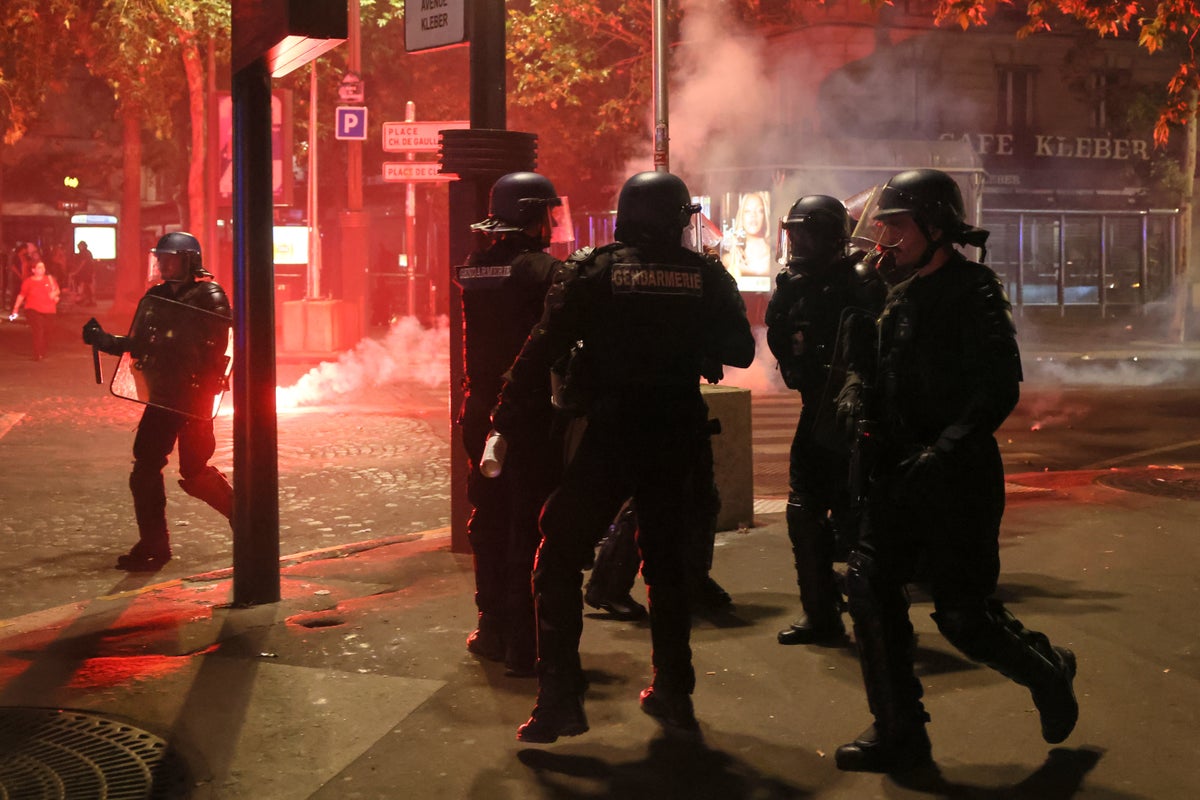
A plastic bottle flew through the air, catching the light before spraying beer over a line of CRS riot police. The officers stood frozen behind their plexiglass shields, looking like plastic Roman legionnaires under the streetlamps. Another bottle followed. Then a paving stone, wrenched from the very ground that tourists walk on during the day.
Chaos.
The first tear gas canister exploded with a sharp, metallic pop. If you have never inhaled tear gas, it is difficult to describe the immediate, primal panic it triggers. It doesn't just sting your eyes; it commands your lungs to stop working. It tastes like hot pepper and battery acid. Suddenly, the crowd that had been singing arm-in-arm split into a thousand terrified, angry fragments.
The Math of the Morning After
By three o'clock in the morning, the celebration was entirely gone, replaced by a grim, logistical exercise in state power.
The French Ministry of the Interior does not deal in emotion; it deals in metrics. When the sun began to rise over the smoke-stained avenue, the spreadsheets took shape. Over one hundred and forty people had been arrested in Paris alone. Across the entire country, as celebrations spilled over in Lyon, Marseille, and Bordeaux, that number climbed past three hundred.
Windows of major flagship stores were webbed with cracks or completely shattered, their luxury contents spilling onto the pavement. Dozens of vehicles were torched, turning into blackened, hollowed-out skeletons that smelled of burnt rubber and melted upholstery. More than sixteen law enforcement officers required medical treatment.
These numbers are real. They are verifiable. But they fail to capture the true cost of the night.
The real casualty was the collective illusion of a unified celebration. We often look at sports as the ultimate social glue, the one thing that can bridge the yawning chasm between the elite enclaves of the central arrondissements and the struggling suburbs of the banlieues. For ninety minutes, while the ball was in motion, that glue held. The moment the whistle blew, the pressure proved too immense.
The state responded with the only tool it has for systemic fractures: overwhelming force. Nearly three thousand extra police officers had been deployed across the capital in anticipation of the match. They were not there to celebrate. They were there to contain.
The Two Cities
To understand why a football victory ends with hundreds of citizens in zip-ties, you have to look at the architecture of French anger.
There is a deep, historical muscle memory in Paris for rioting. It is the city’s default setting for expression when words feel spent. When the police advanced in tight, mechanized lines, pushing the crowds back into the dark side streets, they weren't just clearing a roadway. They were reenacting a century-old dance between the state and the street.
The tragedy of the modern football mega-club is that it no longer belongs to the neighborhood that birthed it. Paris Saint-Germain is an international corporate juggernaut. Its shirts are worn by teenagers in Tokyo, New York, and Lagos. The fans who rioted on the Champs-Élysées cannot afford a ticket to sit in the pristine seats of the Parc des Princes anymore; those seats are reserved for corporate sponsors and international tourists who view the match as a lifestyle experience.
So, the local fans take the only thing they have left: the streets outside.
The destruction wasn't political in the traditional sense. Nobody was chanting slogans about tax reform or labor laws. It was an explosion of pure, unguided adrenaline from a generation that has grown up under the shadow of economic stagnation and social isolation. The victory was the catalyst, the excuse to occupy a space that usually tells them they do not belong.
By dawn, the municipal cleaning crews were already out. They are the unsung ghosts of Paris, moving efficiently in their bright green uniforms, sweeping away the broken green glass of Heineken bottles and the charred remains of trash cans. They work quickly because the city needs to look beautiful before the boutiques open their doors at ten.
If you walked down the Champs-Élysées by midday on Monday, you might not even notice that anything had happened. The smell of tear gas hangs around, though. It clings to the leaves of the chestnut trees and the stone facades of the buildings, a faint, bitter reminder of what happens when the party ends.
Amine went back to his delivery route. The police officers went back to their barracks. The club executives in Doha and Paris began planning the victory parade, ensuring the cameras would focus tightly on the trophy and the smiling players, carefully cropping out the boarded-up windows and the stains on the asphalt just a few miles away.
The silver trophy will sit in a glass case, pristine and gleaming. But the city that won it remains exactly as it was before the kickoff: deeply divided, fiercely passionate, and waiting for the next spark to set the night on fire again.