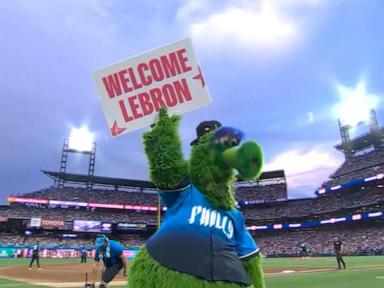
You learn early on that geography is a destiny written in malice.
Grow up in South Philly, and the air tastes like wood-grilled pork, old steel, and a congenital suspicion of anyone who wasn't baptized within the shadow of the Ben Franklin Bridge. We are a city built on chipped ham, narrow rowhomes, and a protective, jagged perimeter of grievance. We don't just root for our teams; we grip them like brass knuckles. We booed Santa Claus. We cheered when Michael Irvin lay motionless on the turf at Veterans Stadium with a career-ending neck fracture. It is a point of perverse pride. You earn our love through sweat, blood, and an absolute refusal to quit when the winter wind rolls off the Delaware. If you found value in this piece, you should look at: this related article.
Then came a Tuesday night in February, and the streetlights flickered over Broad Street like a confession.
For twenty-two years, LeBron James has been a moving goalpost. He arrived in 2003 as a teenager crowned before he could legally vote, an anointed savior carrying the weight of a dying industrial Midwest city on his broad shoulders. We watched him from afar with squinted eyes. In Philadelphia, we distrust royalty. We prefer the grease-stained underdog, the scrappy street-sweeper who bleeds on the hardwood. LeBron was different. He was corporate majesty. He was the king who built his own throne, moved it to Miami, dragged it back to Cleveland, and finally parked it under the neon glare of Los Angeles. For another perspective on this development, see the recent coverage from The Athletic.
We had our reasons to jeer him. He was the outsider. He was the enemy of our Process, the foil to our own long, agonizing sports heartbreak.
Yet, as the Los Angeles Lakers' charter touched down at Philadelphia International Airport, something seismic shifted in the collective marrow of the Delaware Valley.
Inside the Wells Fargo Center hours before tip-off, the concourse buzzed with a rare, anxious electricity. This wasn't the usual venomous hum of a Celtics rivalry game. It felt heavier. Reverent, almost.
Let us be honest about the math of time. LeBron James is thirty-nine years old. He has logged more miles on his basketball sneakers than almost any human being in the recorded history of the sport, spanning over fifty-four thousand regular-season and playoff minutes, a tally that defies the basic biology of human cartilage and tendon. When you watch him warm up from the lower bowl, your eyes play tricks on you. You look for the rust. You look for the stiff hitch in his gait that signals a body finally succumbing to the inescapable arithmetic of aging.
Instead, you see poetry written in sweat.
He stands near the three-point line, hoisting routine jumpers with the rhythmic mechanical precision of a clockmaker. The crowd presses against the tunnel railing, phones raised high like modern votive candles, capturing a fading god in bronze and gold.
When the starting lineups are announced, the PA announcer's voice booms off the concrete rafters. And then, the unthinkable happens.
A roar erupts. Not a chorus of catcalls or a tactical wave of boos designed to rattle free-throw attempts. It is a genuine, deafening appreciation. Thousands of Philadelphians—people who treat sports fandom as a blood sport—rise to their feet. They are cheering.
It is jarring. It feels like wearing winter coats in July.
Consider what a city like Philadelphia is actually cheering for in that moment. We aren't just applauding a four-time NBA champion or a four-time Most Valuable Player. We are paying homage to endurance itself. We are looking at a living artifact of our own youth, realizing with a sudden, sharp ache in our chests that the era we grew up watching is slipping through our fingers like dry sand.
The game begins, and the narrative snaps into sharp, violent focus.
The Philadelphia 76ers, depleted and desperate, scrap like alley cats. They throw double-teams at Anthony Davis. They scramble through passing lanes, trying to choke the life out of the Lakers' offense. But LeBron operates on the floor like a grandmaster playing chess against pigeons. He doesn't need to explode past defenders with the terrifying, freight-train velocity of his Cleveland twenties anymore. He uses geometry. He uses a subtle nudge of a forearm, a panoramic sweep of his court vision, a calculated pause that freezes a rotating help-defender in mid-air.
Midway through the second quarter, he catches an outlet pass on the wing.
For a single microsecond, the floor opens up. The defender backpedals, terrified of the drive, terrified of the pass, terrified of the sheer physical legacy bearing down on him. LeBron doesn't accelerate. He rises. It is an effortless, soaring ascension that defies the wear and tear of two decades of professional collisions. He flings a no-look bounce pass threading the needle through three pairs of outstretched arms straight to Davis for an uncontested slam.
The arena inhales sharply. Even the most hardened, cynical season-ticket holders in Section 101 shake their heads in reluctant awe.
We live in an age that loves to tear down its monuments. We devour our heroes the moment they show a crack in the armor, weaponizing social media to amplify every misstep, every decline, every aging curve. We treat greatness as a temporary loan that must be repaid with interest the second performance dips below superhuman standards.
Yet, watching LeBron weave through the defense on that Tuesday night, you realize how rare it is to witness history while it is still breathing.
The fourth quarter turns into a street brawl. The Sixers claw back within striking distance. The crowd is deafening now, the old tribal instincts threatening to reclaim the room. Every time LeBron touches the ball, a low, electric murmur rises from the seats.
With two minutes left on the clock, he backs down his defender near the baseline. The crowd holds its collective breath. You could drop a pin on parquet and hear it echo. He pivots, fades away over an outstretched hand, and releases the ball in a high, arcing rainbow.
Swish.
The net ripples. The silence breaks instantly into absolute, unadulterated pandemonium.
Philly went wild for LeBron James not because he wore our jersey. We went wild because we recognized the ghost in the machine. We saw a man waging a desperate, magnificent war against the clock, refusing to go quietly into the long winter of retirement. In a city that measures its soul by how much punishment it can absorb and still stand upright, we saw a kindred spirit.
The final buzzer sounds. The scoreboard flashes the final tally. LeBron walks slowly toward center court, wiping the sweat from his brow, chest heaving, taking one long, slow look around the roaring arena.
He doesn't smile. He gives a quiet, respectful nod to the crowd, tapping his chest twice with a closed fist.
The lights in the arena begin to dim, but the concourse outside remains electric, the cold night air suddenly feeling just a little bit warmer against the skin.