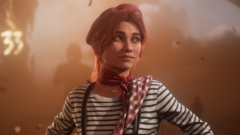
The room smells of expensive air conditioning and the sharp, metallic tang of adrenaline. It is a specific scent, familiar to anyone who has ever stood on a stage waiting for a name—any name—to be called. At the Bafta Games Awards, this tension usually vibrates between the giants. You expect the weight of massive studios to crush the air out of the room. But this year, the gravity shifted.
Sandstone and starlight. That is what Clair Obscur: Expedition 33 feels like when you play it. It is a game about the end of the world, painted with the brush of the French Belle Époque. It is beautiful, haunting, and deeply strange. On this night, that strangeness became its greatest strength. As the envelopes were torn open, the industry realized that the "safe bet" is a dying currency.
The Weight of the Mask
Consider a developer sitting in the third row. Let’s call him Marc. Marc has spent four years obsessing over the way light hits a digital cobblestone. He has missed birthdays. He has survived on lukewarm coffee and the terrifying thought that his art might be too niche, too poetic, or too quiet for a global audience. When Clair Obscur started winning, Marc wasn’t just watching a tally. He was watching a validation of the risk.
The game didn't just win; it dominated the conversation. It claimed the title of Best Game, the crown jewel of the evening. It swept through categories like Artistic Achievement and Technical Achievement, proving that a medium often dismissed as "toys" is actually the front line of modern surrealism.
But there is a specific kind of heartbreak in a near-perfect run.
The "clean sweep" is the white whale of award ceremonies. It is the moment when an entire body of voters agrees that one vision was flawless across every single metric. Clair Obscur was on tracks to do it. The momentum was a physical force in the room. Then came the Narrative category.
The silence that followed the announcement of the winner—which went to the gritty, sprawling investigative epic Shadows of Doubt—wasn't one of disappointment, but of recalibration. It was a reminder. Even a masterpiece has its borders.
The Invisible Stakes of Pixels
Why does a trophy made of bronze-colored metal matter to a person sitting at home on a couch?
It shouldn't. In a world of rising costs and shrinking attention spans, an award ceremony can feel like a self-congratulatory bubble. Yet, these wins dictate what gets made next. When a game about a paintbrush-wielding expedition into a death-dream wins Best Game, the "money men" in boardrooms stop clutching their copies of military shooters quite so tightly.
The stakes are the stories we are allowed to see.
Every time a bold, experimental title like Clair Obscur takes the stage, it creates a permit for the next weird idea to exist. If it had lost to a safe, iterative sequel, the message would be clear: Don't try. Don't deviate. Stay in the lines.
Instead, the night was a riot.
The Human Toll of Excellence
We often talk about "technical achievement" as if the software wrote itself. It didn't. Behind the shimmering vistas of Expedition 33 are thousands of hours of human eye-strain.
When the team took the stage for the third time, their faces told the real story. It wasn't just pride. It was exhaustion. It was the look of people who had poured their personal histories, their fears of mortality, and their love of 19th-century oil paintings into a digital file and hoped the world wouldn't laugh.
They didn't laugh. They stood up.
The technical brilliance of the game isn't just about frame rates or polygon counts. It is about the way the wind moves the grass in a way that makes you feel lonely. It is about the "turn-based" combat that feels like a rhythmic dance rather than a math equation. To achieve that, you don't just need better computers; you need better empathy. You have to understand how a player feels at 2:00 AM when they are lost in your world.
The Missing Piece of the Puzzle
Missing the clean sweep is, in many ways, the most human thing that could have happened to Clair Obscur. Perfection is sterile. It is a closed loop.
By losing out on a few categories, the game stayed part of a community rather than becoming a monolith. It shared the spotlight with Shadows of Doubt, a game built on the backs of procedural generation and gritty noir tropes. That contrast is vital. It shows that the industry isn't just rewarding "prettiness." It is rewarding the soul.
Think about the Narrative win for Shadows of Doubt. It represents the messy, unpredictable nature of storytelling—where the player is the lead investigator in a city that never stops moving. While Clair Obscur provided the grand, operatic vision, Shadows provided the dirt under the fingernails.
The two cannot exist without each other. One provides the dream; the other provides the reality.
The Echo in the Hall
As the gala wound down, the "after-party" chatter wasn't about the snub. It was about the shift.
The industry is leaning into the shadows. We are moving away from the era where "realism" meant making things look like a high-definition photograph of a parking lot. Now, realism means capturing a mood. It means the "Clair Obscur" technique itself—the play between extreme light and deep, impenetrable dark.
It is a metaphor for the state of play.
There is a lot of darkness in the business right now. Layoffs, studio closures, and the fear that AI will replace the hand of the artist. But then a night like this happens. A group of people who dared to make something strange, something beautiful, and something undeniably human, stands under the bright lights of the Baftas.
The trophies are heavy. They are cold to the touch. But for one night, they served as heaters for an industry that has been feeling a bit of a chill.
The final award was handed out. The lights dimmed. The janitors began the long process of sweeping up the glitter and the discarded programs. But the feeling remained. It wasn't about the sweep. It was about the fact that a story about an expedition into the unknown actually found its way home.
Somewhere, a developer is starting a new project. They are looking at a blank screen. They are thinking about a risk that seems too big, a style that seems too weird, and a story that seems too personal.
They remember the night the sandcastle didn't wash away. They remember the night the light won.
And they start to type.