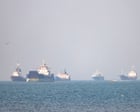
The air in the Strait of Hormuz doesn’t just feel hot; it feels heavy, like a damp wool blanket soaked in salt and diesel. On a clear night, you can see the lights of passing tankers—massive, steel islands carrying the lifeblood of the global economy—flickering against a black horizon. For a few fragile months, those lights represented a rare, quiet victory for diplomacy. A ceasefire, whispered and tentative, had finally allowed the world to look away from this jagged corner of the Persian Gulf.
Then came the flash.
It wasn't the cinematic explosion of a Hollywood blockbuster. It was a sharp, jagged rip in the dark, followed by the low, bone-shaking thud of a surface-to-surface missile finding its mark. In an instant, the "quiet" vanished. The ceasefire, once hailed as a triumph of restraint, began to bleed out into the turquoise waters of the Gulf.
The Ghost of a Promise
Consider the perspective of a merchant sailor, perhaps a third mate from Manila or Odessa, standing on the bridge of a VLCC (Very Large Crude Carrier). To them, the "US-Iran Ceasefire" isn't a policy paper or a talking point in a Washington briefing room. It is the difference between a peaceful watch and a night spent scanning the waves for the wake of a fast-attack craft.
When the news broke of the recent exchange of strikes, that sailor didn’t read a press release. They felt the ship's engines thrumming a little harder as the captain ordered a change in course. They felt the sudden, cold realization that the invisible lines drawn by diplomats are easily erased by a single battery of rockets.
The recent escalation started with a spark that many saw coming but few could prevent. A drone, small enough to be mistaken for a large bird on a radar screen, crossed a line that hadn't been officially mapped. A response followed. Then a counter-response. This is the "tit-for-tat" trap, a cycle of violence where each side believes they are merely "restoring deterrence." In reality, they are dismantling the floorboards of a house they both still live in.
The Math of a Single Spark
The Strait of Hormuz is a geographic choke point, barely twenty-one miles wide at its narrowest. Through this needle’s eye passes roughly one-fifth of the world’s total oil consumption.
Logic suggests that neither side wants a total collapse. The United States wants to protect the flow of energy and prevent a regional conflagration that would drag its resources back into a Middle Eastern quagmire. Iran wants to maintain its regional influence and push back against economic pressure without triggering a full-scale war that would threaten the survival of its leadership.
But logic is a fickle friend in the heat of a tactical exchange.
When a missile battery in southern Iran locks onto a target, or a US destroyer launches an interceptor, the "high-level strategy" disappears. It is replaced by the raw, terrifying physics of modern warfare. The ceasefire was supposed to be a shock absorber, a way to ensure that small mistakes didn't turn into catastrophic fires. Without it, we are back to a world where a single nervous radar operator can dictate the price of gas in Ohio or the stability of a government in Europe.
The Weight of the Invisible Stakes
We often talk about these conflicts in terms of "assets" and "strategic depth." We should talk about them in terms of heat.
Think about the heat generated by a drone strike hitting a supply depot. Now, think about the heat generated by a family in a cold climate realizing they can no longer afford to heat their home because the "risk premium" on global oil has skyrocketed overnight. These things are connected by a thousand invisible threads.
The ceasefire wasn't just about stopping bullets; it was about lowering the global blood pressure. It allowed markets to stabilize. It allowed humanitarian aid to move with slightly less friction. It gave the people living on both sides of the Persian Gulf—people who want to go to work, buy groceries, and see their children grow up—a moment to breathe.
Now, that breath is being held.
The strikes in the Strait are a physical manifestation of a deeper breakdown in communication. When words fail, metal speaks. And metal has a very limited vocabulary. It only knows how to destroy, how to puncture, and how to burn.
The Mirage of Deterrence
There is a persistent myth in the world of geopolitics that if you hit someone hard enough, they will stop hitting you back. We call it deterrence. It sounds scientific, almost like a law of physics.
The reality is far messier.
In the Strait of Hormuz, deterrence often looks like two people standing in a room filled with gasoline, flicking lighters at each other to prove they aren't afraid. Each flick is a "strike." Each flicker is a "message." But the gasoline doesn't care about the message. It only cares about the flame.
The recent exchange shows that the "threshold" for violence has shifted. What used to be a red line is now a blurry gray smudge. By trading strikes, both the US and Iran are testing the limits of the other’s patience. They are gambling on the idea that the other side will be the one to blink first.
But what happens if neither side blinks? What happens if the next strike doesn't hit an empty warehouse or a remote patrol boat, but a crowded transport hub or a ship carrying chemicals that could poison an entire coastline?
The Human Cost of High-Stakes Poker
Behind every headline about "Exchange of Strikes" are people who didn't sign up for the game.
There is the fisherman in Bandar Abbas who finds his fishing grounds turned into a restricted military zone, his livelihood disappearing into the churn of gray hulls and wake. There is the young officer on a US carrier, thousands of miles from home, staring at a green screen and wondering if the next blip is a glitch or a declaration of war.
These are the people who pay the "interest" on the debt of failed diplomacy. They are the ones who live with the constant, low-level vibration of anxiety that comes when a ceasefire starts to crumble.
The ceasefire was a fragile thing, built on a foundation of mutual exhaustion rather than mutual trust. It was a bridge made of glass. To see it cracking under the weight of these new strikes is to realize how little progress has actually been made. We are still standing on the same cliff’s edge we were on years ago, only now the ground beneath our feet is even more eroded.
The Silence After the Siren
The most haunting part of a naval engagement isn't the noise. It’s the silence that follows.
After the sirens stop and the damage control teams finish their work, there is a moment where the ocean returns to its natural state. The waves keep rolling. The salt spray keeps biting. But the world has changed. The "peace" that existed an hour before is gone, replaced by a grim, watchful waiting.
We are currently in that silence.
The strikes have happened. The messages have been "sent." Now, the world waits to see if anyone is actually listening, or if we are simply waiting for the next flash to tear through the heavy, humid air of the Gulf.
History is rarely written in grand, sweeping strokes. It is written in the small, panicked decisions made in the dark. It is written in the moments when restraint is discarded in favor of "sending a message."
The ceasefire is currently a ghost, a remnant of a hope that we could find a better way to coexist in this narrow, vital stretch of water. Whether that ghost can be brought back to life, or whether it will be drowned in the rising tide of another conflict, remains to be seen. But as the sun rises over the Strait, reflecting off the oily surface of the water, one thing is certain.
The fire is getting harder to put out.