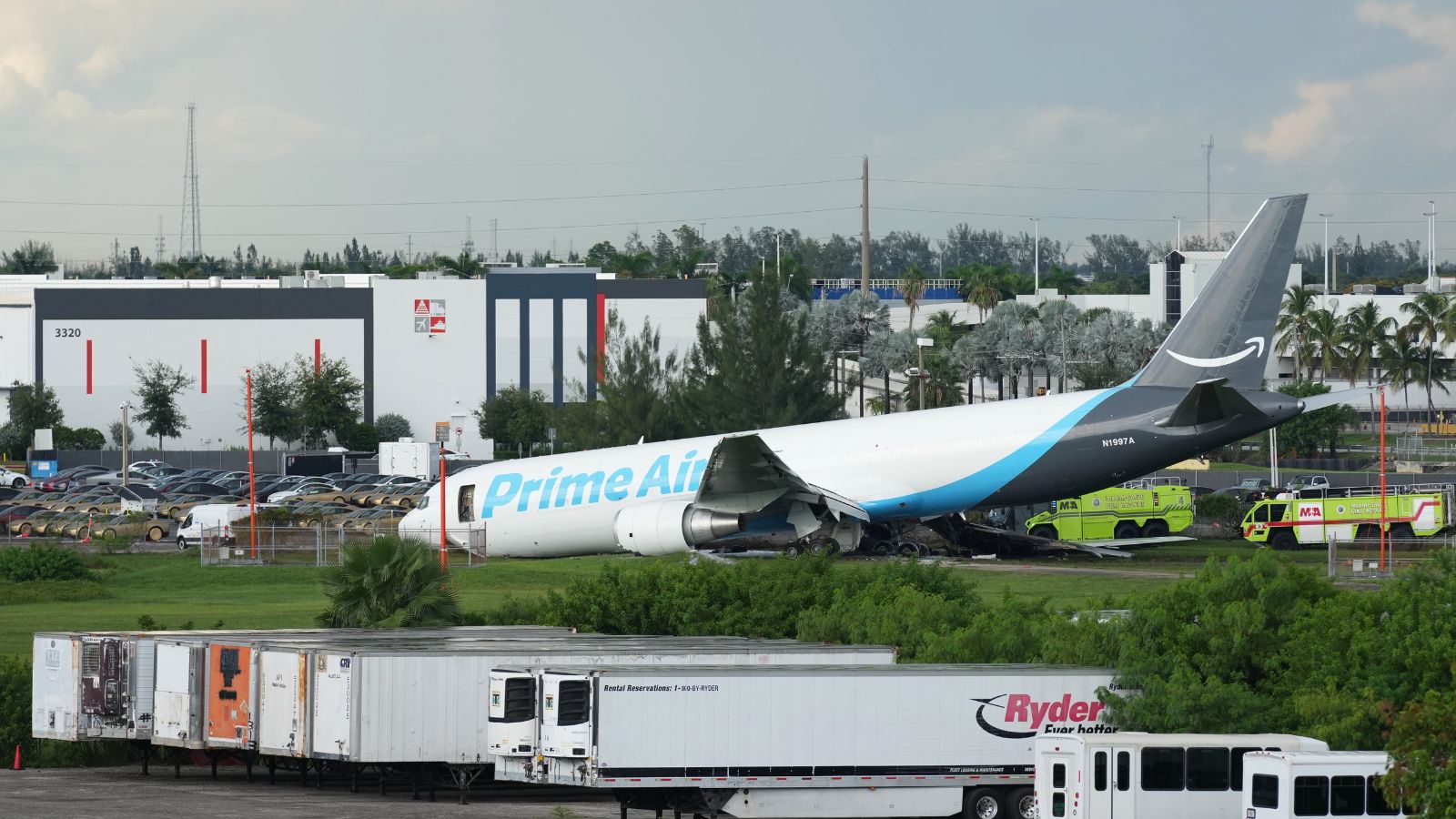
The coffee was still warm on the center console when the world turned sideways.
Midnight at Miami International Airport carries a specific, steady rhythm. Heavy birds descend through the humid Florida night, their belly lights painting the low clouds in amber and white, guided by the familiar geometry of runway markers and the calm, practiced voices coming through the headset. Ground crews move like ants across the vast concrete expanse, loading containers, checking seals, beating deadlines that never sleep. Logistics is an invisible architecture. When it works, it is utterly silent.
Then, the silence shatters.
Consider the mechanics of a modern air freighter. When an Amazon Prime Air cargo aircraft—a massive Boeing 767 converted to haul the endless stream of boxes, gadgets, and overnight dreams demanded by millions of consumers—touches down, it is carrying more than freight. It carries momentum. Tons of metal, fuel, and cargo moving at highway speeds dropped onto a strip of wet pavement.
On this particular night, something went terribly wrong during that critical deceleration. The aircraft failed to stop.
Instead of shedding speed and turning smoothly toward the cargo ramp, the multi-ton jet overran the runway boundary. It punched through perimeter fencing like tissue paper, tearing across the marginal terrain, and collided directly with multiple vehicles stationed near the perimeter service road.
Metal groaned. Glass exploded. The night air filled with the sharp, acrid scent of scorched rubber, spilled aviation fuel, and ruptured hydraulics.
For the people working the ground shift that night, the transition from routine operations to catastrophe happened in less time than it takes to draw a breath. (Note: The following dramatization of the crew’s immediate internal experience is a hypothetical reconstruction based on standard aviation incident profiles). Imagine sitting in a maintenance truck near the airfield boundary, watching the familiar landing lights grow too large, too fast. There is no time to calculate vectors or assess brake pressures. There is only the primal, jarring realization that the physics of the machine have overpowered the design of the ground.
Runway overruns are among the most terrifying scenarios in aviation. Pilots train for engine failures, crosswinds, and electrical blackouts. They spend hours in simulators practicing rejected takeoffs and slick-pavement braking. Yet, when a heavy widebody aircraft refuses to halt before the pavement ends, the margins for human error or environmental variables shrink to zero.
Why did it happen? Early reports and aviation safety investigations immediately zero in on a complex matrix of factors. Was it hydroplaning on a rain-slicked surface? Did a thrust reverser fail to deploy symmetrically? Was there a mechanical anomaly in the anti-skid braking system, or did sudden wind shear alter the touchdown point down the strip?
The Federal Aviation Administration and the National Transportation Safety Board do not deal in quick answers. They deal in fragments. They pull flight data recorders from the tail. They map skid marks with laser precision. They interview air traffic controllers whose voices remained steady on the tape while chaos bloomed outside their windows.
What lingers long after the emergency vehicles clear and the wreckage is hauled away to a secure hangar is the reminder of our modern reliance on velocity.
We live in a culture that measures progress by speed. We click a button at two in the morning, expecting a package on our porch by sunrise. Behind that simple transaction lies a dizzying apparatus of global supply chains, massive distribution hubs, and red-eye cargo flights crisscrossing the continent under the cover of darkness. Thousands of flights land and take off every single day without incident, fading into the background of our modern comfort.
We forget that flight is a defiance of gravity, and logistics is a defiance of distance. Both demand absolute perfection from man and machine.
When that perfection cracks, the cost is measured not just in damaged aluminum and halted flight paths, but in the frayed nerves of first responders, the intense scrutiny placed on flight crews, and the quiet realization of how fragile our hyper-connected infrastructure truly is.
The runway lights at Miami International have long since been repaired. The planes continue their midnight descent, sliding down the invisible beams toward the concrete. But out on the perimeter, where the fence was mended and the tire tracks were paved over, the night holds a heavier shadow. It stands as a quiet testament to the immense forces we harness every day, and the thin, precarious line that separates a routine delivery from a catastrophe.