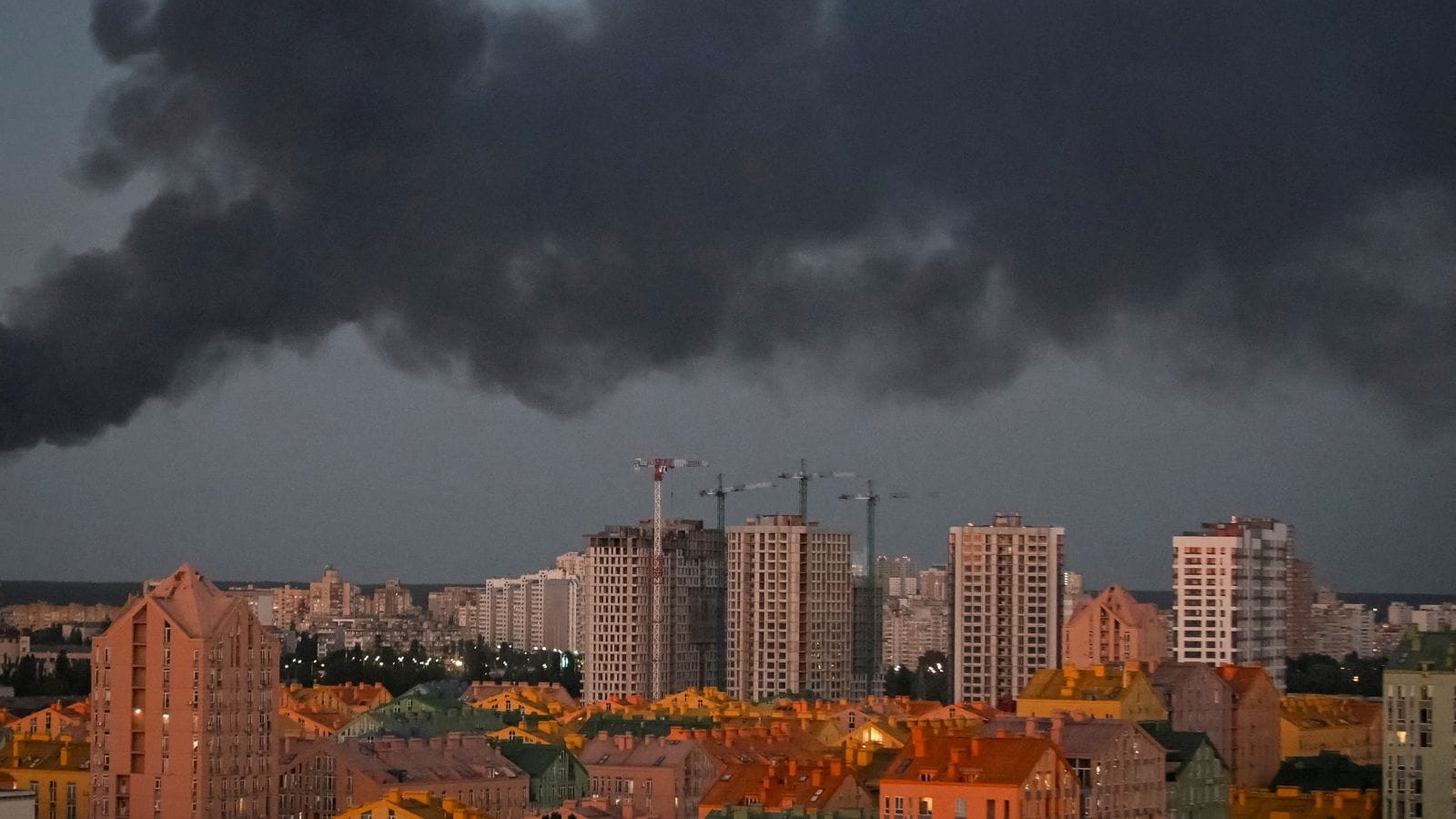
The sound arrives before the fire. It is a low, rhythmic drone, mimicking the mundane familiarities of peacetime life. It sounds exactly like a two-stroke lawnmower or a weed whacker working overtime in a neighbor’s yard. But it is two o'clock in the morning in a sleeping city hundreds of miles behind the front lines, and nobody is cutting grass.
Windows rattle. Dust shakes free from old crown molding. In the dark, people look toward the ceiling, tracing the invisible trajectory of a machine that weighs less than a couch but carries enough high explosives to rewrite the geography of a city block. You might also find this similar coverage useful: The Anchorage Backlash and the Breakdown of Great Power Diplomacy.
For years, war was something that happened somewhere else, contained within a brutal, mud-choked ribbon of trenches in the south and east. It was measured in artillery shells, heavy armor, and the slow, agonizing movement of infantry units across obliterated fields. Now, the sky has become a crowded highway.
The recent wave of hundreds of long-range drones crossing into multiple Russian regions marks a profound shift in how modern conflicts are fought. It is no longer just about territorial capture. It is about psychological parity, economic disruption, and the sudden, terrifying democratization of airpower. When the sky hums, the entire calculus of safety vanishes. As discussed in detailed reports by The New York Times, the effects are significant.
The Garage Engineers of Kyiv
To understand how a nation without a massive, legacy military-industrial complex managed to orchestrate one of the most sprawling aerial bombardments in recent history, you have to look away from traditional arms factories. You have to look at the small workshops, the converted basements, and the university laboratories scattered across Ukraine.
Imagine a young woman named Olena. She is twenty-four, a former software UI designer who, in another life, spent her evenings drinking flat whites in trendy cafes. Today, her fingers are stained with carbon fiber resin and her eyes are bloodshot from staring at open-source flight routing software. She is one of thousands of loose-knit engineers who have turned commercial components into strategic weapons.
The mathematics of this transformation are brutal and undeniable.
A standard military cruise missile can cost anywhere from one to three million dollars. Producing one requires specialized metallurgy, state-of-the-art guidance systems, and supply chains that span continents. Olena’s team builds long-range strike drones for a fraction of that cost, sometimes using off-the-shelf fiberglass, hobbyist engines, and custom circuit boards designed to bypass sophisticated electronic jamming.
When Ukraine launched its massive, multi-region strike, it wasn't deploying a fleet of billion-dollar stealth bombers. It was launching swarms of these inexpensive, low-flying composite aircraft. They fly slow. They fly low to the treetops, hugging the contours of the earth to hide from radar networks designed to detect high-altitude supersonic threats.
Consider the sheer scale of the operation. Drones targeted fuel depots, ammunition warehouses, and military airfields across regions like Bryansk, Voronezh, Krasnodar, and even the outskirts of the capital. Air defense systems fired millions of dollars' worth of interceptor missiles into the dark, trying to swat down objects that cost less than a used compact car.
This asymmetry is the defining feature of the new battlefield. Even when an air defense system successfully destroys a drone, the economic victory often belongs to the attacker. If an expensive missile is required to stop a cheap piece of flying plastic, the defender is slowly, mathematically bleeding to death.
The Anatomy of the Swarm
The true terror of a swarm strike lies not in the sophistication of a single drone, but in their collective behavior. They do not arrive all at once in a neat formation. They trickle in from different angles, at different altitudes, utilizing carefully mapped blind spots in the defensive radar grid.
During the recent attacks, local Telegram channels across western Russia lit up with frantic videos captured on smartphones. The footage is almost always the same: pitch-black darkness, the distinct, mechanical buzz approaching from the horizon, followed by the frantic, fiery tracer rounds of anti-aircraft guns tearing into the night sky. Then, a sudden flash. A fireball blooms on the skyline, silhouetting apartment buildings and illuminating the terrified faces of residents looking through their curtains.
The targets chosen in these deep-strike operations are highly specific. They are the logistical tendons that keep a war machine moving. Fuel oil refineries, electrical substations, and storage facilities holding glide bombs are the primary focus. By striking these nodes, the objective is to create a cascading failure across the supply lines feeding the front.
But the physical damage to a refinery tower or a railway junction is only half the story. The invisible stakes are deeply psychological.
For the average citizen living in a city far removed from the border, the war had largely been an abstraction broadcast through state media filters or discussed in hushed tones over dinner tables. The sudden appearance of exploding drones over local industrial zones shatters that insulation. It brings the reality of the conflict into sharp, undeniable focus. The front line is no longer a line on a map. It is everywhere.
The Blind Spots of Modern Defense
The world’s most advanced air defense networks were built during the Cold War. They were engineered to stop massive, hot-burning ballistic missiles or high-flying strategic bombers moving at incredible speeds. They are masterworks of engineering, capable of tracking objects moving faster than the speed of sound.
Yet, they are surprisingly blind to a piece of foam and fiberglass drifting through a valley at eighty miles per hour.
When a drone flies beneath the radar horizon, it becomes invisible to long-range sensors until it is almost directly overhead. It hides in the ground clutter. It blends into the natural noise of the terrain. To counter this, defenders are forced to rely on older, kinetic solutions: truck-mounted machine guns, searchlights, and mobile acoustic teams listening to the night sky with specialized microphones.
It is a bizarre fusion of World War II tactics and twenty-first-century digital warfare.
Behind the physical clashes lies a silent, invisible war of radio frequencies. As the drones advance, electronic warfare units try to flood the airwaves with noise, severing the satellite navigation links that guide the craft to their coordinates. If the GPS signal is jammed, a drone can lose its way, drifting harmlessly off course until its fuel runs out.
To counter this, the engineers have adapted again. They are equipping their creations with basic optical navigation systems—small cameras paired with simple onboard processors that can recognize the terrain below by comparing it to pre-loaded satellite imagery. The drone doesn't need a satellite signal anymore. It can see its way to the target.
This constant, iterative cycle of measure and countermeasure happens in weeks, not decades. There are no bureaucratic committees approving design changes over several years. A vulnerability is discovered on Tuesday; a software patch is written on Thursday; the updated drone is in the air by Saturday night.
The Price of Light
The morning after a massive strike reveals a distinct kind of weariness. In the targeted towns, the smoke rises lazily from the ruins of industrial parks. Fire crews work through the dawn, their faces blackened by burning oil, spraying foam onto collapsed steel storage tanks.
Residents walk their dogs past shattered glass on the sidewalks, checking their cars for shrapnel damage. The tension doesn't dissipate when the sun comes up. It simply settles into the bones. Everyone knows the night will return, and with it, the potential for that unmistakable hum to fill the air once more.
The strategic reality is that this capability cannot be put back into the bottle. The technology required to build long-range, autonomous strike weapons is now global, decentralized, and cheap. It has altered the power dynamics of modern statecraft forever. Small nations, insurgent groups, and blockaded economies can now project power across vast distances, bypassing traditional military obstacles entirely.
This is the uncomfortable truth at the heart of the modern sky. Security is no longer a matter of distance. Having a massive army at the border means very little when the threat can simply fly over them, guided by a motherboard that costs less than a pair of shoes, seeking out the one vulnerable transformer station that keeps a city warm.
The fire eventually goes out, but the sky remains open.