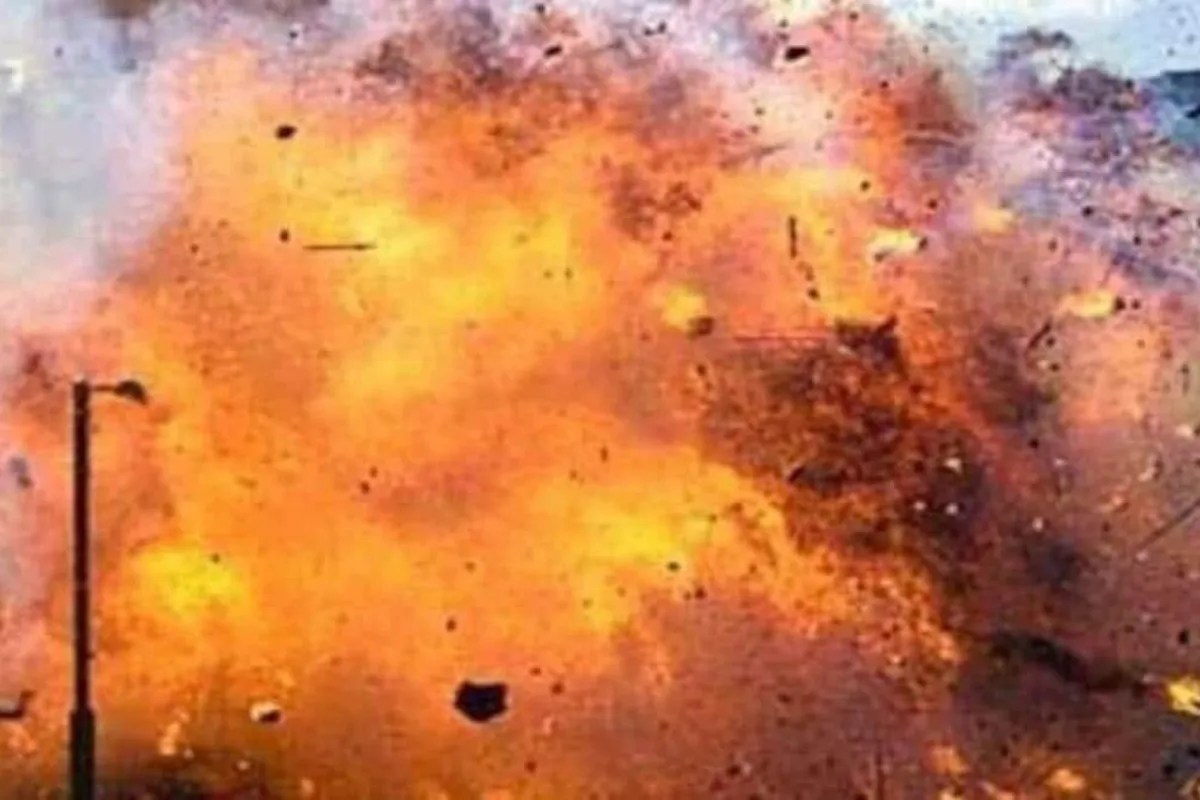
The air in the Voronezh region usually carries the scent of damp earth and industrial exhaust, a heavy, predictable smell that defines the Russian heartland. But on a Tuesday that felt like any other, that stillness was punctured. It wasn’t the sound of thunder. It was the high-pitched, persistent whine of lawnmower engines in the sky—a sound that has become the modern herald of ruin.
When the drones struck the Borisoglebsk aviation center, they weren’t just hitting concrete and fuel. They were puncturing the myth of distance.
For the technicians working the late shift or the residents in nearby apartments, the war had always been a flickering image on a television screen, a series of maps and red arrows occurring "over there." Then came the flashes. Red blooms against a black horizon. The ground shook with the rhythmic pulse of secondary explosions, the kind that tell you something expensive and volatile is being systematically erased.
Ukraine didn't just lob a few explosives over the fence. This was a surgical dismantling of the infrastructure that allows Russian jets to breathe.
The Anatomy of a Blind Spot
To understand why a warehouse in Borisoglebsk or a repair plant in Yeysk matters, you have to look past the hardware. Think of a long-distance runner. The runner is the Su-34 fighter-bomber, the sleek, lethal machine that drops glide bombs on Ukrainian cities. But even the fastest runner is useless if their shoes are shredded and their lungs are filled with smoke.
Borisoglebsk is the "lungs." It is a hub for training, repair, and the logistical connective tissue that keeps the Russian Air Force from grinding to a halt. When those drones—locally produced, relatively cheap, and terrifyingly persistent—found their mark, they weren't just seeking to destroy a few planes. They were attacking the Russian military's ability to maintain a tempo.
Imagine a specialized mechanic named Aleksei. He is a hypothetical composite of the men who work these lines. Aleksei has spent twenty years learning the specific tensions of a turbine blade. He works in a world of micrometers and high-grade alloys. When a drone tears through the roof of his hangar, it doesn't just destroy the engine on the stand; it destroys the tools, the blueprints, the specialized diagnostic computers, and the safety of the environment.
Aleksei can’t just go to a hardware store to replace a calibration rig for a Sukhoi jet. Those parts are often caught behind the jagged teeth of international sanctions. Every strike on a repair facility like the one in Yeysk is a compounding interest of failure. It’s not just one day of work lost. It’s months of technical regression.
The Physics of the Long Game
There is a brutal, mathematical elegance to what is happening. A Russian S-400 air defense missile can cost millions of dollars. The drone it is trying to shoot down might cost the same as a used hatchback.
Ukraine is forcing a realization: the frontline is no longer a trench in the Donbas. The frontline is wherever a drone can reach. And lately, they are reaching very far.
The strike on the 590th radio-technical center in Mordovia—hundreds of miles from the border—was a different kind of message. They hit the "eyes." Specifically, a "Container" over-the-horizon radar. This isn't a radar that looks for a single plane; it’s a massive, sprawling array designed to monitor the entire European airspace. It’s meant to detect nuclear launches. It is a crown jewel of the Russian early-warning system.
When a cheap drone clips the ear of a giant like that, the giant doesn't just get a bruise. It develops a blind spot. In the high-stakes poker of global security, a blind spot is an invitation to disaster.
The Weight of Silent Skies
There is a psychological toll that no spreadsheet can capture. For decades, the Russian military identity was built on the foundation of the "impenetrable fortress." The sheer vastness of the country was its best defense. But the digital age has shrunk the map.
In the border towns and the aviation hubs deep in the interior, the silence of the night is now a source of anxiety. People listen for that hum. They watch the shadows. The invisible stakes are no longer about who controls a specific village in the east; they are about whether the state can fulfill its most basic promise: protection of the interior.
Consider the ripple effect of the Yeysk facility hit. Yeysk sits on the Sea of Azov, a strategic knuckle in the Russian logistical fist. It’s a place where pilots are minted. When the sky there turns to fire, the training cycles break. The confident stride of the military apparatus begins to hitch and stutter.
It is a war of attrition, yes, but not just of bodies. It is an attrition of competence. Every fire that burns at a Russian airbase represents a thousand tiny problems that can't be solved quickly. It’s the missing specialized bolt. It’s the charred wiring harness that was the last one in the warehouse. It’s the pilot who now wonders if the runway will still be there when he returns from a sortie.
The Ghost in the Machine
We often talk about "asymmetric warfare" as a dry academic concept. It is anything but. It is the visceral reality of a smaller power using its wits to bypass the armored chest plate of the giant and go straight for the jugular.
Ukraine has turned its lack of a traditional navy and a massive air force into a terrifyingly lean, tech-first insurgency. They are coding their way through air defense nets. They are using off-the-shelf components to blind the very systems designed to win World War III.
The strikes on Borisoglebsk and Yeysk aren't isolated events. They are chapters in a new kind of history book. One where the "rear" no longer exists. One where the most sophisticated radar in the world can be defeated by a plastic wing and a GPS chip.
As the smoke cleared over the Voronezh region, the sun rose on a landscape that looked the same but felt fundamentally different. The hangars were still there, mostly. The runways were still concrete. But the certainty was gone.
Aleksei, the mechanic, might look at the jagged hole in the roof and see a repair job. But the planners in the Kremlin see something much worse. They see a future where the sky is no longer theirs, not because they were shot down in a dogfight, but because they were dismantled while they slept.
The lawnmower hum is fading now, replaced by the crackle of cooling metal and the distant sirens of a country realizing its borders are made of glass.
Somewhere, a technician is looking at a charred circuit board that can no longer be ordered from the West, realizing that the most powerful weapon in this war isn't a missile. It’s the realization that nowhere is far enough away.
The steel is cold. The sky is waiting. And the drones are already being fueled for the next flight.
Would you like me to analyze the specific technological specifications of the Ukrainian "Long-Range" drone fleet used in these deep-strike missions?