A massive tremor wakes you up at 7:30 in the morning. The floor rolls violently. You try to stand, but your legs give out. You are forced to crawl on your hands and knees just to reach a safe spot under a table. That is exactly what residents in northern Japan went through on Thursday, June 25, 2026, when a preliminary magnitude 6.9 earthquake ripped through the Pacific Ocean seabed right off the coast of Iwate prefecture.
The epicenter sat about 42 kilometers away from the coastal city of Kuji. It went down deep, roughly 50 kilometers beneath the earth's crust. Panic naturally rippled through the region. People immediately remembered the catastrophic March 2011 disaster that shattered the exact same coastline. This time, thankfully, things played out differently. Also making waves in related news: The Deadly Illusion of Foreign Disaster Aid.
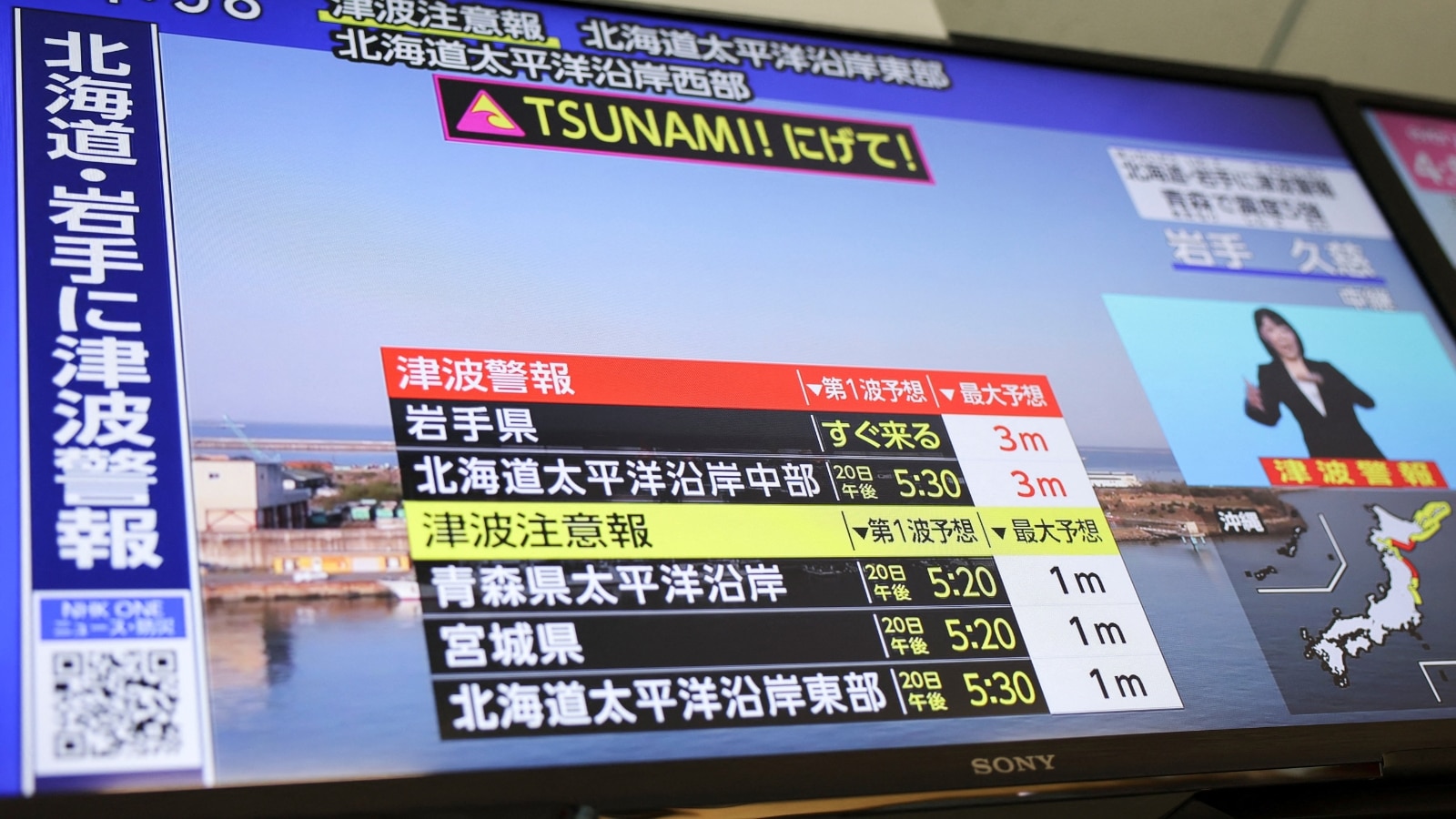
The Japan Meteorological Agency quickly confirmed there was no tsunami danger. Aside from minor, negligible sea level fluctuations, the ocean stayed calm. No major injuries popped up in the immediate aftermath. The regional nuclear power plants reported zero abnormalities. Trains stopped automatically, highways closed for quick checks, and life ground to a temporary halt. But the country did not break.
Why did a near-7 magnitude quake leave the coast intact without a wall of water rushing inward? The answer comes down to a mix of pure planetary physics and some of the strictest engineering standards on earth. More details into this topic are detailed by Al Jazeera.
Why the Tohoku Shaking Felt Massive but Left No Tsunami
Most people assume that every large underwater earthquake automatically triggers a massive tidal wave. That is a dangerous misconception. Tsunamis require very specific mechanical actions under the ocean floor to actually form.
When an earthquake hits, it can move the seafloor in two basic ways. It can displace it horizontally, or it can displace it vertically. For a tsunami to happen, the seabed has to snap upward or downward with incredible force. This sudden vertical shift displaces the massive column of water sitting directly above the fault line. Think of it like slapping the bottom of a filled bathtub. The water has nowhere to go but up and out.
The June 25 event did not feature that massive vertical displacement. While the 6.9 magnitude release brought severe horizontal shaking, it lacked the vertical thrust needed to push the ocean upward.
Depth plays a massive role here too. The rupture happened 50 kilometers down. That is relatively deep for a coastal quake. Shallow earthquakes, meaning those breaking less than 20 kilometers below the crust, disrupt the surface far more violently. A deep rupture dampens the vertical displacement of the seafloor. The energy still travels through the rock as seismic waves, which is why the ground shook so hard, but the water column above remained mostly undisturbed.
We also have to look at the sheer scale of energy. A magnitude 6.9 earthquake is undeniably powerful. However, the Richter and Moment Magnitude scales are logarithmic. A magnitude 9.0 quake, like the nightmare event in 2011, is not a little bit bigger than a 6.9. It releases roughly 11,000 times more energy. The 2011 disaster tore open a fault line hundreds of kilometers long. This 2026 quake was a localized release of stress. It was a sharp, hard shock, not a cataclysmic tectonic shift.
Breaking Down the Intensity Six Upper Reality
While the ocean stayed calm, the situation on land felt incredibly violent. Japan does not just rely on the standard magnitude scale to explain earthquakes to the public. Magnitude measures the energy released at the source. Instead, locals care about the Shindo scale, which measures the actual intensity of shaking at specific locations on land.
The system runs from 0 to 7. During this event, parts of Aomori prefecture registered a Shindo 6-plus, or Upper 6.
To understand how terrifying an Upper 6 is, you have to look at how it affects a human body. At this level, it is completely impossible to remain standing. You cannot walk. The force throws you to the ground. Your only option is to crawl on your stomach or knees. Unsecured furniture flips over completely. Wall tiles crack and pop off. In older, non-reinforced wooden buildings, walls can buckle and roofs can cave in entirely.
The fact that an Upper 6 shaking level resulted in zero immediate deaths or collapsed high-rises is a testament to Japanese building codes. After the 1981 Amendment to the Building Standard Law, known as Shin-Taishin, every structure built in Japan had to handle severe ground shaking without collapsing. Buildings are designed to sway, absorb, and dissipate seismic energy.
Many modern structures in Sendai, Morioka, and Hachinohe sit on massive rubber pads or fluid-filled dampers. When the earth thrashes back and forth, the building essentially floats on these isolation layers. The ground moves, but the structure stays relatively still. Older structures have been systematically retrofitted with steel cross-braces over the last two decades. That is why an event that would flatten cities in other parts of the world resulted in little more than spilled groceries and broken dishes in Aomori and Iwate.
The Technical Reason Nuclear Plants Avoided Disaster
The moment news broke about the quake, eyes turned to the region's nuclear facilities. The Tohoku region holds several key nuclear sites, including the Onagawa nuclear power plant and the idled Higashidori facility. Memories of the Fukushima Daiichi meltdown are permanently burned into global consciousness.
The Nuclear Regulation Authority moved fast to check the telemetry. Tohoku Electric Power confirmed that both Onagawa and Higashidori suffered no irregularities. Systems remained completely stable. Radiation monitoring posts around the facilities showed completely normal base levels.
The public often misunderstands what actually caused the 2011 Fukushima crisis. The earthquake itself did not destroy the reactors. When the 2011 quake hit, the plant's automatic safety systems worked perfectly. Control rods inserted themselves into the core instantly, halting the nuclear fission reaction. The disaster happened because the subsequent 14-meter tsunami overtopped the plant’s sea wall. The water flooded the basement emergency diesel generators. Without those generators, the cooling pumps lost power. The cores overheated because they could not pump water to cool the residual decay heat.
Lessons from that failure changed everything. Today, the Onagawa plant features a massive concrete sea wall standing 29 meters above sea level. The facility sits built on elevated ground. More importantly, backup generators are no longer trapped in vulnerable basements. They sit in watertight, hardened structures high above any potential water line.
Even though there was no tsunami threat on Thursday, the plants are now built to survive the worst-case scenario. The cooling systems have multiple layers of redundancy. If primary power fails, battery banks can run the essential valves for hours while independent, air-cooled generators fire up. The grid went through a massive test, and the safety measures did exactly what they were engineered to do.
Why Three Global Quakes on the Same Day Is Just a Coincidence
Social media lit up with wild conspiracy theories shortly after the Iwate quake. Within a twelve-hour window on Thursday, three distinct, powerful earthquakes rattled different corners of the globe.
- Twin earthquakes struck Venezuela, causing structural damage and tragic fatalities in places like Caracas.
- The magnitude 6.9 quake hit northeastern Japan.
- A magnitude 5.6 earthquake shook Northern California.
It looks terrifying on a map. It feels like the planet is tearing itself apart at the seams. Doom-scrollers quickly claimed that one quake triggered the others, or that a massive tectonic shift was happening worldwide.
Seismologists stepped in immediately to debunk the panic. Dr. Lucy Jones, a renowned seismologist from Caltech, explained that these events occurred on completely separate fault systems and entirely different tectonic plate boundaries. They share no physical connection.
The earth’s crust is constantly moving. It is divided into roughly a dozen major tectonic plates and many smaller ones. These plates slide past, crash into, and dive beneath one another at a rate of a few centimeters per year. Japan sits at the intersection of four major plates: the Pacific, Philippine Sea, Eurasian, and North American plates. The Iwate quake happened because the Pacific plate is subducting underneath the North American plate. Venezuela’s quakes involved the interaction between the Caribbean and South American plates. California’s tremor involved the famous San Andreas fault system or adjacent local faults.
Large earthquakes can trigger local aftershocks along the same fault line. They cannot, however, spark a major earthquake thousands of miles away on a completely different plate. The energy waves from the Japan quake degrade into faint vibrations by the time they pass through the core of the earth to reach South America or California. They simply do not have the mechanical force to unlock a stuck fault line on the other side of the world. It was pure statistical coincidence. The planet experiences tens of thousands of earthquakes every single year. Sometimes, the larger ones simply cluster on the calendar.
Real Preparedness Strategies You Can Action Right Now
If you live in a seismically active zone, you cannot rely on luck. The smooth handling of the Japan event shows that preparation mitigates disaster. You need a clear strategy before the ground starts moving.
First, fix your immediate environment. Most injuries during an Upper 6 earthquake do not come from collapsing ceilings. They come from flying objects. Heavy bookshelves, wardrobes, and television sets become deadly projectiles. Use L-shaped steel brackets to anchor heavy furniture directly into the wall studs. Put heavy items on lower shelves. Install latches on kitchen cabinets so dishes do not fly out and turn your floor into a minefield of broken glass.
Second, understand your local geography. If you are near a coast and feel an earthquake that lasts for more than thirty seconds, do not wait for an official government warning. Move to high ground immediately. The ocean can change within minutes. Even though Japan avoided a tsunami this time, the next fault rupture could be different. Memorize evacuation routes that lead at least 20 to 30 meters above sea level.
Third, maintain an independent survival kit. If a major quake cuts off power, water, and gas lines, emergency services will be overwhelmed. You must be self-sufficient for at least three to seven days.
Keep your kit stocked with essential supplies:
- Three liters of water per person per day.
- Non-perishable, high-calorie food items that do not require cooking.
- A sturdy flashlight with extra batteries.
- A portable, hand-cranked radio to receive emergency broadcasts when cell towers go dark.
- A comprehensive first-aid kit containing personal prescription medications.
- A backup power bank kept fully charged at all times.
When the shaking starts, drop, cover, and hold on. Do not try to run outside while the ground is moving violently. Most people get tripped up or struck by falling exterior masonry when they try to flee buildings. Stay put under a heavy piece of furniture. Protect your head and neck. Wait until the movement stops completely before checking your surroundings and executing your evacuation plan.