The failure of urban security systems often manifests as a rapid transition from stable public transit flow to high-kinetic violence, as evidenced by the mass stabbing incident outside Leytonstone Station in East London. When analyzing such events, the primary objective is to deconstruct the Violence Lifecycle, which consists of the pre-incident escalation, the active tactical phase, and the post-kinetic containment. The Leytonstone event provides a raw data set for evaluating how density, bystander behavior, and emergency response times intersect to dictate the casualty rate and the speed of suspect neutralization.
The Triad of Urban Vulnerability
Public transport hubs function as high-value targets due to three specific structural factors. These variables create a "security vacuum" that assailants exploit before law enforcement can establish a perimeter.
- Flow Density Bottlenecks: Train stations funnel large numbers of people through narrow exit points. This creates a high-target density environment where an assailant’s strike-to-casualty ratio is maximized.
- Predictability of Response: Fixed infrastructure dictates the pathing of responders. Assailants often choose locations that offer multiple egress routes or structural blind spots that delay the visual confirmation of a threat by CCTV operators.
- The Diffusion of Responsibility: In crowded settings, the "Bystander Effect" often delays the initial 999/911 call. Individuals assume others have already reported the incident, leading to a critical lag in the first response window.
Tactical Deconstruction of the Active Phase
The video evidence from the scene confirms a chaotic phase where the "OODA Loop" (Observe, Orient, Decide, Act) of the bystanders was completely compromised. In professional security analysis, the efficiency of an attack is measured by its Kinetic Intensity, which tracks the frequency of strikes against the duration of the engagement.
Phase 1: The Initial Breach
The assault began outside the station—a transition zone where surveillance is often less concentrated than on the platforms. By engaging targets in a transitional space, the assailants utilized the ambiguity of the environment. Witnesses initially perceive shouts or movement as "standard urban friction" rather than a coordinated attack, granting the perpetrators several seconds of uncontested action.
Phase 2: The Saturation of Chaos
Violence in public spaces operates on a feedback loop. As victims are struck and bystanders flee, the resulting "crowd turbulence" creates secondary risks, such as trampling or the obstruction of police vehicles. The presence of digital recording—while useful for post-incident forensics—often creates a dangerous "curiosity lag." Individuals who stop to film the scene inadvertently place themselves within the Inner Kill Zone, prioritizing content capture over personal extraction.
Phase 3: Neutralization and Containment
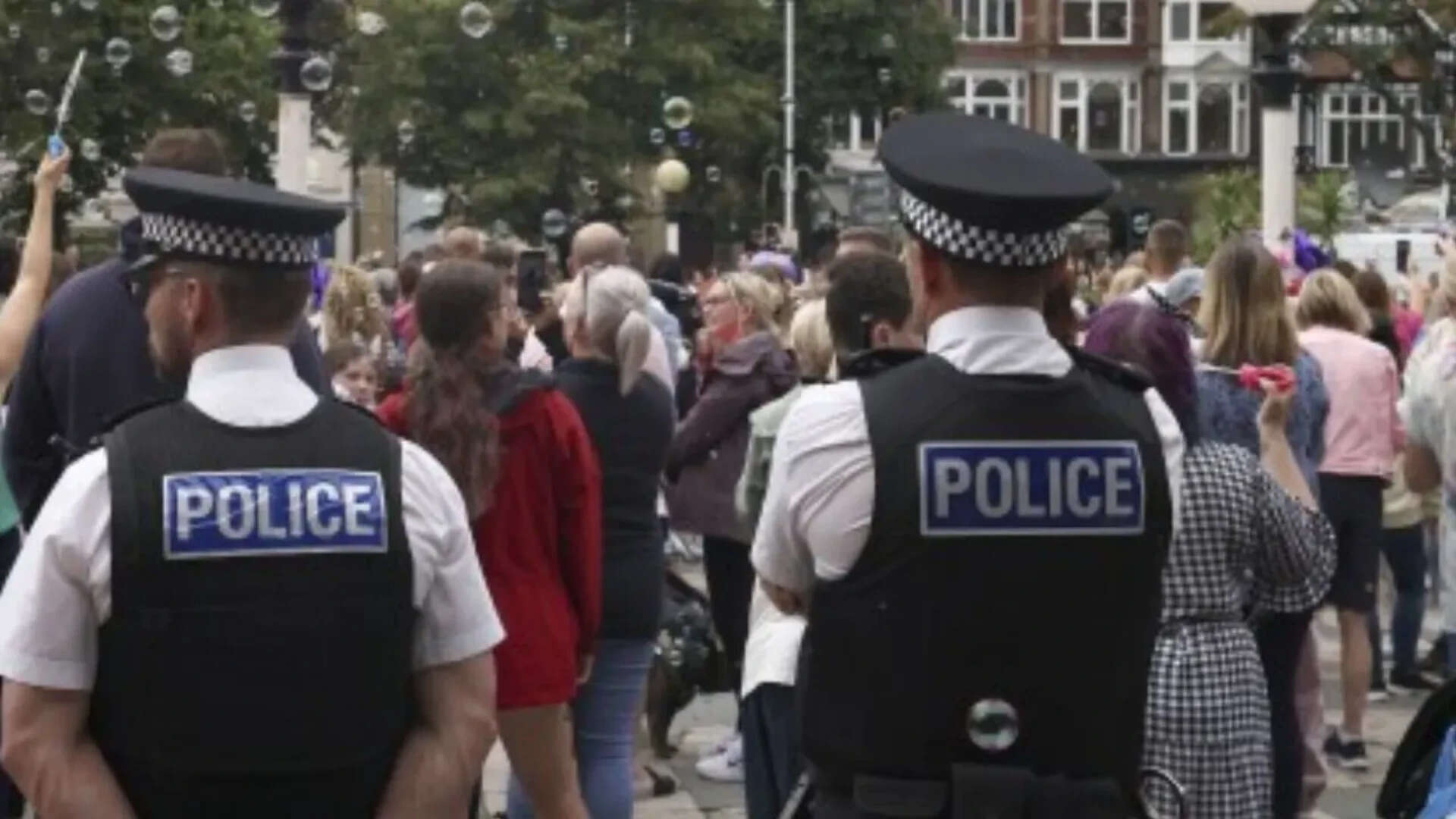
The Metropolitan Police’s arrival and the subsequent arrest of two suspects highlight the transition to the containment phase. The speed of this transition is the only variable that reliably reduces the mortality rate in sharp-force trauma incidents. Unlike firearms, which allow for distance, knives require physical proximity, meaning the "stop-clock" on casualties is directly tied to the physical presence of a superior force.
The Logistics of Sharp-Force Trauma Response
The medical outcome of the four victims depends on the Golden Hour of trauma care, specifically the "Platinum Ten Minutes." In incidents involving multiple stabbings, the local medical infrastructure faces a sudden spike in demand for vascular surgery and blood products.
- Triage Prioritization: Responders must categorize victims based on the anatomical location of the wounds. Thoracic or femoral injuries take precedence over extremity lacerations, regardless of the victim's distress level.
- Environmental Sterilization: Police must secure the area not just to catch suspects, but to ensure paramedics can operate without the threat of a secondary attack. The delay between "Police on Scene" and "Scene Safe for EMS" is a frequent point of systemic failure.
Behavioral Economics of Public Panic
The "chaotic scenes" reported are not random; they follow a predictable pattern of human flight mechanics. When a threat is perceived, the crowd moves away from the epicenter in a wave-like motion. However, in an urban station environment, this movement is often blocked by physical barriers—turnstiles, railings, and traffic.
The mismatch between the Physical Capacity of the exit and the Required Velocity of the fleeing crowd leads to "clogging." This phenomenon increases the density around the assailant, effectively trapping potential victims. Improving the safety of these hubs requires an engineering shift: designing spaces that allow for rapid, omnidirectional dispersal rather than channeled flow.
The Forensic Value of Citizen Journalism
The proliferation of bystander video serves as a dual-edged sword for intelligence analysts. While it provides a chronological record of the event, it also risks contaminating the witness pool.
- Digital Trace Analysis: Analysts use timestamps from multiple social media uploads to triangulate the movement of the suspects. This creates a high-fidelity map of the attack path.
- Confirmation Bias: Witnesses who view viral footage before giving an official statement may unconsciously alter their testimony to match the video, a phenomenon known as "memory conformity."
Security Policy Implications
The Leytonstone incident exposes a significant gap in the "Security-by-Design" philosophy of modern transit. The current reliance on reactive policing—waiting for an emergency call and then dispatching units—is insufficient for high-velocity knife attacks.
The first limitation is the lack of immediate physical deterrents. While station staff are trained in evacuation, they are rarely equipped or authorized to intervene in kinetic violence. This creates a reliance on "soft security" (CCTV, signage) in an "active threat" environment.
The second bottleneck is the communication lag between Transport for London (TfL) controllers and the British Transport Police (BTP). Information must often pass through multiple dispatchers before reaching the officers on the ground, losing granularity regarding suspect descriptions and the exact number of victims.
The Probability of Recurrence and Mitigation
Statistical modeling of urban violence suggests that "High-Frequency, Low-Impact" crimes are often prioritized over "Low-Frequency, High-Impact" events like mass stabbings. This leads to a resource allocation bias. To harden transit hubs against these events, a shift toward Pre-Emptive Spatial Awareness is required.
- Acoustic Threat Detection: Implementing AI-driven microphones that can distinguish the specific sound profile of a scream or a struggle from ambient station noise to trigger an instant police alert.
- Static Guarding Density: Moving from mobile patrols to fixed-point security during peak hours at high-risk hubs.
- Public Bleed-Kit Integration: Placing trauma kits (tourniquets and hemostatic dressings) alongside Defibrillators (AEDs) to allow bystanders to provide immediate life-saving care.
The strategic play for urban safety directors is to move beyond the "Observe and Report" model. The Leytonstone attack demonstrates that when the response time is measured in minutes, and the attack speed is measured in seconds, the only effective countermeasure is the immediate availability of trauma-suppression tools and the reduction of spatial bottlenecks. Future infrastructure must treat "Human Flow" not just as a convenience metric, but as a primary safety variable.