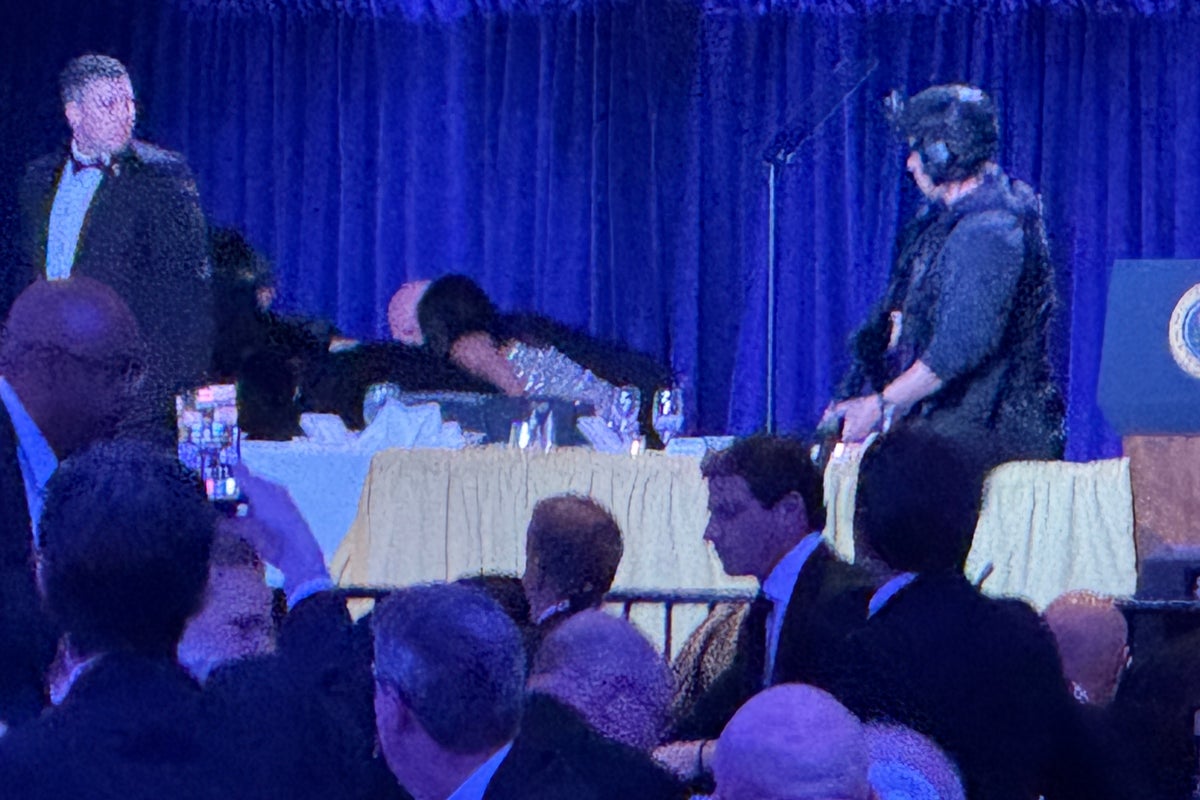
The transition from a high-threat environment to a controlled public forum creates a psychological friction point where established security protocols often collide with the performative requirements of political leadership. At the 2026 White House Correspondents’ Dinner, the delayed physical response of President Donald Trump during a security disruption exposed a fundamental gap between protective doctrine and the human "OODA" loop (Observe, Orient, Decide, Act). Analyzing this delay requires a breakdown of ballistic physics, sensory saturation, and the failure of ingrained muscle memory in the face of immediate kinetic risk.
The Biomechanics of Defensive Lag
The effectiveness of a protective detail is measured in milliseconds. When a threat manifests, the objective is the immediate minimization of the protectee's surface area. Trump’s admission that he remained upright longer than protocol dictates highlights a failure in the Decide phase of the OODA loop. Several biological and environmental variables dictated this latency:
- Auditory Masking and Localization: In a cavernous ballroom filled with overlapping sound signatures—clinking glassware, HVAC systems, and a high volume of human speech—the brain requires more time to isolate a sudden percussive sound (a shot or a simulated threat) from ambient noise.
- The Startle Response vs. Tactical Action: The human startle response is involuntary, often resulting in a brief freeze or a search for visual confirmation. Tactical training is designed to bypass this by replacing the search for "Why is this happening?" with the immediate action of "Get down."
- Physical Inertia: At age 79, the transition from a seated or standing stationary position to a prone position involves significant musculoskeletal demand. The kinetic chain required to drop 240+ pounds to the floor is governed by gravity, but the initial muscular release is often slowed by age-related neural degradation.
The Calculus of the Target Profile
In any kinetic engagement, the probability of a successful hit is directly proportional to the size of the target and the duration of exposure. By remaining upright, the former President maintained a maximum target profile.
$P(h) = A \times T \times E$
In this simplified heuristic, $P(h)$ represents the probability of a hit, $A$ is the surface area of the target, $T$ is the time exposed, and $E$ is the efficiency of the threat actor. By failing to "get down faster," the variable $T$ remained elevated, exponentially increasing the risk profile regardless of the Secret Service’s intervention. The "bubble" of protection provided by agents is not a solid wall; it is a dynamic shield that relies on the protectee’s cooperation to close the gaps.
Psychological Anchoring and the Performative Burden
A primary driver of the delay in presidential responses during public events is the Performative Anchor. A political figure is conditioned to project strength, composure, and control. Dropping to the floor is an admission of vulnerability and a loss of the "command presence" that defines their brand.
This creates a cognitive dissonance. While the reptilian brain signals danger, the social brain signals the cost of looking "weak" or "scared" on a global broadcast. Trump’s self-critique suggests an awareness of this dissonance after the fact—a realization that the instinct to maintain the image of the "unshakable leader" nearly overrode the instinct for survival. This is a recurring failure in high-profile protection where the client becomes a liability to their own safety by prioritizing optics over physics.
Coordination Failures in the Protective Circle
The Secret Service uses a "Cover and Evacuate" methodology. The immediate goal is to form a human shield (Cover) and move the protectee to a secure location (Evacuate). However, this system assumes a compliant or passive protectee.
When a protectee resists the downward force of an agent or hesitates, they create a "lever effect." The agent must use more physical force to bring the protectee down, which can lead to:
- Balance Instability: Both the agent and the protectee become unstable, slowing the evacuation.
- Exposure Gaps: As the agent struggles to manipulate the protectee's mass, gaps open in the 360-degree coverage.
- Tactical Tunnel Vision: Agents may focus too heavily on moving the uncooperative client, losing situational awareness of secondary threats.
The delay at the White House Correspondents’ Dinner was not merely a personal failure of the former President but a systemic failure to synchronize the client’s movements with the detail's rhythm.
Sensory Saturation and Command Clarity
During a crisis, the prefrontal cortex—the part of the brain responsible for logical decision-making—often shuts down in favor of the amygdala. For a protectee who is used to being the "commander" in every room, the sudden shift to being a "package" that must be moved without question is jarring.
The environment of a gala dinner is the antithesis of a tactical environment. The presence of strobe lights from cameras, the tight proximity of unvetted or lightly vetted attendees, and the physical constraints of tables and chairs create a "congested theater." In this theater, verbal commands from the Lead Advance Agent can be lost. If the command "Down!" is not heard or processed instantly, the protectee remains in a state of "Information Search," looking around to understand the source of the commotion instead of reacting to the command.
Infrastructure and the Geometry of Escape
The physical layout of the Washington Hilton ballroom presents specific tactical bottlenecks. The stage is elevated, making the protectee a "silhouette" against the background.
- Vertical Exposure: An elevated target is visible from more angles, including those that may bypass floor-level ballistic shields.
- Limited Exits: The route from the podium to the secure holding room or the motorcade is often a single, narrow path.
The failure to get down faster in this specific geometry means the protectee spent more time in the "Kill Zone"—the area where a shooter has a clear line of sight before the protectee reaches the "Hard Room" or a ballistic shadow.
The Myth of the Controlled Environment
The admission of late reaction serves as a reminder that there is no such thing as a "100% secure" event. The Secret Service operates on the principle of Defense in Depth, but the final layer of that depth is the individual.
The transition from the "Peaceful" state to the "Combat" state is the most dangerous moment in executive protection. Most protectees spend 99% of their time in the Peaceful state, leading to a decay in tactical readiness. Trump’s reflection on his slow response indicates a recognition that his personal "Readiness Level" had dropped, likely due to the perceived safety of the event and the familiarity of the setting.
Quantitative Analysis of the Protective Window
If we analyze the timeline of a typical ballistic event:
- T+0.00s: First shot fired.
- T+0.15s: Sound reaches the detail.
- T+0.40s: Initial agent reaction (Cover).
- T+0.80s: Protectee begins downward movement.
- T+1.50s: Protectee is fully covered/prone.
Any delay in step 4—the protectee’s movement—cascades through the rest of the timeline. A 0.5-second delay in "getting down" represents a 33% increase in total exposure time. In a high-cadence firing scenario, that 0.5 seconds can be the difference between a near-miss and a fatal engagement.
Future Mitigation Strategies for High-Value Targets
To address the latency issues identified in the White House Correspondents’ Dinner incident, protective details must shift from "passive compliance" models to "forced compliance" maneuvers.
- Aggressive Physical Redirection: Agents must be trained to use overwhelming physical force to ground a protectee immediately, regardless of the protectee’s stature or resistance. The "request" to get down must be replaced by the "requirement" of being brought down.
- Haptic Signaling Devices: Utilizing wearable tech that provides a high-intensity vibration or mild electric pulse to the protectee’s skin can bypass auditory masking, signaling an immediate "Drop" command through a dedicated sensory channel.
- Psychological Priming: Protectees must undergo regular "cold-start" drills where they are forced to react to simulated threats in non-tactical settings (offices, dinners, cars) to maintain the neural pathways required for immediate physical response.
The realization that one "should have gotten down faster" is an autopsy of a near-disaster. In the high-stakes environment of global politics, the physics of the bullet will always outpace the ego of the target. Survival depends on the brutal realization that in the second of impact, the President is not a leader, but a target that must be moved, masked, and miniaturized with clinical precision.
The strategic imperative for any high-threat individual is the total subversion of personal autonomy to the protective protocol. The moment a threat is perceived, the hierarchy of command flips: the youngest agent on the detail becomes the commander, and the most powerful person in the world becomes a cargo to be secured. Failure to accept this inversion is the primary cause of defensive latency.