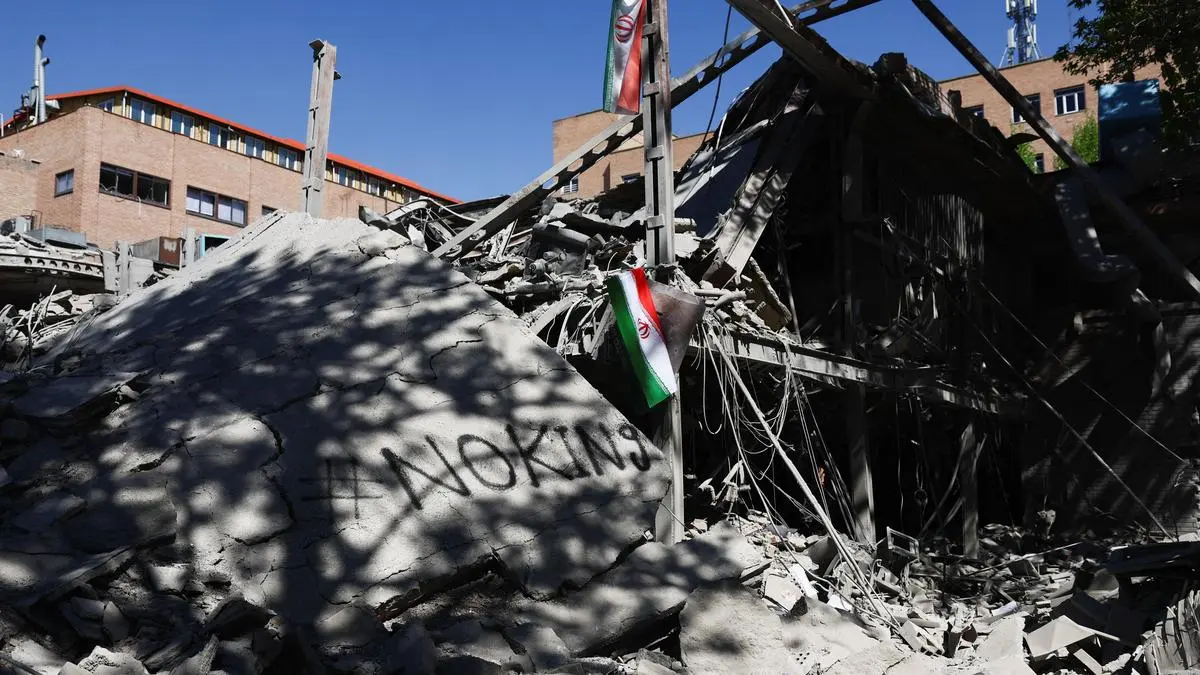
The mobilization of "human chains" around Iranian electrical and nuclear infrastructure is not a spontaneous act of civil defense but a calculated deployment of asymmetric signaling. By placing non-combatant populations in the direct line of kinetic kinetic action, the Iranian state seeks to alter the Targeting Cost Function for United States and Israeli planners. This strategy relies on the assumption that Western liberal democracies operate under a strict "Proportionality Constraint," where the political and legal cost of civilian casualties outweighs the strategic gain of neutralizing a power grid or an enrichment facility.
The Triad of Infrastructure Vulnerability
To understand why power plants have become the focal point of this standoff, one must deconstruct the Iranian energy sector into three operational layers. Each layer presents a different set of risks and rewards for a potential aggressor, and each is being "shielded" through different psychological and physical mechanisms.
1. The Generation Layer (Hard Assets)
Thermal and hydroelectric plants are fixed, high-value targets. From a military perspective, these are "soft" targets compared to deeply buried nuclear facilities like Fordow. However, the destruction of a primary generation node does more than dim the lights; it collapses the Industrial Interdependency Loop. Without consistent 50Hz frequency stability, water desalination plants fail, hospital oxygen concentrators seize, and the digital economy halts. The human chain here serves as a "Moral Fuse"—an attempt to make the technical act of dropping a precision-guided munition socially and diplomatically untenable.
2. The Distribution Grid (Systemic Fragility)
The Iranian grid is a complex, interconnected system that suffers from chronic underinvestment. Strategic analysis suggests that an attacker does not need to destroy every plant. Instead, they can target "Critical Switching Nodes." Removing these nodes triggers a cascading failure known as a Transient Stability Collapse. By focusing civilian presence at the plants themselves, the Iranian government may be attempting to draw attention away from the more vulnerable, less "photogenic" substations and transmission lines that actually keep the country synchronized.
3. The Nuclear-Energy Nexus
The dual-use nature of Iran's nuclear program creates a unique targeting dilemma. While a gas-fired plant is a standard civilian target, a nuclear site carries the risk of radiological release. The human chains at these locations serve to amplify the Radiological Deterrence Effect. If a strike occurs while thousands of civilians are present, the narrative shift from "preventing proliferation" to "humanitarian catastrophe" is instantaneous.
The Calculus of Human Shielding as Strategic Communication
Human shielding in a modern geopolitical context functions as a form of Information Kinetic Hybridization. The goal is not to stop a missile with a body—which is physically impossible—but to stop the order to fire the missile by manipulating the "Value of Target" vs. "Probability of International Condonation" equation.
The Elasticity of Political Will
Strategy consultants often use the "Escalation Ladder" to map conflict. Iran’s call for human chains is an attempt to jump several rungs at once. They are betting on the Asymmetry of Accountability. A state actor like the United States is bound by the Geneva Conventions and domestic oversight; a non-state actor or a revolutionary government can often absorb higher levels of internal trauma if it serves a survivalist narrative.
The Cost of False Positives
For the Trump administration or any subsequent leadership, the deadline creates a binary choice. However, the presence of human chains introduces a "Noisy Signal." Intelligence assets must now determine if the people in these chains are truly non-combatants, coerced government employees, or "Plainclothes IRGC" (Islamic Revolutionary Guard Corps) operatives. This ambiguity increases the Decision Latency—the time it takes to clear a target for strike—which can be the difference between a successful mission and a missed window of opportunity.
Technical Constraints of Grid Defense
While the human element provides a psychological layer of defense, the physical reality of Iran's power sector remains its greatest liability. The state's call for civilian protection highlights a profound lack of Cyber-Physical Redundancy.
- SCADA Vulnerabilities: Much of Iran's industrial control hardware is aging or acquired through secondary markets to bypass sanctions. This creates a "Patchwork Perimeter" where software vulnerabilities are often more dangerous than physical bombs. A cyber-attack on a power plant’s turbine control system can cause catastrophic physical failure without a single civilian in the chain even knowing an attack has occurred.
- The Fuel Supply Chain: Power plants require a constant flow of natural gas or fuel oil. These pipelines are thousands of kilometers long and impossible to shield with human chains. An effective blockade or targeted pipeline disruption achieves the same result as destroying the plant, rendering the human shields irrelevant to the actual operational outcome.
The Strategic Recommendation for Western Policy
Approaching the "Deadline" requires moving beyond the binary of "Strike vs. Sanction." The presence of human chains necessitates a shift toward Sub-Kinetic Neutralization.
If the objective is to degrade Iranian industrial capacity to force a diplomatic concession, the focus must move from the "Generation Nodes" (where the people are) to the "Functional Enablers." This involves targeting the logistical and financial arteries that allow the power plants to function.
- Precision Economic Decoupling: Instead of broad energy sanctions, focus on the specific supply chains for turbine spare parts and high-voltage transformers. These items have long lead times and are nearly impossible to manufacture domestically under current constraints.
- Frequency Disruption via Cyber-Operations: Disrupting the grid's synchronization from within the SCADA environment bypasses the need for physical proximity, nullifying the human shield strategy entirely.
- Information Counter-Signaling: The Iranian state is spending significant political capital to mobilize these chains. Counter-operations should highlight the "Expendability Doctrine"—the fact that the state is willing to use its own citizens as structural components in a defense grid.
The deadline is not a clock counting down to a single explosion; it is the expiration date of a specific geopolitical equilibrium. As the physical and psychological walls are built around these plants, the true vulnerability remains the internal economic pressure and the inherent fragility of a centralized, aging energy architecture that cannot be protected by hands joined in a circle.