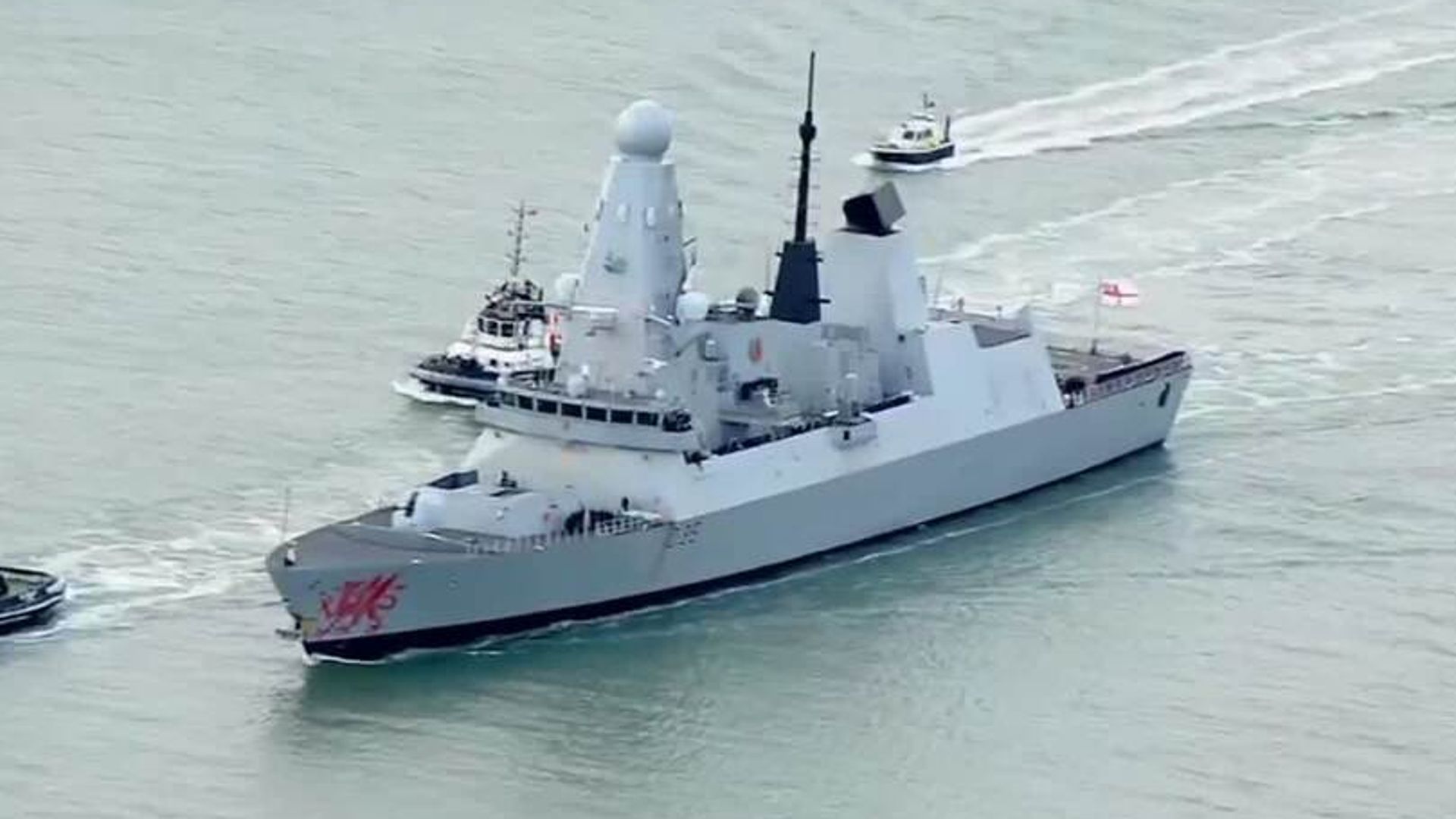
The failure of HMS Dragon’s propulsion system during its deployment to the Gulf of Oman exposes a critical mismatch between the United Kingdom’s strategic ambitions and its available naval readiness. This is not an isolated mechanical failure but a symptom of the "readiness-to-presence" paradox. When a high-value asset like a Type 45 destroyer—specifically designed for integrated air defense in high-threat environments—suffers a technical withdrawal, the resulting security vacuum forces a total reassessment of regional maritime stability. The immediate consequence is a degradation of the United Kingdom's ability to protect merchant shipping against asymmetric threats from Iranian-backed forces.
The Architecture of Type 45 Reliability
To understand the failure of HMS Dragon, one must analyze the Integrated Electric Propulsion (IEP) architecture of the Type 45 fleet. Unlike traditional mechanical drives, the Type 45 utilizes an "all-electric" system where gas turbines and diesel generators provide power to a common bus, which then drives electric motors.
The system relies on two primary power sources:
- Rolls-Royce WR-21 Gas Turbines: These utilize an intercooler-recuperator system designed to improve fuel efficiency by recovering heat from exhaust gases.
- Wärtsilä Diesel Generators: These provide the baseline power for cruising and hotel loads.
The technical bottleneck originates in the WR-21’s intercooler unit. In high-ambient temperature environments, such as the Persian Gulf or the Gulf of Oman, the intercooler system has historically struggled to maintain the necessary temperature gradients. When the intercooler fails, the gas turbines cannot generate sufficient power, leading to a total electrical failure known as a "blackout." While the "Power Improvement Plan" (PIP) was designed to rectify this by replacing the two existing diesel generators with three more powerful units, the rollout across the fleet remains incomplete. HMS Dragon’s withdrawal suggests either a failure in an un-upgraded system or a secondary failure point in the power distribution software that manages the load between the turbines and the motors.
The Strategic Cost of Attrition
The loss of a single Type 45 destroyer is not a linear reduction in force; it is a logarithmic degradation of mission capability. In the context of escalating tensions with Iran, the Type 45 serves as the primary "shield" for the carrier strike group and commercial oil tankers.
The Force Multiplication Deficit
The Sampson radar system on HMS Dragon is capable of tracking over 2,000 targets simultaneously. When this asset is removed from the theater, the remaining naval presence—often consisting of smaller Type 23 or Type 31 frigates—loses its high-altitude, long-range situational awareness. This creates a "detection lag" where subsonic cruise missiles or loitering munitions launched from Iranian coastal batteries have a higher probability of penetrating the defensive perimeter.
The Escort-to-Hull Ratio
The Royal Navy’s surface fleet is currently operating at a precarious escort-to-hull ratio. With only six Type 45 destroyers in existence, the maintenance cycle dictates that:
- One is usually in deep maintenance or refit.
- Two are in training or transit.
- One is held in high-readiness reserve.
- Only two are typically available for forward-deployed operations.
HMS Dragon’s technical issue effectively reduces the UK's global air-defense capability by 50% in the short term. This lack of redundancy means the UK must either rely on US Navy Aegis cruisers to fill the gap—surrendering operational autonomy—or leave commercial corridors under-protected.
Iran and the Asymmetric Incentive Structure
State actors like Iran do not view a technical failure as a neutral event. They view it as a data point in a broader assessment of Western "overstretch." The withdrawal of a Type 45 changes the cost-benefit analysis for the Islamic Revolutionary Guard Corps (IRGC) Navy.
The IRGC utilizes a "Swarm and Strangle" doctrine. This involves using fast inshore attack craft (FIAC) and shore-based anti-ship missiles to overwhelm a vessel's targeting computer. A Type 45 is specifically built to counter this via the Sea Viper (PAAMS) missile system. Without HMS Dragon, the IRGC sees a window of opportunity where the "missile-to-target" ratio shifts in their favor. The technical issue on HMS Dragon acts as a psychological catalyst, signaling that the Royal Navy's presence is fragile and easily disrupted by the environmental conditions of the Middle East.
The Logistics of Forward Repair
The inability to repair HMS Dragon on-station points to a deeper crisis in forward-deployed logistics. In modern naval warfare, the "Mean Time To Repair" (MTTR) is just as critical as the "Mean Time Between Failures" (MTBF).
The complexity of the IEP system means that repairs cannot be handled by standard shipboard engineering teams. It requires:
- Specialized Tooling: Many components of the WR-21 turbine are not modular and require heavy lifting equipment available only in specific deep-water ports like Duqm or Gibraltar.
- Software Calibration: Modern propulsion is code-dependent. A mechanical fix often requires a corresponding update to the Power Management System (PMS), requiring specialized civilian contractors to fly into the theater.
- Supply Chain Latency: The bespoke nature of Type 45 components means that spares are not "off-the-shelf." The lead time for a specialized intercooler or a high-tension transformer can stretch into weeks, during which the vessel is a "sitting duck" or must be towed, further draining regional resources.
Operational Risk Mapping
The failure of HMS Dragon creates a ripple effect across three distinct risk domains.
The Tactical Domain
The immediate threat is the "Air Defense Gap." Without the Sampson radar, the ability to track ballistic missiles increases the risk to the remaining fleet. The remaining vessels must increase their sensor output, making them "electronically loud" and easier for Iranian signals intelligence to track.
The Economic Domain
Insurance premiums for merchant vessels in the Strait of Hormuz are pegged to the perceived level of naval protection. HMS Dragon’s departure signals a reduction in "Safe Transit Assurance." This likely leads to a 5-10% spike in war-risk insurance for tankers, a cost ultimately passed to the global energy market.
The Diplomatic Domain
The UK’s "Global Britain" posture relies on the ability to project power independently. When a flagship asset fails due to known, persistent engineering flaws, it weakens the UK's hand in maritime security coalitions like the Combined Maritime Forces (CMF). Partners begin to question if the UK can fulfill its commitments or if it is a "liability participant" that requires constant support from the US.
The Deterrence Decay Function
Deterrence is a function of capability and will. While the UK’s "will" remains stated, the "capability" is now under scrutiny. The decay of deterrence follows a specific trajectory:
- Observation: The adversary notes the withdrawal of the high-capability asset.
- Testing: The adversary conducts low-level provocations (e.g., drone flybys, bridge-to-bridge harassment) to see how the replacement vessels react.
- Escalation: If the replacement vessels show a slower response time or limited sensor range, the adversary moves to kinetic or semi-kinetic actions (e.g., limpet mine attachment or boarding operations).
The HMS Dragon incident has accelerated the timeline from Observation to Testing. The Iranian Navy is now incentivized to increase its activity to prove that the UK cannot maintain a consistent "shield" over the region.
Structural Recommendations for Maritime Continuity
To mitigate the fallout from HMS Dragon’s technical failure and prevent a recurrence, the following strategic shifts are required.
The Royal Navy must move away from the "high-end/low-count" fleet model. Having six ultra-capable destroyers is useless if three are inoperable. A transition toward a "Distributed Maritime Operations" (DMO) model is necessary. This involves deploying a larger number of smaller, more maintainable autonomous or semi-autonomous sensor platforms that can network into a single Type 45, spreading the sensor risk across multiple hulls.
The Power Improvement Plan must be treated as a national security priority rather than a scheduled maintenance task. The current pace of one ship per year is insufficient for the current geopolitical climate. Accelerating the PIP for the remaining hulls (HMS Daring, HMS Diamond, HMS Duncan) is the only way to restore the fleet's credibility in hot-weather environments.
Forward-operating bases like HMS Jufair in Bahrain must be upgraded from "rest and replenishment" stations to "full-service technical hubs." The reliance on flying parts and personnel from the UK creates a lag that adversaries can exploit. Establishing a permanent, climate-controlled warehouse for Type 45 propulsion components in the Gulf would reduce MTTR by an estimated 60%.
The failure of HMS Dragon is a reminder that in modern conflict, the most dangerous enemy is often the complexity of one's own systems. Until the Type 45 fleet achieves mechanical stability, the UK's strategy in the Middle East will remain reactive, fragile, and dependent on the tolerance of its allies. The immediate move must be a surge of land-based air defense assets to regional partners to compensate for the lost sea-based coverage while the propulsion bottleneck is resolved.



