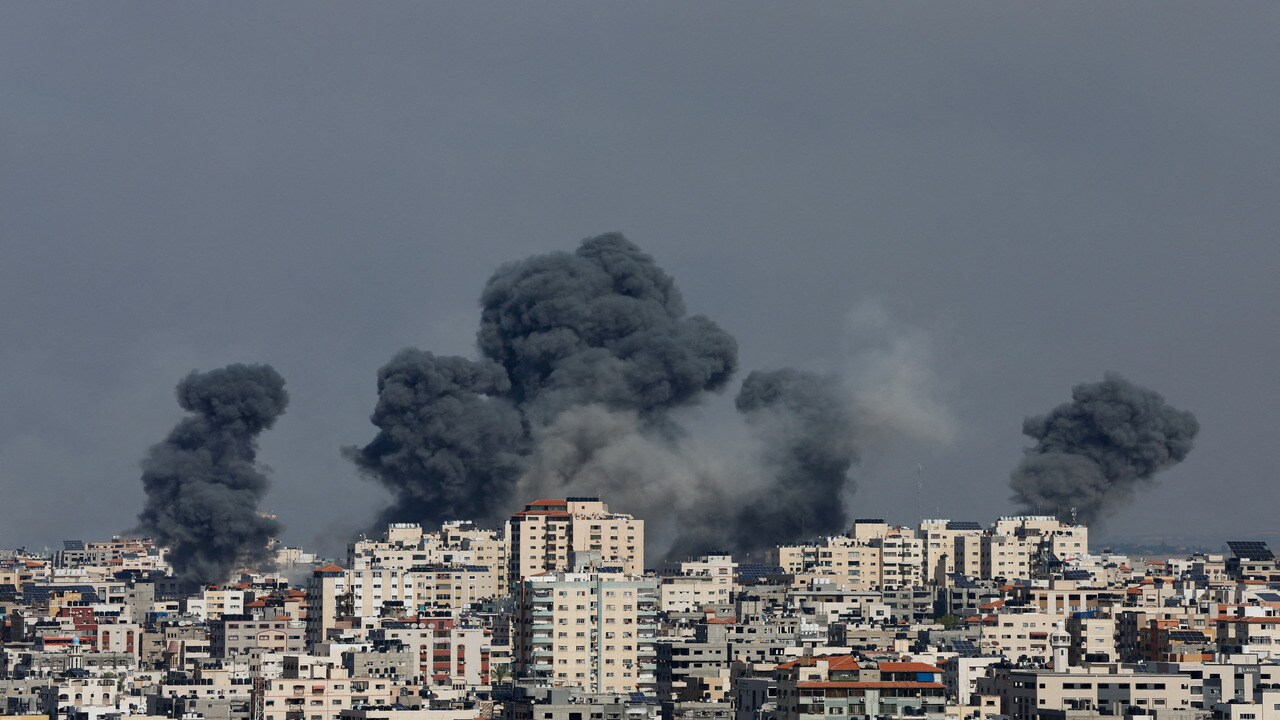
The kinetic engagement of civil-security infrastructure in Gaza represents a deliberate shift from tactical attrition to the systemic degradation of internal governance. When an Israeli strike targets a police checkpoint, the primary objective is rarely the localized removal of six personnel; instead, it is the disruption of the Hamas-led Ministry of Interior’s ability to exercise administrative control over territory. This operation must be analyzed through the lens of institutional collapse, where the elimination of low-level security actors serves as a catalyst for the broader breakdown of civil order, complicating both aid distribution and the survival of the governing status quo.
The Triad of Urban Control Degradation
To understand the impact of targeted strikes on police checkpoints, one must evaluate the three functional pillars these units provide to the local administration.
- Territorial Presence: Checkpoints function as the "nervous system" of urban governance. They facilitate tax collection, movement monitoring, and the physical manifestation of sovereignty. Removing these nodes creates "gray zones" where neither the central authority nor the invading force maintains clear jurisdiction.
- Resource Interdiction Control: In the context of Gaza’s current humanitarian crisis, police checkpoints are the primary mechanisms for managing the flow of goods. Strikes on these sites immediately compromise the security of aid convoys, as the removal of a centralized security escort invites decentralized looting by opportunistic actors or rival clans.
- Intelligence Gathering and Reporting: These outposts serve as forward observation points. Their destruction blinds the local administrative apparatus to localized troop movements and civilian shifts, effectively severing the feedback loop required for urban management.
Kinetic Precision vs. Collateral Governance Failure
The use of precision-guided munitions against static checkpoints indicates a high level of intelligence regarding the shift patterns and command structure of the Palestinian Police Force (PPF). However, the technical success of a strike—defined by the neutralization of the target with minimal peripheral damage—often ignores the resulting "governance vacuum."
From a strategic standpoint, the Israeli Defense Forces (IDF) categorize these units as an extension of the Hamas military wing, citing the dual-use nature of the Ministry of Interior. This categorization removes the legal protections usually afforded to civil police under international law during an occupation. The logic is binary: if the personnel report to a command structure that is integrated with a militant organization, they are legitimate military targets.
This creates a specific bottleneck for humanitarian organizations. When police checkpoints are struck, the risk profile for aid delivery increases exponentially. International NGOs frequently rely on the "de facto" security provided by these units to prevent chaotic distribution. The removal of six officers at a checkpoint is, in operational terms, the removal of the gatekeepers of the "last mile" of logistics.
The Cost Function of Civil Breakdown
The degradation of the police force follows a predictable decay curve.
- Phase 1: Retraction. Following a strike, police units often abandon fixed positions to avoid further targeting, moving into mobile or covert postures.
- Phase 2: Power Fragmentation. As the centralized police force retracts, local neighborhood committees or armed gangs fill the void to protect or exploit resources.
- Phase 3: Institutional Irrelevance. The Ministry of Interior loses the ability to project authority, leading to a state where the civilian population is forced into total self-reliance or dependency on the military occupier.
The strike on the police checkpoint is a catalyst for Phase 2. By targeting the uniformed presence, the IDF forces a choice upon the remaining administrative cadres: continue to operate and risk liquidation, or cease operations and cede the streets to anarchy. Both outcomes serve the military objective of dismantling the Hamas governing model, though the latter creates significant friction for the IDF’s own stated goals of stable aid distribution.
Mechanism of the Strike: Tactical Observations
While specific munition types are rarely disclosed in immediate post-action reports, the casualty patterns in Gaza police strikes suggest the use of small-diameter bombs (SDBs) or drone-launched missiles designed for high-accuracy, low-yield impact. The goal is the destruction of the personnel and the vehicle or kiosk, rather than the leveling of the surrounding block.
This precision confirms that the targets are identified via persistent surveillance (ISR). The timing—often during peak transition hours or during the coordination of convoy movements—suggests that the strikes are intended to maximize the psychological impact on the remaining force. Seeing a checkpoint neutralized in broad daylight informs every other officer in the vicinity that their uniform is now a liability rather than a shield of authority.
Strategic Divergence in Security Definitions
A fundamental gap exists between how the IDF and the local Gazan population define "police."
- The IDF Perspective: The police are a combat-support element. They manage logistics, provide intelligence, and maintain the internal stability required for Hamas's military wing to focus on external defense. Thus, they are combatants.
- The Local/NGO Perspective: The police are the only barrier between a semblance of order and total civil collapse. They are the individuals who direct traffic, mediate family disputes, and guard bakeries.
This divergence means that every strike on a checkpoint is viewed by the IDF as a tactical win (degrading the enemy's support structure) and by the civilian population as a direct attack on their survival infrastructure. This friction point is where the most significant long-term damage occurs, as it erodes the possibility of a "day after" governance plan that relies on any pre-existing local administrative capacity.
The Logistics of Civil Insecurity
The strike on the six personnel at the checkpoint creates an immediate logistical ripple effect.
- Insurance and Risk Premiums: Commercial drivers and aid agencies must reassess the safety of that specific route.
- Secondary Security Deployment: To replace the lost nodes, the Ministry of Interior must draw from its dwindling reserves, often deploying younger, less-experienced personnel who are even more susceptible to tactical errors or panic under fire.
- Intelligence Leakage: Empty or destroyed checkpoints become blind spots that can be exploited by various actors, including insurgent groups or intelligence-gathering units of the opposing force.
This is the "attrition of order." By systematically removing the individuals tasked with maintaining the social contract, the kinetic strategy ensures that the territory becomes ungovernable for any entity other than a full-scale military occupation.
Operational Constraints and the Governance Vacuum
The Israeli strategy appears to prioritize the total removal of the Hamas administrative layer regardless of the immediate chaos produced. This is a high-risk gamble. The historical precedent for removing the local security apparatus—most notably the de-Ba'athification of Iraq in 2003—shows that a governance vacuum is rarely filled by a "moderate" alternative. Instead, it is filled by the most aggressive and least accountable local actors.
The limitation of this strategy is the lack of a "buy-in" mechanism for a replacement force. If the existing police are targeted, any new force seen cooperating with the IDF will be viewed as illegitimate or as a target for the remaining insurgent elements. The strike at the checkpoint, therefore, is not just an act of war; it is a permanent closure of an administrative channel.
Strategic Vector: The Forced Shift to Military Administration
The continued targeting of Gaza's internal security forces indicates an inevitable trajectory toward an IDF-managed civil administration, whether desired or not. By making it impossible for the local police to function, the IDF is systematically removing the buffers between its troops and two million civilians.
The immediate strategic requirement for the IDF is the establishment of a "third-party" security layer—perhaps clan-based or international—to prevent the total descent into warlordism. However, as long as the kinetic targeting of the current police force continues, the risk-reward ratio for any alternative force remains untenable. No local actor will step into a role that carries a high probability of being targeted by the IDF or assassinated by the remnants of the Hamas internal security service.
The strike on the police checkpoint should be viewed as a definitive signal: the dismantling of the Hamas state is being prioritized over the maintenance of civil stability. The resulting friction in aid delivery and civilian safety is not an accidental byproduct but an accepted cost of the mission to terminate the adversary's governing capacity. Success in this theater will not be measured by the number of personnel killed, but by the speed at which a viable, non-Hamas security alternative can be deployed before the territory reaches a state of irreversible social fragmentation.