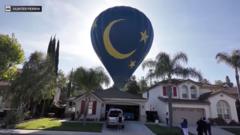
The transition from controlled aerostatic flight to a residential emergency landing represents a total breakdown in the primary flight envelope, forcing a pilot to prioritize immediate terrain clearance over structural or logistical preservation. While mainstream reporting focuses on the visual anomaly of a balloon in a California backyard, the event is actually a case study in the Three Determinants of Aerostatic Displacement: thermal exhaustion, localized meteorological shifts, and the hard constraints of urban encroachment.
Understanding these events requires moving past the narrative of "accidents" and toward a model of kinetic risk management. In a hot air balloon, the pilot does not possess directional thrust; they manipulate altitude to find differentiated wind layers. When those layers fail to provide a vector toward a designated landing zone (LZ) and fuel reserves hit the "VFR Reserve" threshold, the pilot must execute a forced landing. This is not a failure of the aircraft, but a calculated exhaustion of options within a shrinking spatial window.
The Physics of Displacement and Thermal Inertia
A hot air balloon operates on the principle of buoyancy defined by Archimedes' Principle, where the upward force is equal to the weight of the displaced air. The internal temperature of the envelope must be maintained significantly higher than the ambient air to create the density differential required for lift.
The primary failure mode in residential landings is often the Envelope Cooling Gradient. If a pilot encounters a downdraft or a "dead" wind layer near the surface, they must burn more propane to maintain level flight. This accelerated fuel consumption shortens the temporal window for finding a suitable landing spot. In the California context, coastal microclimates often introduce sudden marine layers or temperature inversions that compress the usable airspace.
The Fuel-to-Surface Correlation
- Burn Rate Escalation: Maintaining $100^{\circ}C$ inside the envelope becomes exponentially more fuel-intensive as ambient temperatures drop or as the pilot attempts to clear obstacles like power lines.
- The Point of No Return: Once the liquid propane reaches 10% of tank capacity, the pilot loses the ability to perform a sustained climb. At this juncture, any open space—including a residential backyard—becomes a viable LZ.
- Descent Rates: A controlled emergency landing typically targets a descent rate of less than 2 meters per second. Exceeding this rate increases the risk of basket "tip-over" or structural impact with fences and trees.
Navigational Constraints in High-Density Residential Zones
The geography of California—specifically regions like Temecula or Napa—presents a high-risk interface between recreational flight paths and rapid suburban expansion. This creates a Topological Mismatch. Where there were once open fields (Primary LZs), there are now high-density housing tracts.
Categorizing the Landing Environment
Modern ballooning strategy categorizes terrain into three risk tiers:
- Tier 1: Unrestricted Open Space: Farmland or parks where the ground crew can easily access the balloon.
- Tier 2: Restricted Infrastructure: Roads or schoolyards. These provide safety but involve high logistical friction (police intervention, traffic blockage).
- Tier 3: Confined Backyard LZs: These are the "basement" of flight safety. They are chosen when the pilot identifies an imminent threat, such as an approaching high-voltage power line or a total loss of lift.
The specific incident of a balloon landing in a backyard is a high-stakes trade-off. The pilot chooses property damage (fences, landscaping) over life-safety risks (electrocution, road traffic collisions). It is a binary decision-making process: Is the current sink rate survivable without a cleared path? If the answer is no, the nearest flat surface is the only variable that matters.
The Pilot Decision Matrix: The OODA Loop Under Pressure
A pilot’s ability to manage an emergency landing is governed by the OODA loop (Observe, Orient, Decide, Act). In the seconds leading up to a backyard landing, the orientation phase is dominated by the Obstacle Clearance Envelope.
Obstacle Identification and Avoidance
Power lines are the single greatest threat to aerostatic flight. The envelope is made of ripstop nylon, which is flammable, and the basket is suspended by stainless steel cables that act as perfect conductors. When a pilot realizes they cannot clear a line, they must "dump air" via the parachute valve to force the balloon down short of the wires. This deliberate crash-landing is a proactive safety maneuver, not a loss of control.
This creates a Logistical Ripple Effect:
- Utility Disruption: Even if the balloon does not hit the lines, proximity may require local utilities to kill power for safe extraction.
- Structural Load: A standard 90,000 cubic-foot balloon can weigh over 2.5 tons including the air mass inside. Landing this mass in a residential area introduces significant kinetic energy, even at low speeds.
- Civil Liability: The intersection of FAA regulations and local trespassing laws creates a complex legal environment for the operator.
Meteorological Interference and the "False Calm"
A frequent contributor to these emergency landings is the Surface Wind Shear. A pilot may have 10 knots of wind at 500 feet (ideal for steering), but near the surface, the wind may drop to zero or shift 180 degrees due to "drainage winds" coming off hills. This leaves the balloon becalmed over a residential area.
Without horizontal movement, the pilot is trapped in a vertical cylinder. If they cannot climb back into a wind layer due to fuel constraints or airspace restrictions, they are forced to descend precisely where they are. In the reported California incident, the presence of localized air pockets likely neutralized the pilot's planned trajectory, leaving the backyard as the only remaining viable surface.
Evaluation of the "Emergency" Label
The term "emergency landing" is often a misnomer in aviation that requires refinement. In the context of the California event, it is more accurately described as a Precautionary Landing in Unsuitable Terrain.
- Mechanical Failure: Rare. Most modern burners are dual-redundant.
- Environmental Compulsion: Common. The weather simply stops cooperating with the flight plan.
- Human Error: Usually related to fuel management or late-stage decision-making regarding the shift from "searching for a landing" to "executing a landing."
When the balloon settled in the backyard, the structural integrity of the basket and the envelope remained the primary focus. If the pilot successfully kept the balloon upright and the burner away from flammable structures, the maneuver is technically a success of airmanship, despite the optics of a massive nylon structure draping over a suburban fence.
The Regulatory Gap in Urban Aerostatics
The FAA treats hot air balloons as aircraft, but they occupy a unique regulatory grey area regarding landing rights. Under federal law, an aircraft in distress has the right to land anywhere. However, the definition of "distress" is subjective.
The proliferation of these incidents suggests a growing Spatial Conflict. As cities expand into traditional flight corridors, the probability of a "backyard event" increases linearly. This necessitates a shift in pilot training to focus on "Micro-LZ Acquisition"—learning to flare the balloon within the confines of a 20-meter by 20-meter space.
Operational Takeaways for Commercial Operators
Operators must move from a "reactive" safety posture to a "predictive" model that accounts for urban density. The following variables must be integrated into the pre-flight risk assessment:
- Fuel Reserve Buffer: Increasing the mandatory reserve from 30 minutes to 45 minutes in regions with high residential density.
- LZ Redundancy: Identifying at least three Tier 1 or Tier 2 landing zones within every 5-mile segment of the projected flight path.
- Real-Time Micro-Met: Utilizing localized weather sensors rather than relying on regional airport data, which often misses the surface-level shifts that cause becalming.
The backyard landing in California is a symptom of a shrinking operational environment. Future commercial viability in the region depends on the pilot’s ability to recognize the Termination of Flight Window long before the backyard becomes the only option. The strategic play is not to master the backyard landing, but to treat the approach of a residential boundary as a hard "must-land" trigger for the nearest available open space, regardless of the flight's scheduled duration.
Operators must prioritize the "Early Land" protocol over the "Maximum Duration" customer experience. This reduces the frequency of high-visibility, high-liability incidents that invite regulatory scrutiny and local opposition.