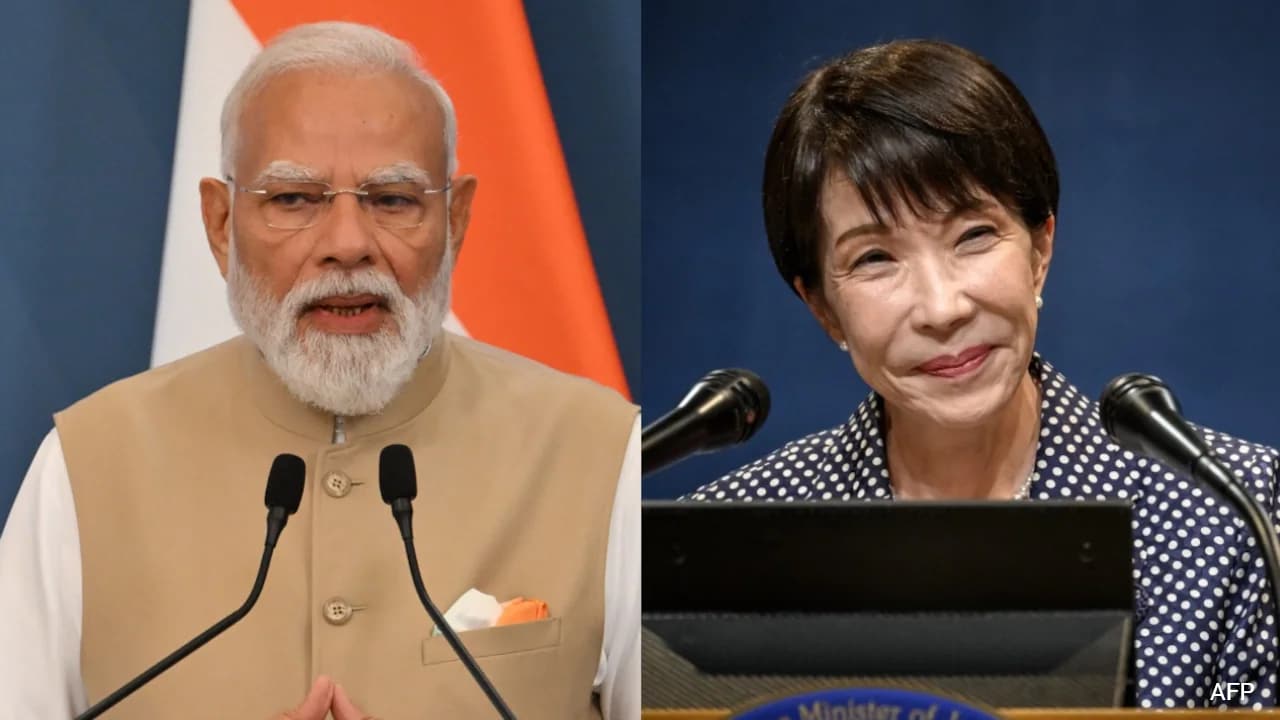
The bilateral summit between Japanese Prime Minister Sanae Takaichi and Indian Prime Minister Narendra Modi in New Delhi establishes a highly structured, operational blueprint for middle-power economic resilience. It moves beyond the historical, primarily maritime focus of the Free and Open Indo-Pacific (FOIP) vision, shifting instead to a codified defense against economic coercion, supply-chain vulnerabilities, and technological asymmetry. The core strategic objective is the institutionalization of a dual-nation framework capable of mitigating systemic risks across three critical domains: advanced computing architecture, critical mineral and energy security, and defense industrial capacity.
The structural reality underpinning this alignment is a profound complementarity of factor endowments. Japan possesses high-value downstream intellectual property, deep capital reserves, and advanced precision-manufacturing capabilities, yet suffers from acute structural bottlenecks: a shrinking demographic base, a near-total dependence on imported primary energy, and severe vulnerabilities to localized geopolitical flashpoints. India offers a massive, highly skilled labor force, an expansive domestic market, growing infrastructure capacity, and a unique position of strategic autonomy. By organizing these complementary variables into a formal, reciprocal framework, both nations aim to decrease their structural dependence on unilateral supply hubs and resist external economic coercion.
The Strategic Architecture of the AI and Advanced Computing Framework
The centerpiece of the summit—the Japan-India Artificial Intelligence Cooperation Initiative—is built on a deliberate departure from generalized consumer software development. The initiative targets vertical artificial intelligence solutions tailored specifically for industrial manufacturing, healthcare delivery, and mobility optimization.
The division of labor within this advanced computing framework follows a precise input-output model:
- Algorithmic and Foundational LLM Development: India provides the data-engineering engineering talent required to build, clean, and optimize large language models (LLMs). This includes specialized training protocols for domain-specific and multi-language architectures capable of operating across heterogeneous industrial environments.
- Hardware and Architectural Infrastructure: Japan provides the foundational capital and supply-chain access to advanced semiconductor lithography and memory technologies. The framework couples Indian software design with Japanese hardware pipelines, establishing an independent digital pipeline outside the dominant United States-China duopoly.
- Human Capital Mobility Vectors: To address Japan's severe deficit in advanced technology professionals, the agreement codifies a structured migration pipeline aiming to transition 500 highly skilled Indian IT professionals to Japanese enterprise environments by 2030. This mechanism directly injects technical labor into Japanese firms while granting Indian engineers direct exposure to advanced hardware optimization systems.
This digital corridor relies on an explicit feedback loop. The deployment of domain-specific AI in Japanese manufacturing plants generates operational data. This data is then used by Indian engineering teams to further refine the underlying models, increasing efficiency across both industrial bases.
The Tri-Sector Supply Chain De-Risking Matrix
The joint declaration on economic security introduces explicit mechanisms to insulate critical supply networks from unilateral disruptions and weaponized economic pressure. The framework isolates three distinct bottlenecks: semiconductors, critical minerals, and pharmaceuticals.
1. Semiconductor Manufacturing and Design Diversification
The global semiconductor value chain is highly vulnerable to geographic concentration risks. The India-Japan strategy approaches this problem by separating the manufacturing stack into capital-intensive fabrication and design-intensive implementation. Japan’s planned 10 trillion yen private-sector investment over the next decade serves as the primary capital mechanism to fund semiconductor assembly, testing, and packaging facilities within India. The objective is to create a parallel manufacturing hub that utilizes Japanese manufacturing equipment and chemical inputs while leveraging Indian land, labor, and domestic demand.
2. Critical Mineral Exploration and Extraction Protocols
Advanced technology and clean energy systems depend entirely on secure access to rare earth elements and critical minerals. The framework deploys the state-run Japan Organization for Metals and Energy Security (JOGMEC) to co-fund and co-develop upstream mining and processing infrastructure in India and select African corridors.
The economic model is designed to bypass concentrated global processing hubs by pairing Japanese extraction technology with Indian mining access, ensuring a predictable flow of raw inputs for both nations' electronics and automotive sectors.
3. Pharmaceutical Supply Continuity
The COVID-19 pandemic and subsequent geopolitical frictions highlighted the extreme vulnerability of global Active Pharmaceutical Ingredients (APIs) supply chains. The bilateral agreement establishes a mutual recognition framework for pharmaceutical standards and a joint investment pool to diversify API manufacturing. This structure ensures that Indian generic drug manufacturing centers have a continuous, non-coerced supply of chemical precursors, while Japan secures a highly resilient secondary sourcing line for critical medical goods.
Energy Resilience Mechanics and De-Carbonization Metrics
A primary vulnerability for both nations is their exposure to maritime chokepoints, particularly the Strait of Hormuz and the Malacca Strait, which handle the vast majority of their fossil fuel imports. The summit addresses this systemic vulnerability through the formal integration of Japan's Partnership on Wide Energy and Resources Resilience Asia (POWERR Asia) framework with India’s long-term energy diversification plans.
Rather than relying on spot-market purchases during periods of geopolitical instability, the strategy introduces an institutionalized Liquefied Natural Gas (LNG) security pact. The operational components of this pact include:
[Global Energy Shock] ──> [Strategic Shock Mitigation Protocol]
                                │
         ┌──────────────────────┴──────────────────────┐
         ▼                                             ▼
[Joint LNG Stockpiling & Reserves]           [Real-Time Market Intelligence]
         │                                             │
         └──────────────────────┬──────────────────────┘
                                ▼
         [Coordinated Secondary Contingency Sourcing]
- Joint Stockpiling Infrastructure: The creation of shared or coordinated emergency LNG reserves, allowing either nation to draw upon contracted volumes during acute supply disruptions.
- Information Interlock Mechanisms: Real-time sharing of market intelligence and carrier tracking to optimize shipping routes and prevent competitive bidding wars between Tokyo and New Delhi during supply crunches.
- Alternative Source Development: Large-scale investments in non-fossil energy vectors inside India, specifically highlighted by a green ammonia and utility-scale biogas production project in Odisha. This project converts localized industrial and agricultural waste into exportable, zero-carbon chemical vectors, directly reducing long-term dependence on Middle Eastern hydrocarbons.
The Rupee-Yen Settlement Framework and Macroeconomic Insulation
To protect bilateral commerce from weaponized financial systems and the volatility of the global clearing currencies, the summit advances a Rupee-Yen bilateral settlement framework. This financial mechanism allows for the direct clearing of trade invoices without intermediate conversion into the United States Dollar.
The economic logic of this direct clearing system reduces transactional friction by eliminating double-conversion costs. It provides structural protection against external monetary shocks, such as sudden shifts in US Federal Reserve interest rate policies. Furthermore, it creates a closed-loop liquidity pool where Japanese capital investments in India can be serviced and repatriated using local currency denominations, significantly lowering currency risk for long-horizon infrastructure projects like the Mumbai-Ahmedabad bullet train.
Defense Equipment Co-Development and Industrial Interoperability
The defense dimension of the summit transitions away from standard joint naval exercises toward deep industrial and technological integration. This shift is enabled by the Takaichi administration’s policy change loosening domestic restrictions on the export of defense equipment and technology. India is one of only 17 nations with a formal Equipment and Technology Transfer Agreement with Tokyo, putting it in a unique position to benefit from this policy shift.
The primary operational test case for this integration is the "Unicorn" project, which focuses on transferring advanced unified complex radio antenna technology to the Indian Navy. The strategic importance of the Unicorn project lies in its structural delivery model:
- Co-Production Protocols: The agreement avoids simple off-the-shelf procurement. It requires the physical transfer of manufacturing blueprints and specialized assembly techniques to Indian defense public sector undertakings.
- Maintenance, Repair, and Overhaul (MRO) Access: The summit formalizes negotiations allowing the Japanese Self-Defense Forces to utilize Indian naval facilities for comprehensive MRO services. This creates a critical logistical node for Japanese assets in the Indian Ocean, significantly increasing their operational durability without requiring a permanent base footprint.
- Dual-Use Technical Synergy: By integrating Japanese radar and electronics expertise with Indian naval architecture, the project builds a base layer of technological interoperability. This foundation can be applied to future joint projects in unmanned surface and underwater vehicles.
Strategic Pitfalls and Structural Constraints
An objective analysis of the India-Japan Special Strategic and Global Partnership reveals several structural frictions that could slow down implementation. These limitations must be managed carefully if the framework is to meet its objectives.
The first major bottleneck is bureaucratic misalignment. Japan’s decision-making process relies heavily on a consensus-driven approach involving multiple ministries, which often leads to long timelines. In contrast, India's regulatory environment can be unpredictable, characterized by sudden policy shifts, complex tax structures, and localized land-acquisition delays. These factors can create friction for large-scale private capital deployments, such as the 10 trillion yen investment target.
The second limitation involves the reality of asymmetric trade flows. While the strategic alignment is strong, actual bilateral trade volume remains modest compared to each nation's trade with China. The risk is that economic security measures could inadvertently increase transactional costs for private enterprises, creating tension between state-directed security goals and private-sector profitability.
Finally, the divergent geopolitical priorities of the two nations require careful navigation. Japan is tightly bound to the US security umbrella and emphasizes maintaining the existing international legal order. India, guided by its foundational principle of strategic autonomy, avoids formal alliances and maintains independent relationships with non-Western powers, including Russia. This divergence means the partnership will remain focused on practical, issue-based cooperation rather than a binding mutual security pact.
Tactical Execution Roadmap
To achieve the strategic objectives outlined in the summit, execution must focus on verifiable, measurable benchmarks rather than high-level diplomatic statements.
The immediate next step requires the formal establishment of the joint task force on LNG stockpiling, which must define clear asset-allocation percentages and legal clearance protocols for emergency maritime diversions by the end of the fiscal year.
Concurrently, the India-Japan Artificial Intelligence Cooperation Initiative must launch its first three domain-specific pilot programs in industrial robotics and automotive automation. These pilots will serve as the initial testing ground for model transferability and data-sharing security.
On the capital front, the proposed Rupee-Yen settlement framework should be introduced initially within a ring-fenced pilot program. This program should focus specifically on servicing the procurement contracts for the Unicorn antenna project and the Odisha green ammonia facility. By testing the direct clearing mechanism on these state-backed initiatives, both central banks can refine clearing speeds, assess liquidity depth, and mitigate exchange-rate friction before opening the framework to wider commercial trade. Private-sector investment tracking must also be tied to a publicly accessible joint registry that monitors the conversion of Memoranda of Understanding into active infrastructure projects. This will ensure that the 10 trillion yen target is met with real capacity rather than unexecuted commitments.