Statecraft in the digital era relies as much on pixel management as it does on bilateral treaties. When the official digital channels of a national government distribute a cropped archival asset to alter the apparent spatial hierarchy of a multilateral assembly, the action ceases to be a mere media quirk and becomes a measurable variable of political signaling. The decision by the Pakistani Prime Minister's Office to publish a truncated version of the 26th Shanghai Cooperation Organisation summit group photograph, excising Indian Prime Minister Narendra Modi alongside four other regional figures to center Prime Minister Shehbaz Sharif, provides a clinical case study in digital realpolitik.
Analyzing this occurrence requires moving past online mockery to examine the structural mechanics of image curation in international relations. Governments operate within strict information ecosystems where domestic audiences require narratives of parity, centrality, and regional gravitas. When physical positioning at a multilateral forum—dictated by protocol, alphabetical order, or host-country design—fails to provide the desired visual dominance, digital intervention acts as a low-cost substitute for actual geopolitical leverage.
The Mechanics of Spatial Reconfiguration
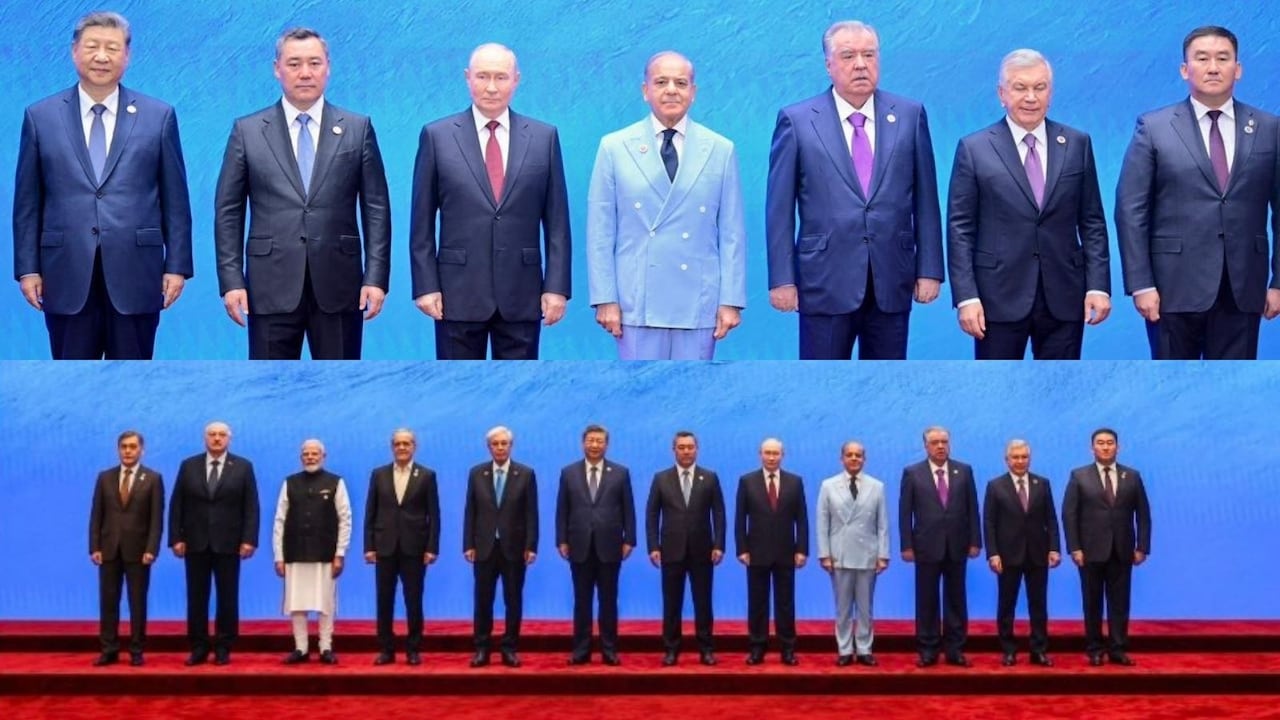
In standard diplomatic photography, spatial proximity and centrality convey weight within a bloc. In the unedited frame captured at Bishkek, Sharif stood fourth from the right, embedded within a wide roster of member states, observers, and institutional secretaries-general. The complete lineup, subsequently broadcast by external actors including the Indian Prime Minister's Office, placed the Pakistani leader well away from the optical focus of the composition.
The edited iteration released by Islamabad's administrative apparatus removed five specific entities from the left flank:
- The Secretary-General of the Shanghai Cooperation Organisation
- The President of Belarus
- The Prime Minister of India
- The President of Iran
- The President of Kazakhstan
By executing this symmetrical excision, the image software effectively shifted the visual median of the frame. Sharif was relocated from the periphery to the exact optical center, flanked by figures such as Chinese President Xi Jinping and Russian President Vladimir Putin. The economic and political cost of this manipulation is negligible in direct capital terms, but the reputational cost involves an immediate loss of analytical credibility once unedited primary sources enter the public domain.
Domestic Audience Costs and External Signals
The strategic utility of such image management targets domestic consumption rather than foreign capitals. State media and digital channels often function as internal morale preservation mechanisms. In environments experiencing severe macroeconomic strain, currency depreciation, and persistent security challenges, administrative leaderships require visual counters to project strength and international integration.
However, this strategy triggers a predictable sequence of operational vulnerabilities:
- Verification Speed: In contemporary media ecosystems, decentralized open-source intelligence and rival state apparatuses monitor and archive primary feeds instantly. The latency between an edited asset publishing and its unedited counterpart appearing online has dropped to minutes.
- Asymmetric Counter-Response: Rivals do not need to issue formal diplomatic demarches to counter such moves; simply publishing the raw capture neutralizes the domestic narrative value and reframes the conversation around insecurity and operational amateurism.
- Signaling Distortion: External partners within the multilateral bloc observe these internal adjustments. When a state alters baseline records of a collective summit, it signals an internal anxiety regarding regional standing, particularly when juxtaposed against substantive policy disagreements occurring inside the plenary sessions.
The Divergence of Narrative Delivery
The timing of the photographic edit coincided with substantial policy friction on the floor of the summit. While digital handlers focused on horizontal centering, policy addresses underscored deep structural fissures. The debate extended beyond visual optics into foundational security frameworks, specifically concerning cross-border networks, regional trade corridors, and resource management mechanisms like the Indus Waters Treaty.
When a delegation's digital output emphasizes aesthetic repositioning while its principal representative addresses systemic economic and security vulnerabilities, a strategic disconnect emerges. Analysts evaluating bilateral stability measure state maturity through alignment between operational reality and public communication.
Strategic Outlook for Multilateral Optics
Digital asset manipulation within state communications creates a permanent audit trail that undermines long-term credibility. Future multilateral engagements will feature intensified verification protocols, rendering rudimentary framing adjustments counterproductive. State information strategies must transition away from cosmetic digital alterations toward substantive diplomatic engagement, where regional centrality is earned through economic output and security cooperation rather than pixel-level geometry.