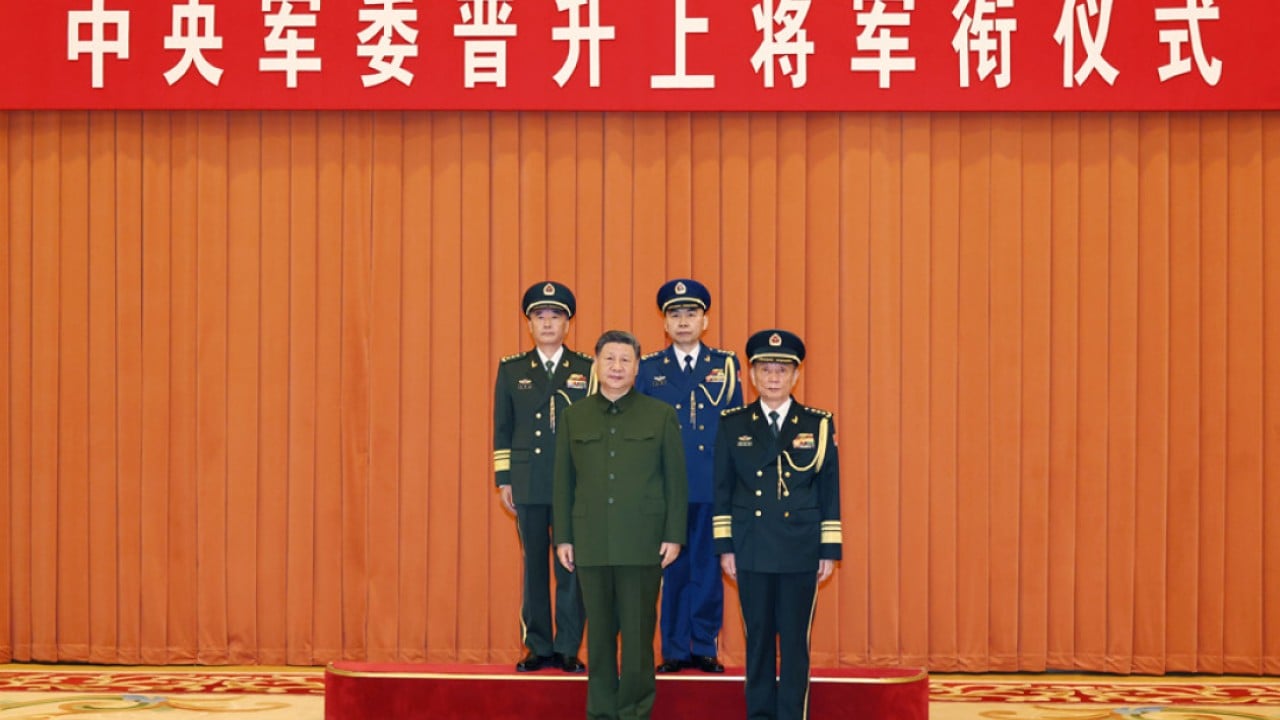
The wholesale structural liquidation of the People’s Liberation Army (PLA) leadership under Chinese President Xi Jinping is not a temporary purge; it is a permanent systemic calibration designed to minimize political variance within the armed forces. Recent actions removing six senior military officers from the National People’s Congress Standing Committee—including General Xu Xueqiang of the Central Military Commission (CMC) Equipment Development Department and senior leaders from the Cyberspace Force and Western Theatre Command—represent an unprecedented reduction of the supreme military command structure. By shrinking the active operational footprint of the CMC to an absolute core consisting almost exclusively of Xi Jinping and anti-graft chief Zhang Shengmin, the Chinese Communist Party (CCP) has structurally redefined the cost function of military careerism.
To analyze this transformation requires looking past the standard media narratives of political vulnerability or personal rivalry. The continuous execution of anti-graft campaigns within the PLA operates as an institutionalized auditing mechanism designed to solve a fundamental principal-agent problem: ensuring that an increasingly complex, technologically advanced military apparatus remains an uncompromised instrument of party will.
The Tri-Deviational Risk Framework
The ongoing purge of high-ranking military cadres cannot be understood through the lens of simple financial malfeasance. The state evaluates military vulnerability across three distinct operational variables, which together form a Tri-Deviational Risk Framework. When an officer accumulates high scores across these variables, institutional elimination becomes certain.
- Strategic Divergence: Disagreements regarding the operational timeline or tactical viability of regional modernizations, particularly concerning the Taiwan Strait and regional contingencies.
- Logistical Corruption: The diversion of capital intended for high-tech military procurement, hardware stress-testing, and structural modernization.
- Factional Consolidation: The formation of informal horizontal networks among theatre commands, which threatens the vertical hierarchy of the central leadership.
                  [ Central Authority / CMC Chairman ]
                                  |
            +---------------------+---------------------+
            |                     |                     |
            v                     v                     v
   Strategic Alignment   Logistical Integrity   Vertical Loyalty
            |                     |                     |
            +---------------------+---------------------+
                                  |
                                  v
                [ Target: Absolute Operational Readiness ]
The removal of General Xu Xueqiang underscores the acute risk present within the logistical variable. As the head of the Equipment Development Department and the commander-in-chief of China's Manned Space Programme, Xu controlled the capital allocation pipelines for the nation's most advanced military and aerospace projects. In highly complex supply chains involving advanced semiconductor acquisition, missile guidance systems, and aerospace engineering, information asymmetry between central civilian overseers and military procurers is maximized. This asymmetry creates systemic rents. By targeting the procurement apparatus, the administration aims to eliminate the gap between reported military readiness and actual combat capacity.
The Cost Function of Institutionalized Auditing
The transition of anti-corruption efforts from periodic campaigns to a normalized feature of military administration alters the risk-reward matrix for the officer corps. The Mainland Affairs Council noted a significant escalation in the removal velocity of high-ranking cadres during the early months of the year, outstripping previous annual averages. This acceleration indicates that the state has internalized the auditing process into the standard operating procedure of military governance.
This normalization introduces a distinct operational trade-off.
The primary benefit is the enforcement of absolute compliance. By demonstrating that even hand-picked appointees from the 2022 National Congress are subject to immediate removal, the central leadership eliminates the concept of political immunity. The perceived probability of detection and subsequent punishment approaches unity for any cadre attempting to build an independent power base or exploit state contracts.
The secondary effect, however, is an increase in institutional friction. A military leadership defined by continuous purges experiences a degradation of horizontal trust. Operational commanders across the five military theatres face structural disincentives to take tactical risks or voice realistic assessments of material limitations. When survival is tied to the absolute absence of perceived deviation, the generation of data within the command chain becomes inherently biased toward toxic optimism.
Operational Continuity and the 2027 Horizon
A critical paradox of this systemic purification is its timing. The intensification of internal investigations occurs as the PLA approaches its 100th anniversary in August 2027—the benchmark deadline for the first major phase of China's military modernization.
External assessments frequently assume that high-level command turnover degrades immediate combat readiness. However, structural indicators suggest an intentional separation between political purging and operational execution. The execution of major joint combat readiness patrols and multi-theatre gray-zone activities around Taiwan has proceeded without measurable deceleration.
The mechanism enabling this insulation is the rigid separation of political commissars from operational staff functions. While political figures like General Li Fengbiao of the Western Theatre Command and General Guo Puxiao of the PLA Air Force have been removed, the structural processes governing low-level tactical units remain intact. The state is betting that the institutionalization of command automation and algorithmic logistics can substitute for the disruption of senior leadership continuity.
The strategy relies on a stark calculation: a slightly disrupted command structure that is entirely loyal is far more effective for the party's ultimate strategic objectives than a highly stable command structure containing hidden nodes of resistance or material inflation. The ultimate metric of success for this structural overhaul will not be the number of targets eliminated, but whether the procurement data reaching the supreme command reflects actual field capabilities before the 2027 strategic deadline.


