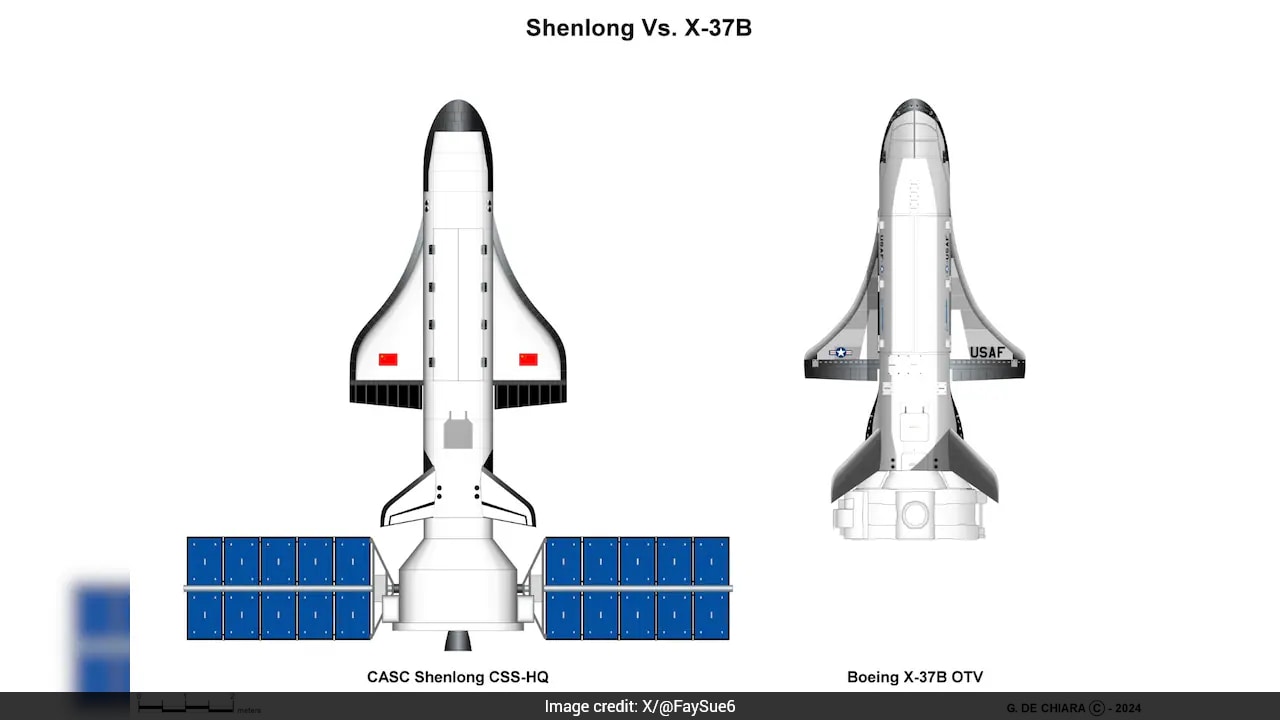
Orbital spaceplanes do not exist to replace disposable heavy-lift rockets; they exist to solve the dual problems of payload recovery and unpredictable inclination changes in low Earth orbit (LEO). Comparing the United States Space Force’s Boeing X-37B Orbital Test Vehicle (OTV) against the People’s Liberation Army Strategic Support Force’s (now Aerospace Force) Shenlong reusable experimental spacecraft requires stripping away speculative press narratives and evaluating both platforms through three hard engineering constraints: thermal protection mass fractions, delta-v budgets for orbital plane changes, and launch-to-turnaround amortization schedules.
Most public analyses treat these vehicles as mysterious orbital weapons platforms. That framing misunderstands orbital mechanics. A spaceplane is an inefficient payload delivery truck compared to a fairing-enclosed satellite bus because wings, landing gear, and thermal protection systems (TPS) consume roughly 25% to 35% of the vehicle's dry mass. To justify that structural penalty, the platform must execute mission profiles that expendable buses cannot perform: returning physical hardware from vacuum to Earth intact, testing volatile sensor packages in high-radiation environments without abandoning them, or executing rapid, unannounced orbital maneuvers that disrupt adversary ground-based tracking networks.
The Physics of the Reusable Spaceplane Value Proposition
To evaluate the operational utility of the X-37B and Shenlong, one must look at the mechanics of orbital station-keeping and reentry. Conventional satellites operate on predictable Keplerian trajectories. Once ground radar networks—such as the U.S. Space Surveillance Network or China’s land- and sea-based telemetry, tracking, and command (TT&C) stations—establish a satellite's two-line element (TLE) set, its future position is mathematically deterministic unless it expends propellant.
Spaceplanes alter this calculus through aerodynamic plane changes and high-impulse onboard propulsion.
- Propulsive Plane Changes: Altering an orbit's inclination ($\Delta i$) in space is notoriously expensive in terms of propellant. The velocity change ($\Delta v$) required is governed by the equation $\Delta v = 2v \sin(\Delta i / 2)$, where $v$ is the orbital velocity (approximately 7.8 km/s in LEO). Even a 5-degree inclination shift demands roughly 680 m/s of $\Delta v$, exhausting the entire maneuvering budget of a standard reconnaissance satellite. Both the X-37B and Shenlong utilize dedicated service modules and hypergolic or advanced storable propellants to carry larger fuel fractions than standard commercial buses, trading payload volume for sustained maneuvering authority.
- Aerodynamic Skip-Glide Maneuvers: Unlike cylindrical satellites, winged lifting bodies can dip into the upper mesosphere and thermosphere (around 80 to 100 km altitude), use aerodynamic lift to bank and alter their orbital inclination, and fire their main engines to circularize back into a new orbital plane. This aero-assisted orbital transfer conserves propellant while creating severe tracking gaps for ground-based sensors that rely on ballistic trajectory predictions.
- Environmental Recovery and Component Iteration: In standard aerospace development, a sensor or solar array failure in orbit requires years of telemetry forensics. Spaceplanes compress the hardware iteration cycle. By housing experimental payloads inside an unpressurized cargo bay and returning them to a runway, engineers can physically inspect radiation degradation, atomic oxygen erosion, and thermal fatigue on materials before committing to billion-dollar constellation architectures.
Architectural Baseline of the US Space Force X-37B
The X-37B program, originally initiated by NASA in 1999 before transferring to DARPA and subsequently the U.S. Air Force and Space Force, represents a mature, long-duration orbital testbed. Two known airframes (OTV-1 and OTV-2) have completed seven missions as of late 2026, progressively extending endurance from 224 days on OTV-1 to 908 days on OTV-6.
The physical architecture of the X-37B dictates its operational limits:
- Dimensions and Mass: Measuring 8.8 meters in length with a 4.6-meter wingspan, the vehicle has a launch mass of approximately 4,990 kg. Its payload bay measures roughly 2.1 meters by 1.2 meters—comparable to the bed of a compact pickup truck. This volume immediately disqualifies the X-37B from deploying large optical reconnaissance mirrors or heavy kinetic interception payloads.
- Thermal Protection and Reentry: Unlike the retired Space Shuttle, which used fragile silica tiles requiring thousands of man-hours for post-flight refurbishment, the X-37B employs Toughened Uni-piece Fibrous Reinforced Oxidation-Resistant Composite (TUFROC) tiles on its leading edges and Advanced Flexible Reusable Surface Insulation (AFRSI) blankets on upper surfaces. This material architecture lowers turnaround costs and enables autonomous, crosswind-capable landings on conventional runways at Vandenberg Space Force Base or the Kennedy Space Center Shuttle Landing Facility.
- Propulsion and Power: Early missions relied on an Aerojet Rocketdyne AR2-3 engine burning hydrogen peroxide and JP-8, alongside hydrazine thrusters. Later configurations integrated deployable gallium arsenide solar arrays and an aft service module (first confirmed on OTV-6) to expand payload capacity and power generation. On OTV-7, launched aboard a SpaceX Falcon Heavy in December 2023, the X-37B demonstrated high-elliptical orbit operations and executed novel aerobraking maneuvers to lower its apogee without expending onboard propellant, proving its utility well beyond standard LEO altitudes.
Structural Capabilities and Observed Behavior of China’s Shenlong
Publicly verified specifications for China’s Shenlong spaceplane remain scarce, requiring analysts to deduce its mass, propulsion, and thermal limits from launch vehicle constraints, orbital tracking data, and post-flight recovery infrastructure.
Shenlong launches vertically inside a modified payload fairing atop a Long March 2F rocket from the Jiuquan Satellite Launch Center. This single fact establishes hard upper bounds on the vehicle's geometry and mass:
- Mass and Dimensional Constraints: The Long March 2F has a maximum payload capacity to LEO of approximately 8,400 to 8,600 kg. Accounting for the structural mass of the payload adapter and the extended fairing (which features a 4.2-meter diameter and expanded blister accommodations), the Shenlong airframe must weigh under 8,000 kg at liftoff, with a wingspan constrained to roughly 4.2 to 4.5 meters unless it utilizes folding wing surfaces. In physical scale, Shenlong is nearly identical to the X-37B.
- Flight Cadence and Endurance: China has accelerated its flight testing cadence significantly since the platform's first orbital mission in September 2020 (which lasted two days). The second mission, launched in August 2022, remained in orbit for 276 days. The third mission, launched in December 2023—just two weeks before the X-37B's OTV-7 launch—operated for 268 days before landing at the Lop Nur test facility in Xinjiang, which features a 5-kilometer-long paved runway built specifically for high-speed autonomous aerospace recovery.
- Rendezvous and Proximity Operations (RPO): Where the X-37B primarily emphasizes long-duration material and power-beaming tests (such as the Naval Research Laboratory's Photovoltaic Radio-frequency Antenna Module), publicly tracked orbital telemetry indicates Shenlong heavily prioritizes RPO and sub-satellite deployment. During both its second and third missions, Western space-tracking firms and the U.S. Space Force cataloged multiple objects ejected from Shenlong. These sub-satellites demonstrated independent maneuvering, station-keeping within meters of the mother craft, and repeated recapture maneuvers.
Comparative Matrix of Operational Divergence
While external dimensions make the X-37B and Shenlong appear as engineering twins, their observed mission profiles reveal distinct doctrinal priorities.
1. Endurance vs. Dynamic Inspection
The X-37B optimizes for multi-year persistence. Keeping a vehicle in orbit for over 900 days tests component reliability, long-term propellant storage stability, and continuous sensor calibration against background space radiation. Shenlong’s 270-day mission profile suggests an optimization for medium-duration tactical deployments: launching rapidly in response to a geopolitical crisis, conducting close-approach inspections or electronic intelligence gathering on adversary satellites, and returning to base within nine months.
2. Sub-Satellite Deployment Architectures
Publicly documented X-37B missions have occasionally deployed small CubeSats (such as FalconSat-8 on OTV-6), primarily as secondary educational or experimental payloads. In contrast, Shenlong’s repeated deployment, co-orbital formation flying, and recapture of maneuvering sub-satellites point toward an operational doctrine centered on co-orbital inspection, signal interception, or potential grappling/servicing mechanisms. By ejecting a smaller, low-observable inspector craft, the main spaceplane can remain at a safe standoff distance while the sub-satellite closes in on a target spacecraft.
3. Launch Infrastructure and Responsiveness
The X-37B is booster-agnostic by design, having flown on the United Launch Alliance Atlas V, the SpaceX Falcon 9, and the SpaceX Falcon Heavy. This interoperability eliminates single-point-of-failure supply chain bottlenecks and allows the Space Force to select boosters based on target orbital altitude—using Falcon 9 for standard LEO and Falcon Heavy for high-apogee elliptical orbits. Shenlong remains tethered to the Long March 2F, a human-rated, hypergolic-fueled booster manufactured in limited quantities for China’s Tiangong space station crew rotations. Until China transitions Shenlong to a commercial or next-generation kerolox/hydrolox booster like the Long March 12 or a reusable Zhuque-3 variant, its launch cadence will remain constrained by Long March 2F production bottlenecks.
The Cost Function of Reusability vs Expendable Buses
A critical flaw in mainstream defense reporting is the assumption that reusable spaceplanes are inherently cheaper than expendable satellites. In orbital economics, reusability only lowers unit costs if two conditions are met: high flight frequency and low refurbishment overhead.
Consider the amortization equation for an orbital vehicle:
$$\text{Cost per Mission} = \frac{\text{Non-Recurring Engineering} + \text{Airframe Acquisition}}{\text{Total Flights}} + \text{Launch Cost} + \text{Refurbishment Cost}$$
Because the X-37B and Shenlong fly roughly once every one to three years per airframe, the denominator (total flights) grows slowly. A Falcon 9 launch costs approximately $67 million, while a Falcon Heavy launch exceeds $97 million. Adding autonomous range operations, specialized hazardous propellant handling (hydrazine and nitrogen tetroxide require Self-Contained Atmospheric Protective Ensemble suits for ground crews), and post-flight TPS inspection means a single spaceplane mission still costs well over $100 million.
By comparison, proliferated LEO architectures—such as the Space Development Agency’s Proliferated Warfighter Space Architecture or China’s Guowang constellation—mass-produce expendable satellites for $10 million to $15 million per unit. Therefore, spaceplanes cannot compete on cost-per-kilogram of payload delivered. Their economic justification rests entirely on risk reduction and asset preservation. If a spaceplane tests an experimental infrared focal plane array or a space-based solar power transmitter, identifies a design flaw upon recovery, and prevents a $2 billion constellation failure, the program achieves positive return on investment in a single flight.
Analytical Blind Spots and Operational Limitations
Evaluating these platforms accurately requires acknowledging what they cannot do, regardless of classified capabilities:
- No Stealth in Orbit: Neither the X-37B nor Shenlong is invisible. While their small cross-sections and non-ballistic maneuvers complicate continuous tracking, optical telescopes, phased-array radars, and commercial space situational awareness networks (such as LeoLabs and ExoAnalytic Solutions) routinely detect both vehicles within days of launch. Once a spaceplane executes an atmospheric dip or thruster burn, ground sensors lose lock temporarily, but global optical networks inevitably reacquire the object against the starfield during terminator passes.
- Kinetic Weaponization Fallacy: Popular speculation frequently frames both vehicles as orbital bombers capable of dropping tungsten rods or nuclear warheads from space. From a physics and systems engineering standpoint, this is inefficient. De-orbiting a payload from a spaceplane requires heavy retrograde propulsion, heat shielding for the munition, and complex guidance to overcome atmospheric plasma blackout. Intercontinental ballistic missiles (ICBMs) and Fractional Orbital Bombardment Systems (FOBS) deliver equivalent payloads at a fraction of the cost and complexity without requiring wings or runway recovery.
- Payload Mass Bottlenecks: Neither craft can service or capture large geosynchronous (GEO) communications satellites. Reaching GEO (35,786 km altitude) and returning to LEO for atmospheric reentry requires roughly 4,000+ m/s of $\Delta v$—far exceeding the propellant capacity of a 5-to-8-metric-ton winged vehicle. Both platforms are strictly bound to LEO and elliptical orbits whose perigees dip into the upper atmosphere.
Strategic Trajectory for Orbital Spaceplane Operations
As proliferated satellite constellations saturate low Earth orbit, the strategic value of the X-37B and Shenlong is shifting from pure technology demonstration to active orbital policing and rapid hardware iteration.
For defense planners and aerospace strategists, the immediate priority is moving away from bespoke, long-lead launch integration toward responsive launch architectures. The U.S. Space Force has already validated booster agnosticism with the X-37B; the next logical step is integrating non-toxic "green" monopropellants (such as ASCENT) to eliminate the weeks-long hazardous chemical safing procedures required after landing, compressing turnaround times from months to days.
Simultaneously, tracking networks must transition from predictive Keplerian modeling to continuous, multi-phenomenology tracking—combining space-based infrared sensors with commercial optical arrays—to close the blind spots created by aero-assisted orbital plane changes. Any space architecture that relies on predictable orbital mechanics to protect high-value assets is now obsolete; resilience requires distributed constellations capable of absorbing attrition while spaceplanes execute rapid-cycle sensor upgrades and close-proximity inspection missions overhead.