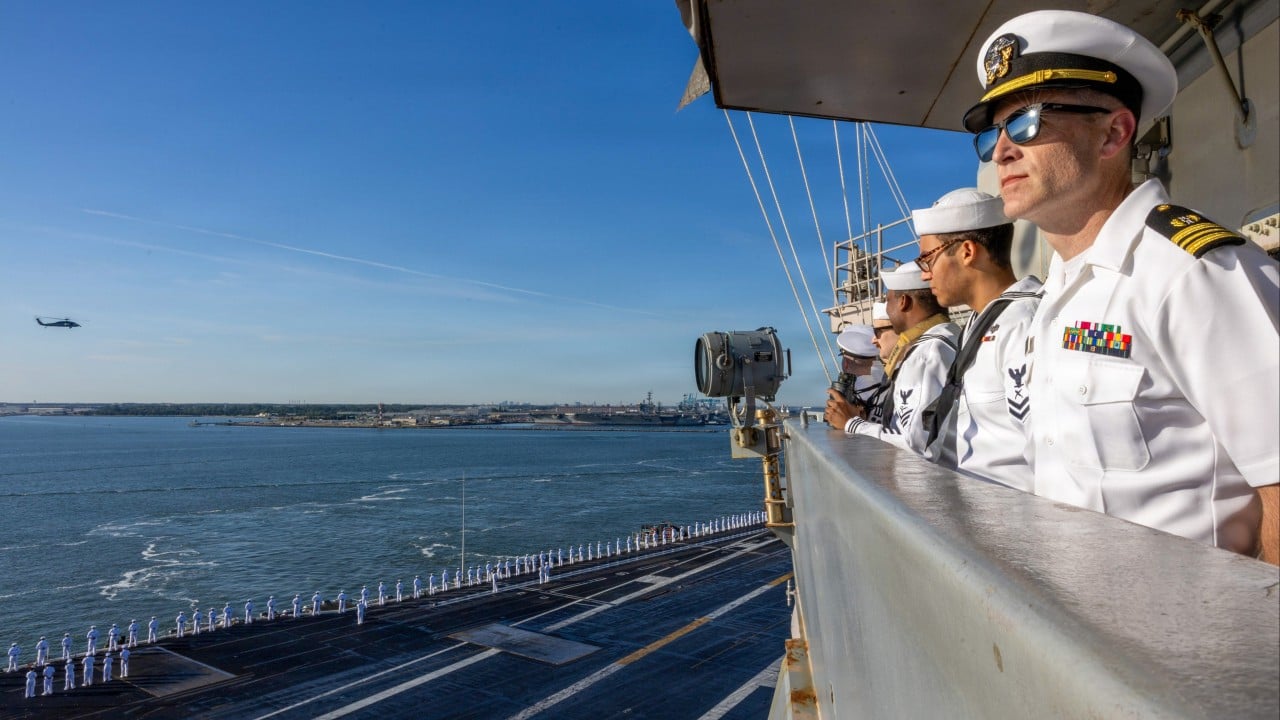
The US Navy has an existential problem, and it isn't an incoming ballistic missile. It's the wiring inside its own walls. Within a shockingly tight window recently, four of America's highest-profile warships suffered major shipboard fires and electrical failures. The stealth destroyer USS Zumwalt caught fire in Mississippi. The supercarrier USS Gerald R. Ford was forced to halt flight operations and limp to Crete after a fire broke out in its laundry spaces. The legendary USS Dwight D. Eisenhower hit a localized blaze, and the Arleigh Burke-class destroyer USS Higgins spent hours drifting in the Indo-Pacific—blind, dead in the water, and electronically helpless after an electrical fire choked out its propulsion.
This isn't a coincidence. It's a systemic chokepoint. The military-industrial complex has spent two decades chasing technological superiority by packing ships with hyper-complex, software-driven integrated electrical grids. But in the rush to build the future, the Pentagon forgot a fundamental rule of engineering: the more complex a system is, the easier it is to break.
The Navy's current crisis stems from a volatile mix of overengineering, relentless deployment cycles, and a domestic shipyard infrastructure that is fundamentally broken.
The Lethal Trap of Integrated Electric Power
For nearly a century, warships operated on a simple, bifurcated principle. You had mechanical propulsion—massive engines turning a shaft—and a separate electrical system for the lights, radars, and radios. If the lights went out, the ship still moved. If the engines sputtered, the crew could still broadcast a distress signal.
Modern vessels threw that redundancy out the window. Ships like the Zumwalt-class destroyers and the Ford-class carriers rely on Integrated Power Systems (IPS). In an IPS framework, massive gas turbines or nuclear reactors generate an ocean of electricity. Everything—from the propellers to the galley ovens to the radar arrays—draws from the exact same central power pool.
On paper, it's brilliant. It lets the ship dynamically route juice wherever it's needed. Want to fire a hypersonic missile or a laser weapon? Just temporarily divert power from the propulsion system.
In reality, it creates a single point of failure. When an electrical casualty hits an integrated grid, the entire ship cascades into a blackout. That's exactly what happened to the USS Higgins. A single component sparked or smoked, the system threw an error, and suddenly a $2 billion destroyer was a drifting metal box in contested waters.
Worse, these systems are so tightly packed and complex that you can't isolate problems easily. Take the Ford's Electromagnetic Aircraft Launch System (EMALS). It stores enough raw juice to power 13,000 homes. Yet, because the engineers failed to include proper electrical isolation switches for individual catapults, you have to de-energize the entire multi-billion-dollar system just to fix a single component. If one part acts up during combat, the entire flight deck goes cold.
Burnout at Sea and the Shipyard Bottleneck
You can't blame these failures entirely on bad blueprints. The operational tempo is killing these ships.
With geopolitical tensions exploding across the Indo-Pacific and the Middle East, the Navy is running its fleet ragged. The USS Gerald R. Ford recently wrapped up a grueling, record-extended deployment. When ships spend months on end executing constant combat sorties or high-stakes patrols, routine maintenance gets pushed. Air filters clog. Insulation on heavy-duty wiring degrades under extreme heat. Dust and moisture creep into high-voltage junction boxes.
When a ship finally returns home for repairs, it hits a massive brick wall: the American shipbuilding crisis.
The United States has a catastrophic shortage of skilled shipyard workers and a severe deficit in drydock capacity compared to near-peer adversaries. Tech-heavy warships require specialized electrical engineers and certified technicians to touch their advanced grids, not just standard welders. The Navy’s rapid introduction of these high-voltage systems completely outpaced the industrial base's ability to maintain them. Ships sit at piers waiting for parts that have a 12-month supply-chain backlog, while overtaxed crews try to patch complex software errors with basic hand tools.
The Human Cost of Automated Defenses
The Pentagon sold these advanced warships to Congress on a specific promise: automation would slash crew sizes, saving billions in long-term personnel costs. The Zumwalt, despite being 40% larger than a standard destroyer, runs on a crew of roughly 175 sailors—half that of its predecessors.
But automation has a dark side when things go sideways.
When a high-voltage fire erupts on a ship, automated suppression systems can only do so much. It still takes physical human beings to drag hoses through smoky passageways, isolate burning compartments, and manually reset tripped breakers. When you cut crew sizes to the absolute minimum, you leave zero margin for error during a mass-casualty event. A smaller crew means fewer sailors available for damage control rotations, leading to rapid exhaustion.
The fact that three sailors were injured fighting the fire aboard the Zumwalt in Pascagoula underscores the persistent danger. When the high-tech sensors fail, the baseline survival of the ship still relies on a sailor with a fire extinguisher. If the crew is already burnt out from double-length deployments, their response times slip.
What the Navy Must Do Next
The US Navy cannot afford to keep building fragile, over-engineered science projects while its current fleet suffers from basic electrical casualties. To stop the bleeding, naval leadership needs to pivot immediately.
- Mandatory Electrical Isolation Retrofits: The Navy must fund immediate engineering overhauls to install hardware isolation switches on critical systems like EMALS and integrated propulsion loops. A fault in one subsystem should never kill power to the rest of the ship.
- De-escalate the Automation Obsession: Future ship designs must prioritize damage-control crew depth over lean-manning metrics. Humans, not automated sensors, save ships from catastrophic blazes.
- Aggressive Investment in Industrial Technical Training: Funding needs to shift away from glitzy weapon concepts and directly into specialized technical pipelines for shipyard workers, ensuring every major naval port has a surplus of technicians certified in high-voltage integrated grids.
Technological superiority is completely useless if your flagship can't keep its lights on.
The systemic maintenance backlogs and technical hurdles facing the fleet are further examined in What The Hell Is Wrong With USS Gerald R. Ford?, which breaks down how policy decisions compromised the reliability of the Navy's premier carrier.