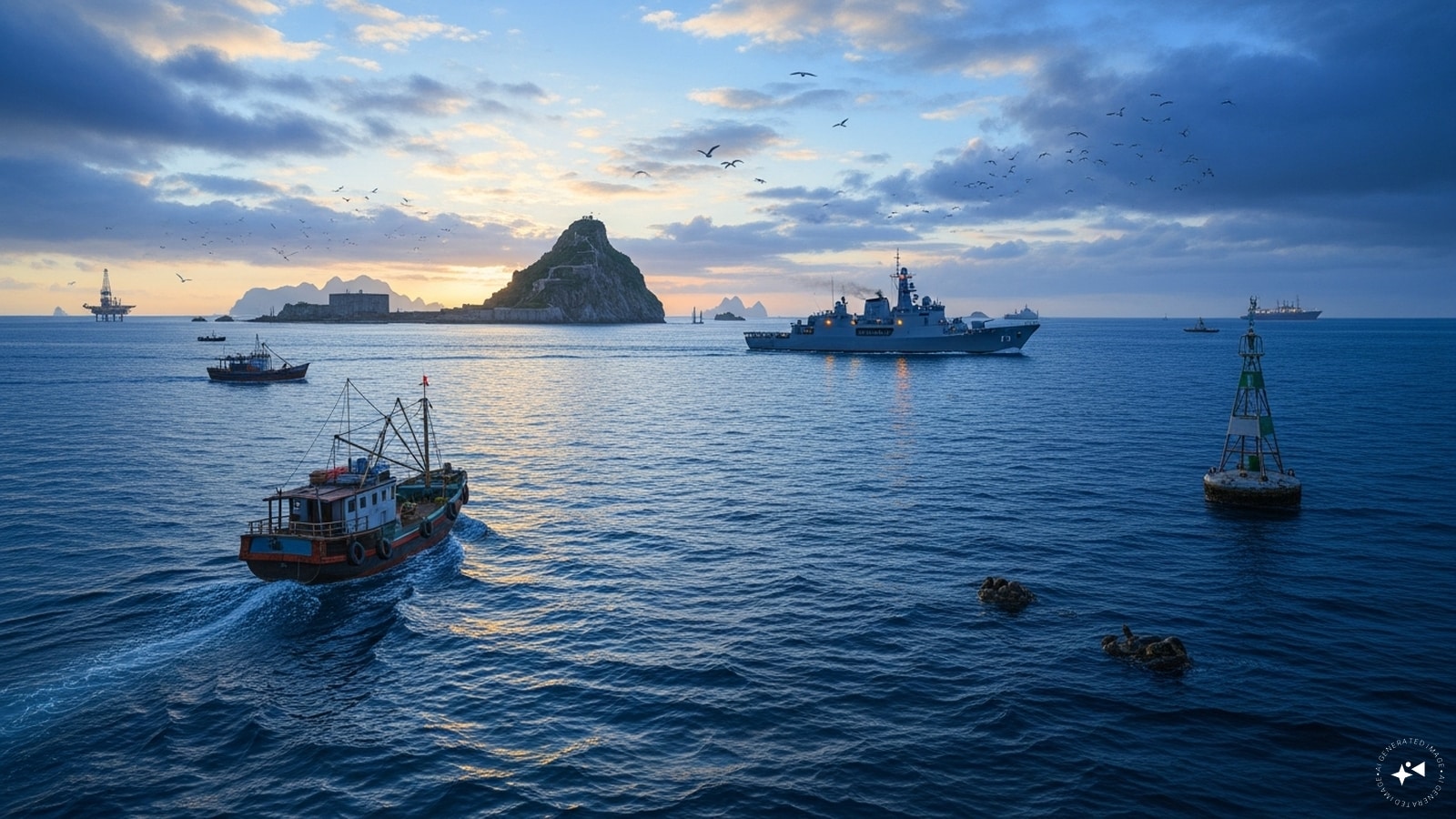
A coalition of 14 nations, led by the United States and the United Kingdom, recently issued a coordinated declaration reaffirming the 2016 Permanent Court of Arbitration ruling that invalidated China’s sweeping historical claims to the South China Sea. The joint statement aims to fortify international law against Beijing's escalating maritime aggression. However, Western diplomatic theater cannot obscure the harsh reality on the water. Beijing has spent the last decade turning the 2016 ruling into a dead letter through physical occupation and military fortification, proving that international law is only as strong as the navy backing it.
While the diplomatic optics suggest a unified global front, the underlying mechanics reveal a deeper, more dangerous stalemate. This is not a legal dispute. It is a slow-motion territorial conquest that the West is attempting to fight with press releases. Meanwhile, you can find other developments here: The Invisible Machinery Behind the Loudest Welcomes.
The Mirage of Legal Deterrence
To understand why this latest declaration is unlikely to shift Beijing’s behavior, one must look at what actually happened in the Hague a decade ago. The tribunal ruled unequivocally that China’s "nine-dash line" had no legal basis under the United Nations Convention on the Law of the Sea (UNCLOS). It concluded that none of the features in the Spratly Islands could generate extended maritime zones, effectively stripping China of any legal cover for its artificial island-building campaign.
China's response was immediate and total non-compliance. Beijing boycotted the proceedings, declared the verdict "null and void," and accelerated its construction efforts. To see the full picture, we recommend the recent report by NPR.
The Western strategy relies on the concept of reputational cost. The theory goes that by repeatedly forcing China to defy a recognized international ruling, Beijing will suffer a loss of global prestige that eventually alters its cost-benefit analysis. This is a fundamental misreading of Chinese grand strategy. For the Chinese Communist Party, dominant control over the South China Sea—a waterway carrying over three trillion dollars in annual trade—is a core national security priority. Prestige matters little compared to the strategic depth gained by controlling the first island chain.
The Gray Zone Blueprint
Beijing does not meet Western diplomatic declarations with conventional military pushback. Instead, it deploys gray zone tactics designed to alter the status quo without triggering a formal military response from the United States or its allies.
The execution of this strategy relies heavily on the People’s Armed Forces Maritime Militia. These are not ordinary fishing vessels. They are steel-hulled, state-subsidized ships operated by personnel trained in naval tactics. When a Western-aligned nation like the Philippines attempts to resupply its outposts, such as the Second Thomas Shoal, it faces a wall of these militia vessels backed by the Chinese Coast Guard.
They use water cannons. They engage in deliberate ramming maneuvers. They employ military-grade lasers to blind thin-skinned civilian supply boats.
By keeping the aggression just below the threshold of an armed attack, China exploits the strategic ambiguity of Western defense treaties. The US-Philippines Mutual Defense Treaty, for instance, covers armed attacks on public vessels. Does a Chinese Coast Guard ship ramming a wooden supply boat constitute an armed attack? By forcing Washington and Manila to debate that question, Beijing wins the psychological battle without firing a single shot.
The Asymmetry of Commitment
The fundamental flaw in the Western coalition’s approach is the gap in national commitment. For the United States, the South China Sea is a critical theater for maintaining freedom of navigation and upholding the rules-based international order. For Great Britain, Australia, and the European signatories, it is an important economic transit route and a chance to project geopolitical relevance.
For China, it is existential.
This asymmetry dictates the risk tolerance of both sides. A US Navy destroyer conducting a Freedom of Navigation Operation (FONOP) sails through the disputed waters, clears its radars, and leaves. Chinese forces remain there permanently. They have transformed reefs like Mischief, Subi, and Fiery Cross into unsinkable aircraft carriers equipped with long-range radar arrays, anti-ship missile batteries, and runways capable of handling strategic bombers.
The legal arguments presented by Western coalitions treat the South China Sea as an open commons protected by treaties. China treats it as a domestic lake. No amount of legal consensus can easily undo the concrete, steel, and military hardware permanently anchored to the seabed.
The Fragile Regional Front
The 14-nation coalition attempts to project an image of global solidarity, but the view from Southeast Asia is far more fragmented. The Association of Southeast Asian Nations (ASEAN) remains deeply divided on how to handle its northern neighbor. Countries like Cambodia and Laos, heavily reliant on Chinese economic investment and infrastructure loans, consistently block any unified, hardline ASEAN statements regarding maritime disputes.
Even the frontline claimant states operate with extreme caution. Vietnam has quietly conducted its own island-dredging operations to fortify its positions in the Spratlys, yet Hanoi maintains a strict "Four Noes" defense policy that prevents it from joining formal military alliances against China. Malaysia regularly sees Chinese state energy vessels operating inside its Exclusive Economic Zone, but its economic ties to Beijing often temper its public diplomatic pushback.
The Philippines, under the current administration, has taken a far more confrontational stance, actively filming and publicizing Chinese aggression at sea to shame Beijing on the global stage. This transparency strategy helped catalyze the latest 14-nation declaration. Yet, Manila walks a knife-edge. If Western legal and diplomatic backing does not translate into physical protection during the next high-seas standoff, the political cost inside the Philippines could trigger a swing back toward appeasement.
The Enforcement Vacuum
International law is not self-executing. The United Nations has no bailiffs to enforce the rulings of the Permanent Court of Arbitration. When the US and UK reaffirm the 2016 ruling, they are highlighting a mechanism that lacks an enforcement arm.
This leaves deterrence as the only viable option, which requires hard naval power. The US Navy, while technologically superior, faces severe capacity constraints. Shipbuilding bottlenecks, maintenance delays, and competing global crises in Europe and the Middle East mean that Washington cannot maintain a continuous, overwhelming presence in the South China Sea.
To compensate, the US is building a network of overlapping minilateral partnerships—AUKUS, the Quad, and expanded base access agreements with Manila. These initiatives aim to distribute the burden of maritime surveillance and defense. They are long-term structural fixes for an immediate, tactical crisis.
While these partnerships mature, China’s naval shipbuilding capability continues to outpace the United States. The People’s Liberation Army Navy is already the largest navy in the world by hull count, and its proximity to the theater gives it an overwhelming logistical advantage. In any sustained maritime confrontation within the first island chain, China can deploy more hulls, more missiles, and more land-based aircraft than the Western coalition can reasonably position in the area.
Beyond the Rhetoric
Reaffirming a decade-old legal victory is a low-cost diplomatic exercise. It allows Western capitals to signal resolve without committing new hulls to the water or risking direct economic retaliation from Beijing. For the nations directly confronting Chinese revisionism in the Pacific, however, these statements offer diminishing returns.
The true metric of success in the South China Sea is not the number of signatures on a joint communique, but the daily control of maritime geography. Every time a Western coalition issues a statement while allowing China to blockade another reef or expel another local fishing fleet, the credibility of the rules-based order erodes further.
If the 14 nations behind the latest declaration want to alter the trajectory of the conflict, they must shift from defending the legal record to raising the physical and economic costs of Chinese gray zone operations. This means deploying joint multinational patrols that actively interpose themselves between Chinese cutters and local supply vessels, effectively calling Beijing's bluff on escalation. It means implementing targeted economic sanctions against the Chinese state-owned enterprises that build the artificial islands and manufacture the maritime militia hulls.
Without a willingness to accept higher operational risks and confront China’s gray zone fleet directly, repeating the words of the 2016 ruling becomes an exercise in irrelevance. Paper treaties and diplomatic declarations cannot repel steel hulls.