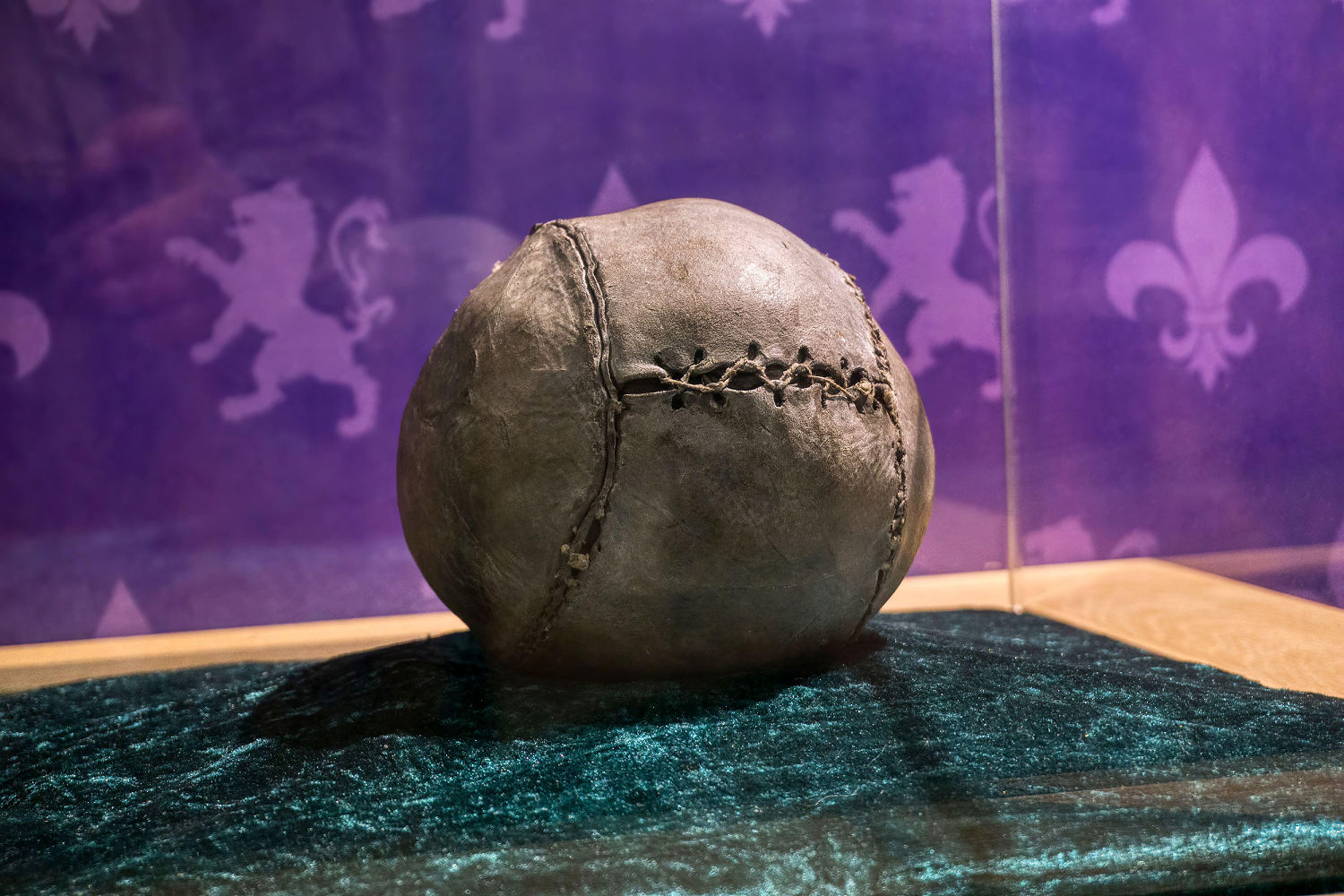
The soccer world is swooning over a piece of stitched pig bladder.
Museum curators and tournament organizers just shipped the Stirling Castle football—widely manufactured around 1540 and recognized as the world's oldest soccer ball—from the backrooms of Scotland straight to the glitz of Miami. The media narrative is painfully predictable. It is a warm, fuzzy tale about "celebrating the roots of the beautiful game" and "connecting the past with the modern spectacle."
It is marketing slop.
While executives toast to heritage in air-conditioned Florida suites, this high-profile stunt exposes a massive, systemic delusion. The sport is obsessed with romanticizing its past because it is terrified of confronting its broken present.
The Fetishization of Heritage
Marketing departments love historical artifacts because objects do not talk back. A leather ball found in the rafters of a queen's chamber does not complain about fixture congestion. It does not demand a cut of broadcasting rights. It just sits there, radiating a false sense of purity.
The collective amnesia required to celebrate this ball as the "ancestor" of the modern game is staggering. Let's look at the actual history. The game played in the 16th century was not soccer. It was folk football—a chaotic, violent brawl between entire villages with virtually no rules, zero tactical structure, and a body count. It was an activity so disruptive that British monarchs repeatedly tried to ban it.
To draw a straight, sentimental line from a medieval riot to a highly commercialized corporate entertainment product is intellectually lazy. We are not honoring a legacy; we are weaponizing nostalgia to distract from a sport that is cannibalizing itself.
The Real Cost of the Modern Spectacle
While fans gawk at centuries-old leather, the actual sport is redlining. The current football calendar is an administrative disaster driven by greed.
Consider the mechanics of the modern elite athlete. Players are being forced into a relentless cycle of domestic leagues, continental tournaments, expanded club competitions, and international duties. The physical toll is quantifiable.
The Data on Player Burnout
Look at the workload metrics compiled by FIFPRO, the global players' union. Elite midfielders and wingers under the age of 24 are logging minutes at a rate that far outpaces previous generations.
- Increased Injury Rates: Soft tissue injuries and ACL tears are skyrocketing because the human body requires physiological recovery windows that the current calendar explicitly denies.
- Diminished Product Quality: When you play 70 matches a year, peak performance becomes impossible. Fans are paying premium prices for fatigued, sluggish displays.
- Career Shortening: We are burning through the prime years of generational talents before they hit 26.
Imagine a scenario where a Formula 1 team runs its engines at maximum RPM for a year straight without a teardown. The engine explodes. That is the current operational model of FIFA and UEFA. Shipping a historical relic across the Atlantic does nothing to fix the fact that the actual human beings playing the sport are being treated like disposable capital.
Dismantling the Premise of the Soccer Purist
Go to any forum or press conference and you will hear the same complaint: "The game has lost its soul." Purists point to the billions of dollars flowing from private equity, sovereign wealth funds, and multi-club ownership models as the ultimate evil. They look at the Stirling ball and sigh for a time when the sport was "pure."
This premise is completely flawed. Soccer was never pure. The moment the Football Association codified the rules in 1863, commercialization began. Industrialists funded clubs to keep factory workers sober and compliant on Saturdays. Purity is a myth invented to make fans feel better about spending hard-earned cash on merchandise.
The problem today is not that money exists in soccer; the problem is that the money is horribly managed.
[Total Revenue Inflow] ──> [Inflated Agent Fees & Transfer Costs] ──> [Systemic Financial Distress]
We see clubs in major European leagues facing administration or points deductions because they cannot balance their ledgers. They chase the illusion of immediate success, overleveraging their futures on unsustainable wage-to-turnover ratios. A shiny old ball in a glass case does not solve a bankrupt economic model.
The Flawed Questions Everyone Is Asking
Search data shows fans constantly asking variations of the same question: How can we protect the traditional spirit of soccer?
The question itself is a trap. You cannot protect a tradition that is fundamentally incompatible with global entertainment scaling.
Instead of trying to preserve an imagined past, the industry needs to ask a brutal question: How do we restructure the sport so it survives the next two decades without collapsing under its own weight?
The obsession with historical pageantry fosters complacency. It allows regulators to look like stewards of the game while they quietly approve formats that dilute competition and exploit labor. The expanding club World Cup structures are not designed to find the best team on earth; they are designed to maximize digital ad impressions.
The Tactical Homogeneity Crisis
The irony of celebrating the chaotic roots of the sport is that modern soccer has never been more boringly uniform.
Step inside any elite academy. You will see the exact same training methodologies, the exact same positional play principles, and the exact same risk-averse tactical frameworks. High-pressing, possession-based systems have conquered the world.
While this approach is mathematically efficient, it has systematically eliminated the maverick. The unpredictable, chaotic geniuses who used to define the sport are coached out of the system by age 14 in favor of hyper-athletic, disciplined press-monsters. We are manufacturing sprinters who can pass, not artists.
If you want to see true innovation, you have to look outside the institutionalized system. But the current structure absorbs or crushes anything it cannot immediately monetize.
Stop Looking Back
If you are a fan buying a ticket to see a 500-year-old ball, you are participating in the distraction. You are validating a marketing apparatus that wants you to look at history so you ignore the ticket price hikes, the hollowed-out stadium atmospheres, and the fact that international federations are actively ruining the sport.
The sport does not need more museums. It does not need more transatlantic PR tours for dead objects.
It needs an immediate, mandatory reduction in the match calendar. It needs strict independent financial regulation with real teeth, not performative compliance rules. It needs a developmental pipeline that values creative expression over physical output.
Put the pig bladder back in the Stirling museum. Leave it there. Turn around and look at the structural rot happening on the pitch right now. Fix the machine before it breaks completely.


