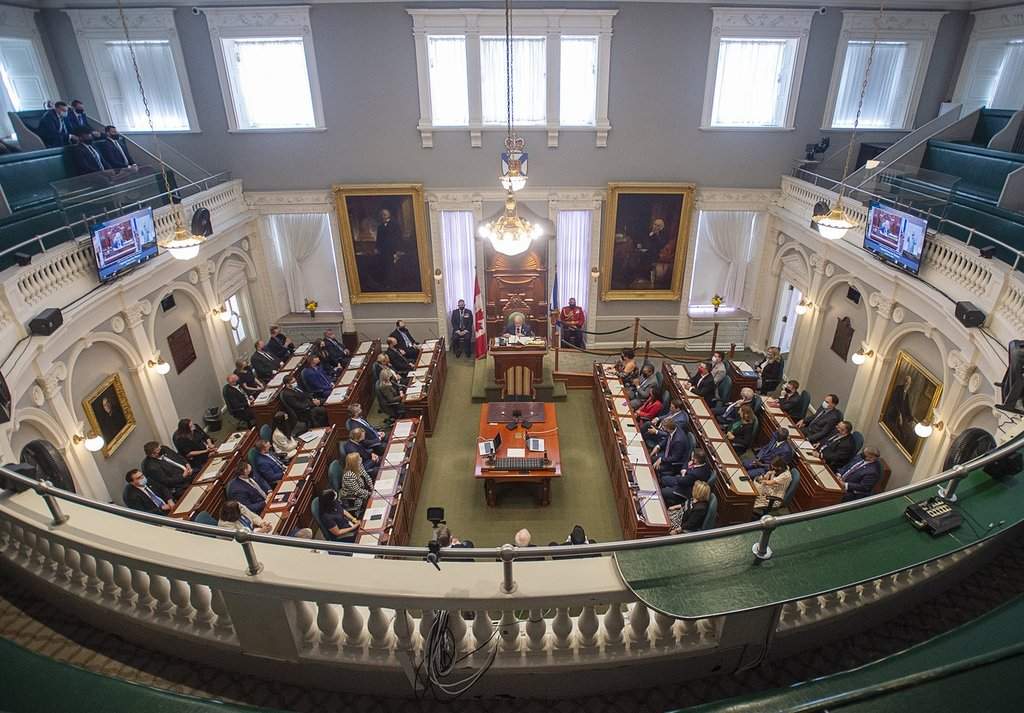
The salt air along the Halifax waterfront carries a particular chill in late autumn, the kind that creeps under wool coats and settles into the bones of anyone waiting for a ferry across the harbour. For generations, political loyalty in Nova Scotia worked much like that cold wind—predictable, seasonal, and deeply ingrained in the geography of the province. You were born into a red family or a blue family, or perhaps you drifted toward the orange of the New Democrats when the shipyards went quiet, and you stayed there until the day they lowered you into the rocky soil.
Betrayal. You might also find this connected coverage interesting: Inside the High-Stakes Friction Between Benjamin Netanyahu and Eyal Zamir Over Iran.
That is the word whispered over burnt coffee in Tim Hortons drive-thrus from Yarmouth to Sydney whenever a politician crosses the floor or breaks ranks. Yet, when a former interim leader of the Nova Scotia Progressive Conservatives recently stepped forward to endorse another former Tory for the leadership of the provincial Liberal Party, the reaction was less a gasp of outrage and more a collective, exhausted nod. Something fundamental has shifted beneath the cobblestones of Province House, and the people watching from their kitchen tables feel it in their wallets long before they read about it in the morning papers.
To understand why two seasoned conservatives would find themselves entangled in the fate of Nova Scotia's oldest political dynasty, you have to strip away the lawn signs and the partisan jargon. Consider a hypothetical voter—let us call her Clara, a retired nurse living in Truro—who has voted Progressive Conservative since the days of John Buchanan, mostly because her father did, and his father before him. Clara does not care about the internal mechanics of party constitutions or the subtle ideological gradations between centre-right and centre-left. She cares about why her grandson cannot find a family doctor in Colchester County, why the power bill from Nova Scotia Power spikes every January like a fever chart, and why the politicians she sends to Halifax seem to spend more energy protecting their brand than fixing the plumbing of the province. As extensively documented in detailed coverage by Reuters, the effects are notable.
For years, I covered regional politics from cramped press galleries and fluorescent-lit community halls, watching decent people slowly contort themselves to fit the rigid geometry of party discipline. You learn to recognize the telltale signs of a political realignment not by reading polling aggregates, but by watching who stops talking to whom at church suppers and legion halls. The tribalism of Maritime politics was always an intimate affair, bound up with local patronage, paving contracts, and shared history. When that tribe begins to fracture at the very top—when a former steward of the blue tent openly campaigns to put a former blue colleague in charge of the red tent—it signals that the old labels have lost their adhesive power.
The Anatomy of a Quiet Defection
Politics, at its core, is a market of trust, and right now the currency in Nova Scotia is badly debased. When Karla MacFarlane—who served as the interim leader of the Nova Scotia Progressive Conservatives before Tim Houston took the helm and swept to a massive majority—decided to throw her weight behind a former Tory cabinet colleague seeking the Liberal crown, she was not merely making a personnel recommendation. She was holding up a mirror to a political culture that has outgrown its nineteenth-century uniforms.
Think of the major political parties in Atlantic Canada not as warring ideological armies, but as two aging general stores sitting across the street from each other in a small town. For decades, one store painted its shutters blue and the other painted its shutters red, though if you walked inside and checked the shelves, you would find the exact same cans of beans, the same sacks of flour, and the same ledger books behind the counter. The rivalry was real, fierce, and often personal, yet the actual distance between a Nova Scotia Progressive Conservative and a Nova Scotia Liberal has historically been measured in inches rather than miles. Both occupy the pragmatic, cautious middle ground of Canadian public life, oscillating between fiscal restraint when the bond rating agencies frown and targeted spending when the ferries need replacing or the hospitals overflow.
Still, crossing that narrow street requires a specific kind of nerve. A party is a family, dysfunctional as it may be, and leaving it—or helping someone else lead the rival house—carries a social tax that few outside politics fully appreciate. The phone calls stop coming. The invitations to the annual golf tournaments dry up. Old friends suddenly remember urgent errands when they spot you in the grocery aisle in Pictou or Antigonish.
Why, then, do it?
Because loyalty to a logo becomes untenable when you believe the institution itself has stopped listening to the street. Under Tim Houston’s leadership, the modern Nova Scotia PCs transformed from a sleepy opposition party into a disciplined, centralized governing machine—one that won a historic supermajority in 2024 by promising to fix healthcare at any cost, even if it meant running billion-dollar deficits that would have made traditional fiscal conservatives blanch. For old-guard Tories who cut their teeth on balanced budgets, local autonomy, and caucus consensus, the new regime felt foreign. Meanwhile, the provincial Liberal Party, battered down to a rump of just two seats in the legislature after years of voter fatigue and strategic missteps, found itself wandering in a wilderness so vast that its surviving members could comfortably hold a caucus meeting in a mid-sized sedan.
When the Tent Collapses
Nature abhors a vacuum, and politics abhors an uncompetitive opposition. When one party holds forty-three of fifty-five seats in the House of Assembly, democracy begins to wheeze. Without a credible alternative waiting in the wings, cabinet ministers grow insulated, backbenchers grow docile, and the public loses its sharpest tool for accountability: the credible threat of throwing the bums out.
Let us return to Clara in Truro, staring at her kitchen table covered in unopened bills and a local weekly newspaper. If she is angry about overcrowded emergency rooms or the soaring cost of groceries, where does her anger go? If the official opposition is too fragmented to project competence, and the third party cannot break through outside the urban core of Halifax, her frustration curdles into cynicism. She stops believing that voting changes anything. That cynicism is the silent rot of civic life—far deadlier than any scandal, because it convinces ordinary citizens to abandon the room altogether.
This is the invisible stake behind an endorsement that might otherwise read like inside-baseball trivia. When a respected former PC interim leader steps into a Liberal leadership race to vouch for a former Tory, she is effectively telling disaffected voters across the province that the door is unlocked. She is giving permission to people who have carried a blue membership card in their wallets for thirty years to look across the aisle without feeling like traitors to their upbringing.
It is an uncomfortable truth, and one that purists in both camps despise. Die-hard Liberals bristle at the notion that their party’s salvation might require importing leadership talent stamped with the DNA of their historical rivals. They worry, not without reason, that absorbing former Conservatives dilutes whatever progressive identity the party still claims, turning the Liberal brand into a lifeboat for political orphans rather than a movement with convictions of its own. Conversely, loyalists inside the Progressive Conservative tent view the maneuver with icy disdain, framing it as sour grapes from figures who lost influence when the party modernized and won power.
Both critiques contain a grain of truth. Politics is never pure altruism; ambition, personal grievance, and long memories are always tangled up in the roots of every public endorsement. Yet reducing the moment to mere spite misses the larger tectonic shift occurring across Canadian provinces. Voters today are mercenaries, not monks. They rent their votes for four-year terms based on tangible results—a shorter wait time at the clinic, a break on the harmonized sales tax, a paved road that does not swallow their suspension every spring. They hold zero reverence for the sacred cows of party history.
The Architecture of Reinvention
Consider what happens next when a political party tries to rebuild from ashes. History offers plenty of sobering lessons. In the 1990s, the federal Progressive Conservatives were reduced to two seats, a humiliation so total that it took a decade of civil war, splinter movements, and an eventual merger to claw back relevance. In Ontario, the provincial Liberals spent years wandering without official party status, learning the hard way that a famous brand name guarantees nothing when voters decide you have stopped making sense.
Rebuilding requires more than a fresh coat of paint and a new slogan on a podium. It demands a bridge back to the voters who walked away—and in a province as tightly knit as Nova Scotia, credibility is personal. People trust messengers they already know. If a former Tory cabinet minister can step onto a Liberal stage and speak fluently to rural voters in the Annapolis Valley or the South Shore—places where the red banner has become toxic in recent election cycles—that candidate offers something no polished newcomer from Halifax can manufacture overnight: instant familiarity.
And having a former PC interim leader stand beside that candidate acts as a translator. It bridges the psychological gap for conservative-leaning moderates who feel homeless in the current political climate. It says, in plain Maritime English, that you do not have to repudiate your past to change your future.
I remember sitting in a diner in New Glasgow years ago, talking with a retired steelworker who had voted for the same party his entire adult life until the local mill closed and nobody in Halifax seemed to notice. He stirred his tea for a long time before looking up and saying, "I didn't leave them. They moved the fence while I was sleeping." That sentence has stayed with me through every election cycle since. Voters rarely wake up one morning and decide to radically alter their worldview; rather, the parties shift beneath their feet until the ground they are standing on suddenly belongs to someone else.
Beyond Red and Blue
There is a risk, of course, that this kind of cross-pollination leads to a grey, indistinguishable mush where every politician sounds like a management consultant and real ideological choices vanish from the ballot. Democracy needs genuine friction. Voters deserve to see clear contrasts between a vision that prioritizes market-driven growth and lower taxes, and a vision that champions robust public services, environmental stewardship, and social safety nets. If both major parties become interchangeable vessels for the same centrist managerial class, the electorate will eventually look elsewhere—toward populist extremes or apathy.
Yet, right now in Nova Scotia, the greater danger is not ideological uniformity; it is one-party dominance unchecked by a viable rival. A healthy democracy functions like a suspension bridge, relying on equal and opposite tension from both towers to keep the roadway level. When one tower crumbles, the whole structure sags toward the water.
Watch how the conversation shifts in the coffee shops over the coming months. The endorsements, the backroom alliances, the raised eyebrows among party stalwarts—all of it is merely the surface tremor of a deeper question that every Nova Scotian is quietly asking: who is actually going to fight for us when the cameras turn off?
The old banners still hang in the committee rooms, faded at the edges and heavy with the dust of battles that no longer matter to a twenty-five-year-old trying to afford rent in Dartmouth or a senior citizen rationing heat in Cape Breton. Out on the harbour, the wind keeps blowing, indifferent to the colors painted on the ferry hulls, caring only about whether the vessel stays upright when the tide turns.



