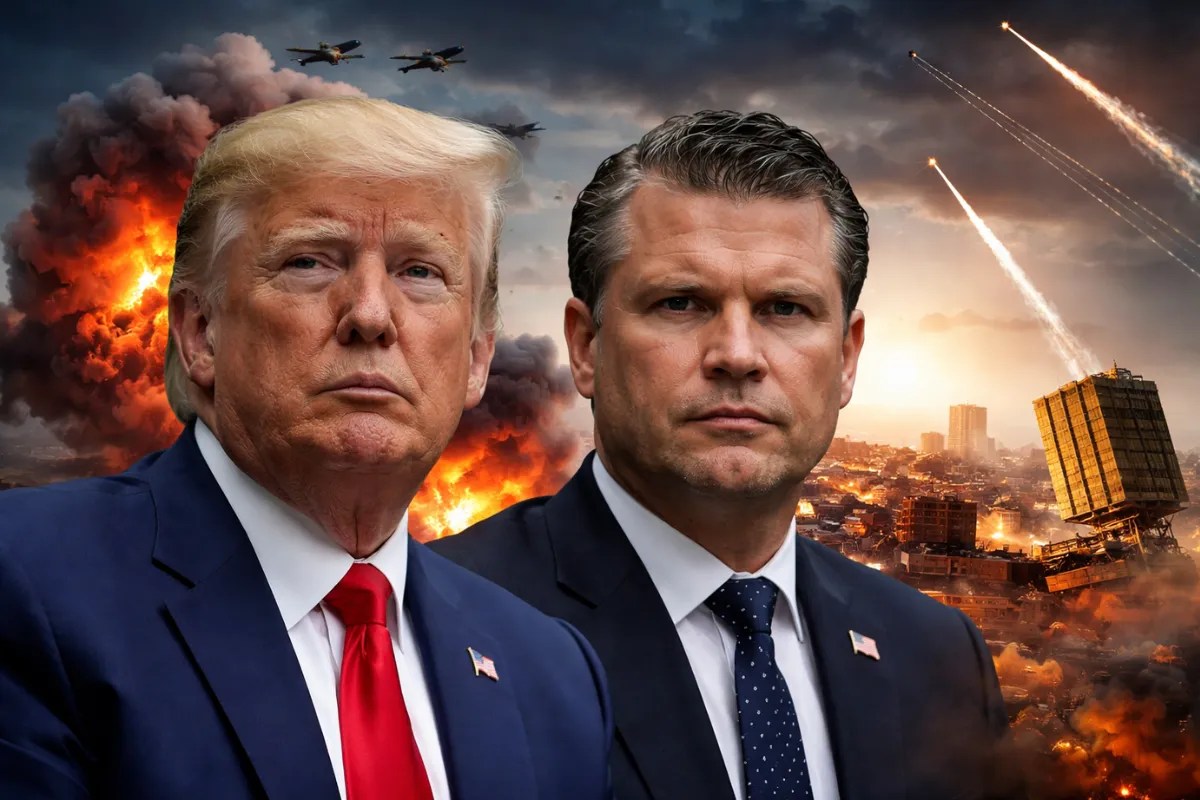
Donald Trump loves a good villain, especially when that villain wears a uniform and sits in the E-Ring of the Pentagon. His recent "revelation" that his former Pentagon Chief—likely Mark Esper or Mark Milley, depending on which day of the week he’s venting—pushed for a strike on Iran isn't a shock. It isn't a "reveal." It’s a calculated misdirection that the mainstream media is swallowing whole because they don't understand how the military-industrial complex actually breathes.
The lazy consensus says we have a rogue military establishment itching for World War III while a "restrained" executive branch holds the leash. This is a fairy tale.
In reality, the Pentagon doesn't want a war with Iran. They want the threat of a war with Iran. There is a massive, multi-billion dollar difference between the two.
The Budgetary Incentive of "Almost" War
Military leaders are managers of a massive bureaucracy. Their primary "product" is readiness. If the U.S. actually goes to war with a regional power like Iran, the "readiness" facade evaporates and is replaced by "depletion."
When Trump claims his advisors were thirsty for a strike, he’s ignoring the fundamental mechanics of Department of Defense (DoD) procurement. A strike on Iran is a logistics nightmare that burns through precision-guided munitions and exposes carrier strike groups to asymmetric drone swarms. The Pentagon brass knows that an actual kinetic conflict with Tehran would force a pivot away from their real cash cow: the "Great Power Competition" with China.
The "advice" to strike was likely a binary choice presented in a briefing—a standard tactical option—which Trump has now weaponized as a "push" for war.
- The Misconception: Generals are warmongers.
- The Reality: Generals are risk-averse bureaucrats who prefer the "Long Peace" because it allows for 30-year procurement cycles for ships and jets that never have to see real combat.
Why Trump is Selling You This Narrative Now
Trump isn't exposing the Deep State; he’s protecting his "Peace Candidate" brand for the 2024 and 2026 cycles. By casting the Pentagon as the aggressor, he absolves himself of the escalatory actions his own administration took, such as the withdrawal from the JCPOA or the assassination of Qasem Soleimani.
If you believe the Pentagon was the sole driver of aggression, you have to ignore the fact that the Executive Branch holds the ultimate "Delete" key on any military plan. The President isn't a victim of his advisors. He is the architect of the environment in which they operate.
I’ve seen this play out in corporate boardrooms and high-level policy circles: the leader sets a chaotic tone, and when the subordinates offer options that match that chaos, the leader blames the subordinates for being "too radical." It’s a classic shift of accountability.
The Hidden Math of the Persian Gulf
Let’s look at the numbers the competitor article ignored. A full-scale conflict with Iran doesn't just "happen." It requires a buildup that costs roughly $2 billion per month just to maintain the posture.
$Cost_{total} = C_{deployment} + C_{munitions} + C_{political_capital}$
The Pentagon knows that $C_{political_capital}$ is currently at zero. The American public has no appetite for another Middle Eastern quagmire. Therefore, any advisor "pushing" for a strike is either a sacrificial lamb or offering a "limited objective" strike that Trump is blowing out of proportion to look like he saved the world from Armageddon.
Stop Asking if We’re Going to War
People always ask: "Is war with Iran inevitable?"
You're asking the wrong question. The right question is: "Who profits from the tension staying exactly where it is?"
- Defense Contractors: High tension equals more sales of THAAD batteries and Patriot missiles to Gulf allies.
- Oil Markets: Fear of the Strait of Hormuz closing keeps a floor under crude prices.
- Political Operatives: It provides a perennial "Boogeyman" to justify massive defense spending without the messy "winning" part of a war.
The "advice" Trump mentions wasn't a call to arms. It was a test of his resolve, or perhaps a clumsy attempt at deterrence that he didn't have the nuance to understand.
The Strategy of Controlled Escalation
The status quo media treats foreign policy like a game of Risk. It’s more like a game of high-stakes insurance fraud. Everyone wants the payout; nobody wants the building to actually burn down because they’re standing inside it.
If the Pentagon Chief actually wanted a war, he wouldn't "advise" it in a meeting where the President could say no and then tweet about it. He would create a "Gulf of Tonkin" style incident that forces the President’s hand. The fact that Trump is talking about this "advice" proves it was never a serious operational push. It was a PowerPoint slide.
The Brutal Truth About Military Advice
Military advisors are legally obligated to provide "best military advice." If a President asks, "How do we stop Iranian proxies?" the general has to provide a strike option. That isn't "pushing for war." That is doing a job.
To frame this as a shadowy cabal of generals trying to trick a President into a global conflict is a fundamental misunderstanding of the civilian-military divide. It’s a narrative designed for voters who want a hero, not for people who want to understand how power actually functions in Washington.
The danger isn't that the generals want war. The danger is that we have a political class that uses the idea of war as a domestic polling tool.
Trump isn't blowing the whistle on the Pentagon. He’s auditioning for a role he’s already played, using the military as his favorite prop. If you’re waiting for the "big reveal" that changes everything, stop. You’re watching a rerun.
Demand more than gossip about old meetings. Look at where the money is moving. While Trump and the Pentagon argue over who wanted to pull the trigger, the defense budget continues to climb toward a trillion dollars, and not a single bullet has to be fired for the "war" to be a massive financial success for everyone involved except you.
Stop falling for the theater. The war isn't coming because the war is already happening in your tax bill.