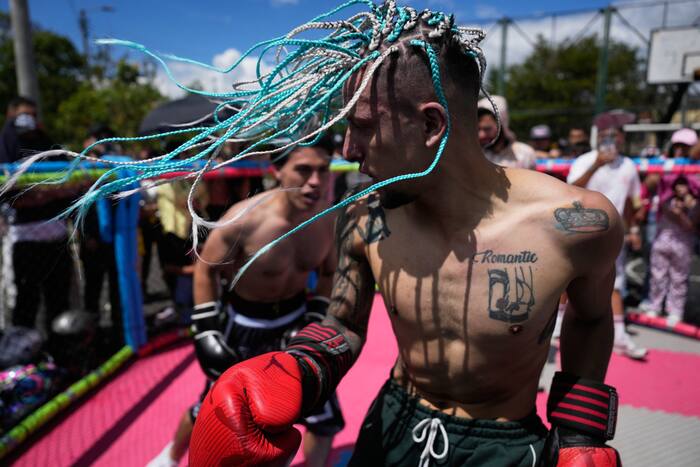
Two complete strangers lace up bulky boxing gloves in the middle of a crowded Bogotá park, touch leather, and start swinging at each other's heads while hundreds of teenagers scream and film on their phones.
If you've spent five minutes on TikTok or Instagram Reels lately, you've seen the clips. Pop-up street fights in Colombia have exploded across social media, turning public plazas, skateparks, and basketball courts into makeshift arenas. To an outsider scrolling from a couch in North America or Europe, it looks like pure anarchy—a real-life Fight Club spiraling out of control in South America.
That take misses the entire point.
Having spent years covering combat sports and grassroots street culture across Latin America, I've watched these events morph from tiny neighborhood meetups into massive viral spectacles. Most media coverage treats Colombia's pop-up fights like either a dangerous criminal underground or a mindless social media stunt. Neither label holds up when you actually look at what's happening on the ground.
How Colombia’s Pop-Up Street Fights Actually Work
Forget the cinematic trope of dark basements, blood oaths, and underground betting syndicates. The pop-up fights happening across major Colombian cities like Bogotá, Medellín, and Cali operate out in the open, usually in broad daylight or under public streetlights.
Organizers—often local content creators, amateur boxers, or event promoters—announce a time and general neighborhood on Instagram or TikTok just hours before the event. Moving fast keeps local police from shutting down the gathering before the first bell rings. Once a crowd forms a human circle, the rules are surprisingly straightforward.
Participants aren't dragged off the street. Anyone in the crowd can step forward, sign a basic waiver or agree on camera to the terms, and get matched with someone roughly their own size and weight.
Here's what separates these pop-up bouts from actual street brawls:
- Mandatory gear. Organizers supply 14-ounce or 16-ounce sparring gloves and, in many cases, headgear and mouthguards. Nobody is throwing bare-knuckle haymakers.
- Strict time limits. Fights rarely last longer than two or three one-minute rounds. Most participants gas out completely after forty-five seconds anyway.
- Zero ground fighting. The second someone slips, drops to a knee, or tries to wrestle, unofficial referees step in and break it up.
- Mandatory respect. Almost every bout starts and ends with a glove tap and a hug, regardless of how hard the punches landed.
It's messy, untrained, and loud. Yet the structure exists specifically to prevent serious injury while maximizing adrenaline.
Why Strangers Are Lining Up to Get Punched
You might wonder why a twenty-two-year-old delivery driver or university student voluntarily steps into a circle to take punches from a total stranger for zero prize money.
The answer comes down to three distinct pressures colliding in urban Colombia right now.
First, there's the obvious pull of social media clout. Getting knocked down on camera sucks, sure, but landing a clean right cross in front of five hundred cheering onlookers turns a regular kid into a local celebrity overnight. Clips routinely pull hundreds of thousands of views, and organizers tag the fighters' accounts. For young people trying to build an online following from scratch, three minutes of chaos offers faster visibility than months of posting standard content.
Second, and honestly more important, is the economics of combat sports. Traditional boxing and MMA gyms in cities like Medellín or Bogotá cost money that plenty of working-class young adults simply don't have. Buying your own wraps, gloves, shin guards, and paying monthly gym dues adds up fast. Pop-up events eliminate every financial barrier. You show up in sneakers and gym shorts, borrow the organizer's gloves, and test your nerve for free.
Third, people want a safe outlet for tension. Living in dense, high-stress urban environments takes a toll. Young men—and increasingly young women—are looking for an intense physical release that doesn't involve weapons, gang beefs, or getting arrested for assault. Stepping into a supervised circle lets two strangers settle an urge to scrap and walk away laughing five minutes later.
The Influence of Streamer Boxing and Global Viral Trends
Colombia didn't invent amateur exhibition boxing out of thin air. This trend sits squarely downstream from the massive wave of influencer and streamer boxing events that took over the Spanish-speaking internet over the last few years.
When Spanish streamer Ibai Llanos launched La Velada del Año, drawing millions of concurrent viewers on Twitch, it completely rewired how young Latin Americans viewed boxing. Suddenly, you didn't need to be a lifelong athlete to step between the ropes. Creators, musicians, and everyday personalities were training for a few months and fighting in front of packed stadiums.
Colombia quickly adapted that energy to the streets. Local creators realized they didn't need a million-dollar production budget or a stadium rental to capture the exact same excitement. A pair of gloves, a megaphone, a smartphone camera, and a public park were enough.
In cities like Cali and Barranquilla, collective crews began hosting regular pop-up sparring sessions that blurred the line between street culture, hip-hop gatherings, and amateur sports. The crowd noise, the raw camera angles, and the unpredictability of watching two untrained people swing wildly made the clips way more compelling to casual viewers than polished professional bouts.
The Real Risks Nobody Talks About
Just because these fights have rules doesn't mean they're safe. Anyone telling you otherwise doesn't understand basic physiology or combat sports medicine.
The biggest danger in Colombia's pop-up fight scene isn't malicious violence—it's unchecked mismatches and poor medical oversight.
When two beginners swing wildly with 16-ounce gloves, the punches look sloppy, so bystanders assume nobody is getting hurt. That's dead wrong. Heavy gloves protect the puncher's hands, allowing them to throw much harder without breaking their knuckles, while still transferring massive rotational force to the opponent's brain.
Consider what's usually missing at these makeshift rings:
- No ringside doctors or paramedics. If a fighter suffers a severe concussion or a delayed subdural hematoma, there isn't an ambulance idling twenty feet away.
- No pre-fight medical screening. Organizers have no idea if a volunteer has an undiagnosed heart condition, high blood pressure, or took a bad concussion two days earlier at another park.
- Concrete surfaces. Grass and dirt offer some cushion if someone gets knocked out cold, but plenty of pop-up fights happen on asphalt basketball courts or concrete plazas. Falling backward onto concrete without breaking your fall causes catastrophic skull trauma.
- Ego-driven officiating. Volunteer referees are usually friends of the organizer, not trained officials. They often let fights continue after a fighter is clearly concussed because the crowd is roaring for a knockout.
Doctors and sports medicine specialists across Latin America have repeatedly warned that repeated sub-concussive blows—even in light sparring—carry real long-term neurological risks. Doing it with zero medical clearance on a Tuesday night in a public park multiplies those odds.
How Local Authorities and Boxing Gyms Are Reacting
Police in Colombia's major cities have had a tough time figuring out how to handle these gatherings.
On paper, organizing an unpermitted public event that draws hundreds of people into a park or blocks a street violates local municipal codes. Riot police and local patrol units regularly break up pop-up fights once word spreads and crowds spill into traffic. Yet because organizers announce locations last-minute and wrap up within an hour or two, law enforcement is always playing catch-up.
More interesting is how Colombia's legitimate boxing community views the phenomenon.
Colombia has a rich, proud boxing history, producing world champions from Kid Pambelé to Miguel "Happy" Lora. Traditional coaches watching these viral street clips have mixed feelings. On one hand, veteran trainers cringe at the terrible technique—heads straight up in the air, chins exposed, looping arm punches that leave fighters wide open.
On the other hand, gym owners admit that pop-up fights have sparked the biggest surge in grassroots interest in boxing they've seen in decades. Teenagers who would have never walked through the doors of a local boxing club are suddenly asking how to throw a proper jab, how to slip a punch, and how to build cardio so they don't gas out in thirty seconds.
Several community gyms in Bogotá and Medellín have started hosting open-door weekend sparring days with actual coaches, ring mats, and mouthguard requirements, directly channeling that street energy into structured training.
What to Keep in Mind If You Watch or Participate
Whether you're fascinated by the viral clips or thinking about stepping into a local pop-up session yourself, you need to separate the social media hype from reality.
If you're watching from home, recognize that viral edits only show the wildest ten seconds of an event. They cut out the awkward clinching, the exhausted fighters leaning on each other after forty seconds, and the organizers constantly yelling at the crowd to step back so nobody trips over a backpack.
If you're actually considering participating in an amateur pop-up sparring event anywhere in the world, treat it with the seriousness combat deserves:
- Check the surface first. Never agree to strike on concrete, asphalt, or tiled plazas. If there isn't grass, turf, or proper wrestling mats down, walk away.
- Bring your own fitted mouthguard. Sharing gear is a fast track to infections, and fighting without a boil-and-bite mouthguard puts your teeth and jaw at serious risk.
- Verify the weight match. Stepping in against someone twenty pounds heavier might look brave on camera, until a single overhand right snaps your neck back.
- Learn basic defense before showing up. Spend at least a few weeks learning how to keep your hands up, tuck your chin, and move your head at a real gym before testing yourself in front of a crowd.
Colombia's pop-up fights aren't going away anytime soon because they tap into something deeply human: the desire to test your courage, earn respect from your peers, and feel completely alive for three intense minutes. Just don't confuse a viral smartphone clip with a safe sport—if you want to trade punches, find a real gym with mats, coaches, and people who actually know when to stop the fight.


