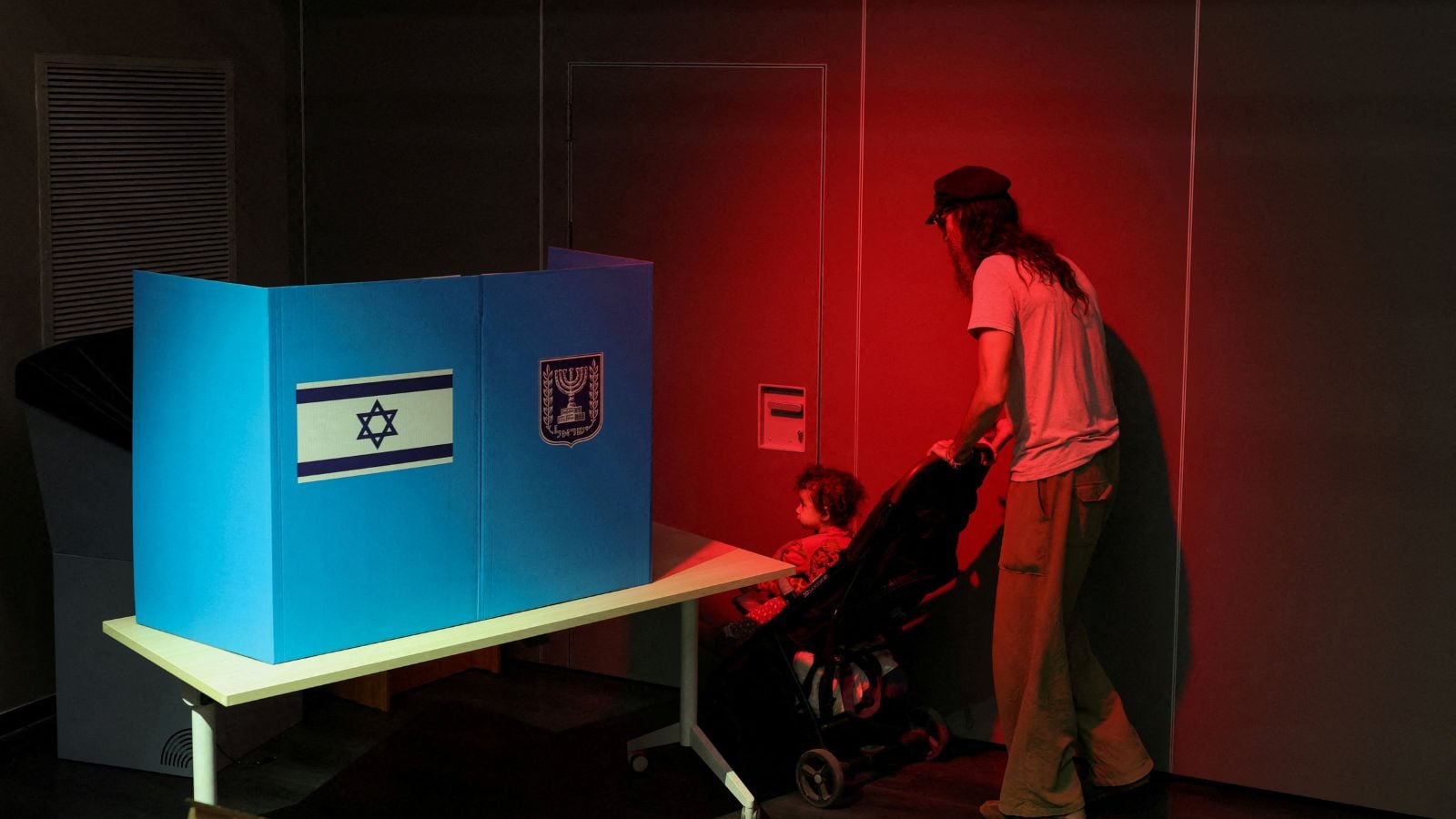
Exit polls in Israel are famously unreliable when the margin comes down to one or two seats. Yet every time Israeli television networks broadcast their initial projections at 10 p.m. local time, pundits treat those numbers like gospel. When Israel election exit polls show no clear winner as Netanyahu faces opposition challenge, the real story isn't who is ahead by a fraction of a percentage point. It's the structural math of the Knesset, the razor-thin electoral threshold, and the days of horse-trading that actually decide who sits in the Prime Minister's Office.
If you've ever watched an Israeli election night unfold, you know the drill. Channel 12, Channel 13, and Kan 11 flash colorful bar charts showing two rival blocs hovering right around the magic number of 61 seats out of 120. Benjamin Netanyahu's right-wing and religious bloc sits at 59 or 60. The anti-Netanyahu opposition bloc sits at 56 or 58, with Arab-majority parties holding the remaining balance without formally joining either coalition. Everybody declares a deadlock. Politicians give victory speeches anyway. And then, forty-eight hours later, the actual certified count from the Central Elections Committee shifts three seats and flips the entire narrative. Also making headlines in this space: Why Moral Outrage Won't Save Tibet's Succession.
To understand why these deadlocks keep happening—and what actually determines the winner when exit polls refuse to crown one—you have to look past the TV graphics and into how Israeli proportional representation actually works on the ground.
Why Israel Election Exit Polls Rarely Tell the Full Story
Israeli elections don't use local districts. The entire country votes as a single nationwide constituency, and voters cast a ballot for a party list rather than an individual candidate. Because of this pure proportional system, the three major television networks—Kan 11, Channel 12, and Channel 13—rely on prominent pollsters like Camil Fuchs, Mano Geva, and Dudi Hassid to sample specific ballot boxes across the country and project the final Knesset breakdown. Additional information regarding the matter are covered by USA Today.
Here's the catch. Those exit polls only sample a fraction of regular polling stations. They completely miss what Israelis call the "double envelopes."
Double-envelope ballots account for roughly 8 to 10 percent of all votes cast in a given election. These are the ballots cast by active-duty IDF soldiers on military bases, diplomats stationed abroad, hospital patients, prisoners, and people with disabilities voting at accessible stations. Because these voters cast their ballots inside two envelopes—one anonymous inner envelope and one outer envelope bearing their identification details to prevent double voting—they can't be counted at local precincts on election night. They are trucked to the Knesset compound in Jerusalem and tallied slowly over the next two days.
Soldiers tend to skew younger and further to the right than the general population. Hospital and accessible-station voters have their own demographic quirks. When an election comes down to a single seat separating Benjamin Netanyahu's bloc from a diverse opposition coalition, those 400,000-plus double-envelope ballots routinely erase an exit poll lead.
I've watched seasoned political analysts in Tel Aviv make the exact same mistake cycle after cycle. They analyze a 60-60 exit poll tie as if the race is frozen in amber, forgetting that a 0.2 percent shift in the final tally can push a small party below the electoral threshold and hand four "free" seats to the opposing camp.
The Electoral Threshold Trap That Makes or Breaks Coalitions
You can't talk about an Israeli election deadlock without talking about the 3.25 percent electoral threshold. To win a single seat in the 120-member Knesset, a party list must clear 3.25 percent of all valid votes cast nationwide. That translates to roughly four seats right out of the gate.
If a party gets 3.24 percent, it gets zero seats. Every single vote cast for that party is thrown into the trash, shrinking the total pool of valid votes and effectively lowering the number of raw ballots needed for every other party to win a seat.
This creates massive headaches for both Netanyahu and his opposition challengers:
- Wasted votes inside a bloc: During the November 2022 election, the left-wing Meretz party and the Palestinian nationalist Balad party both fell just short of the 3.25 percent threshold. Hundreds of thousands of anti-Netanyahu votes evaporated overnight, handing Netanyahu's bloc a comfortable 64-seat majority despite the two camps splitting the raw popular vote almost evenly.
- Last-minute cannibalization: In the final 48 hours of a campaign, big parties routinely run "gevalt" campaigns—panic-driven pleas telling supporters that if they vote for a smaller allied party, the main party will shrink and lose the right to form a government. Sometimes that strategy works. Other times, it pushes the smaller ally under 3.25 percent and destroys the entire bloc's path to 61 seats.
- Surplus-vote agreements: Under the Bader-Ofer method used by the Central Elections Committee, two parties can sign a pre-election agreement to pool their leftover votes that weren't quite enough to earn an extra whole seat. When exit polls show a 60-60 tie, obscure math involving Bader-Ofer agreements between allied lists often decides who gets seat number 61.
Exit polls have a notoriously hard time measuring whether a party sitting at 3.1 percent or 3.4 percent actually cleared the bar. A margin of error of half a percentage point means nothing to a party polling at 20 percent, but it means everything to a party hovering right on the cliff edge.
How Netanyahu and the Opposition Actually Build a Majority
When exit polls show no clear winner, the campaign doesn't end. It just moves behind closed doors. Forming a government in Israel requires securing the backing of at least 61 Members of Knesset, and the path to 61 looks radically different for Netanyahu than it does for his opposition rivals.
Netanyahu's Bloc Mechanics
Benjamin Netanyahu's political strength has always rested on bloc discipline. His core coalition partners—typically the ultra-Orthodox Haredi parties (Shas and United Torah Judaism) alongside religious nationalist lists—share a unified political base and clear ideological alignment. They rarely defect to the center-left because their voters wouldn't forgive them.
When Netanyahu's bloc hits 59 or 60 seats in exit polls, his playbook is straightforward. First, he waits for the double-envelope count to see if natural demographic shifts push his side over 61. Second, if he remains stuck at 59 or 60, he targets individual "defectors" from center-right opposition parties by offering high-profile cabinet ministries—Defense, Foreign Affairs, or Finance—in exchange for breaking ranks.
The Opposition's Structural Hurdle
The opposition challenge against Netanyahu faces a much steeper climb, even when exit polls show them tied or slightly ahead in total anti-Netanyahu seats. That's because the opposition isn't a single ideological movement. It's a patchwork of center-left liberals, secular nationalists, right-wing Netanyahu critics, and independent Arab parties.
In the 2021 election cycle, Naftali Bennett and Yair Lapid famously stitched together an eight-party "change government" that included right-wing hawks, left-wing socialists, and the Islamist Ra'am party led by Mansour Abbas. It was an unprecedented feat of political engineering that ousted Netanyahu for 18 months, yet its internal contradictions made it fragile from day one.
When exit polls show Netanyahu short of 61 seats, it doesn't automatically mean the opposition can form a government. If the opposition's math depends on both staunchly Zionist right-wingers and anti-Zionist Arab lists like Hadash-Ta'al sitting in the same coalition, the numbers simply don't add up. You can have 62 MKs who want Netanyahu out, and still fail to find 61 MKs willing to vote for the same Prime Minister.
The Role of President Isaac Herzog and the Mandate Clock
Once the Central Elections Committee certifies the final results—usually eight days after election day—attention shifts to the President's Residence in Jerusalem. Under Israel's Basic Law: The Government, the President holds formal consultations with representatives from every party that entered the Knesset.
Each party leader walks into the meeting, broadcasts live to the nation, and recommends a specific Knesset member to form the next government—or declines to recommend anyone at all. President Isaac Herzog then tallies those recommendations and hands the mandate to the candidate with the highest realistic chance of assembling a 61-seat coalition.
Here's the timeline that governs the post-election scramble:
- The initial 28-day window: The designated candidate gets four weeks to negotiate coalition agreements, divide up ministries, and present a finished government to the Knesset for a confidence vote.
- The 14-day extension: If negotiations stall, the President can grant a single extension of up to 14 days, provided the candidate proves they are making genuine progress.
- Transferring the mandate: If the first candidate fails after 42 days, the President can hand the mandate to a rival candidate for a separate 28-day period, or inform the Knesset Speaker that no candidate can form a government.
- The 21-day Knesset free-for-all: If both top contenders fail, any group of 61 MKs can sign a petition endorsing a single lawmaker—even someone who didn't lead a major party—to form a government within 21 days. If that fails too, the Knesset automatically dissolves and the country heads straight back to another election.
Between 2019 and 2022, Israel went through five consecutive national elections precisely because this clock ran out repeatedly. Exit polls showed deadlocks, neither camp could bridge the final two-seat gap, and the country remained trapped in caretaker-government limbo.
Common Misconceptions About Israeli Election Deadlocks
If you're following coverage from outside Israel, international headlines often oversimplify what a hung Knesset actually means. Three myths pop up almost every single cycle.
Myth 1: Whoever wins the largest single party automatically becomes Prime Minister.
This isn't true. Tzipi Livni's Kadima party won 28 seats in 2009—one more than Netanyahu's Likud at 27—yet Netanyahu became Prime Minister because his broader right-wing bloc controlled 65 seats while Livni had no viable path to 61. Total bloc size beats single-party plurality every single time.
Myth 2: A caretaker government has no real power during a deadlock.
When exit polls show no clear winner and coalition talks drag on for months, the outgoing Prime Minister stays on as head of a transitional government. While convention discourages major long-term appointments or sweeping irreversible legislation during a caretaker period, the sitting Prime Minister retains full executive authority over military operations, emergency budgets, and diplomatic decisions.
Myth 3: Arab parties never cooperate with Israeli governments.
For decades, predominantly Arab parties remained outside every governing coalition. That changed in 2021 when Mansour Abbas brought his United Arab List (Ra'am) into the governing coalition, proving that pragmatic political partnerships are possible when focused on domestic budgets and municipal funding rather than unsolvable geopolitical disputes. Even when Arab lists refuse to join a coalition formally, their decision to abstain on a confidence vote—or vote against a specific candidate—directly dictates whether an opposition challenger can reach 61.
How to Read the Real Numbers as Vote Counting Unfolds
When you see headlines announcing that Israel election exit polls show no clear winner, skip the breathless cable news panels and watch four concrete indicators over the next 48 hours.
First, check the Central Elections Committee live portal (votes.gov.il) rather than relying on TV graphics, paying close attention to the percentage of polling stations counted rather than just raw seat projections. Early returns almost always come from smaller towns and rural communities, while dense urban centers like Tel Aviv, Jerusalem, and Haifa report much later in the night.
Second, track any party sitting between 3.0 percent and 3.6 percent. A difference of just 15,000 votes across the entire country determines whether that party gets four seats or zero seats, which instantly shifts the math for both Netanyahu and his challengers.
Third, watch the non-aligned bloc—specifically Arab-majority lists and independent right-wing lists that haven't pledged loyalty to either camp. Subtract their combined seats from 120; if a block of 10 MKs refuses to sit with either side, the remaining candidates are fighting over 110 available seats, making a 61-seat majority nearly impossible without defections.
Fourth, monitor party leader statements on recommendations to the President during the 72 hours after polls close. Candidates who claim victory on election night frequently soften their tone by Thursday morning once internal party tally sheets reveal how the double-envelope ballots actually landed.


