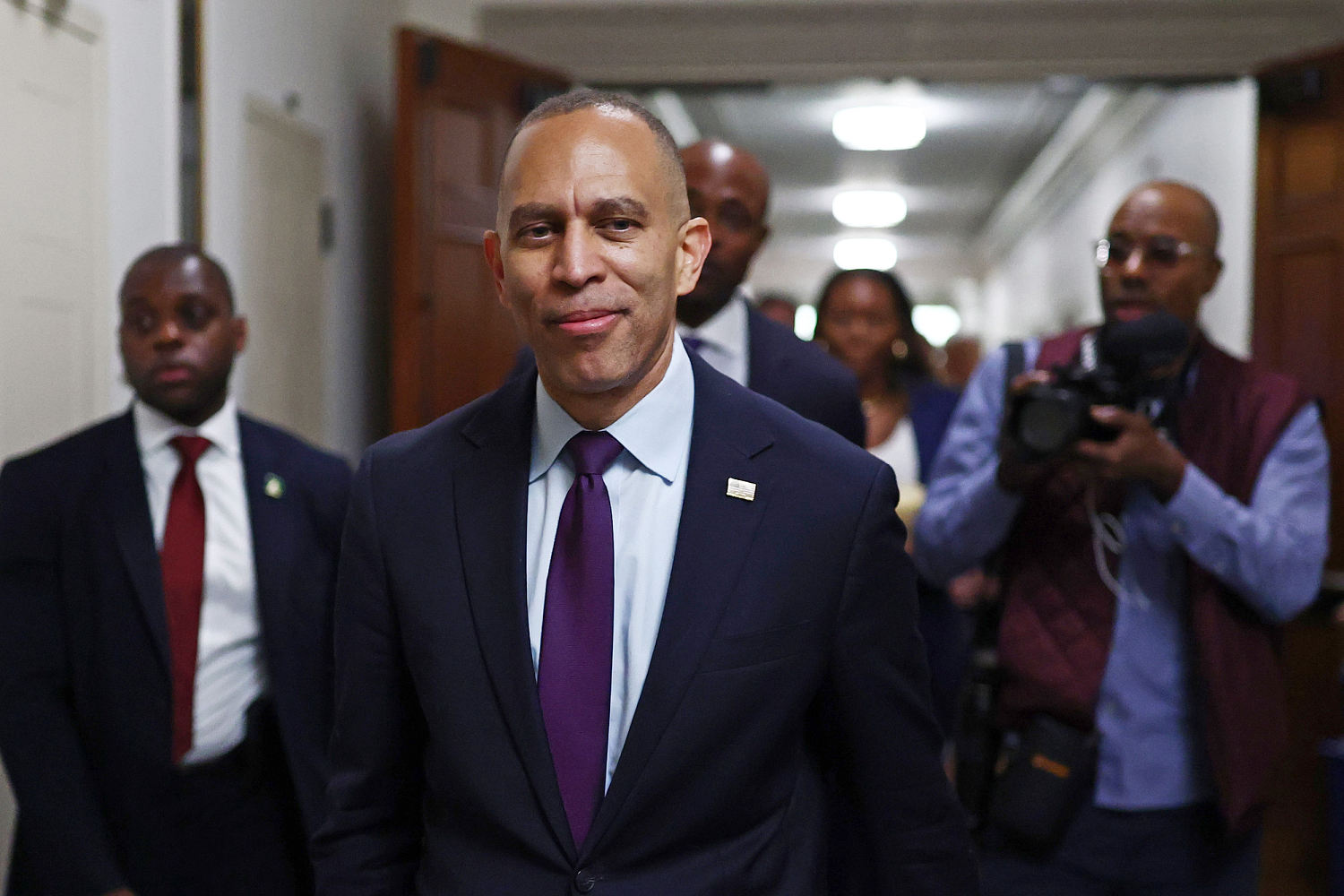
Watching the House floor over the past few legislative cycles has felt like watching a high-wire act without a net. On one side, you've got House Minority Leader Hakeem Jeffries trying to keep a diverse caucus rowing in the same direction. On the other, a vocal bloc of progressive Democrats occasionally breaks ranks, triggering cable news segments about an impending Democratic civil war.
Those segments usually miss the point. According to political analysts and coverage from outlets like NBC News' Politics Desk, the occasional defections by progressive lawmakers don't actually prove that Jeffries is losing his grip on the party. Instead, these moments expose the hard ceiling of progressive leverage inside the modern House of Representatives. If you found value in this post, you might want to read: this related article.
If you want to understand how Capitol Hill actually works—not how it plays on social media—you need to look at the math, the institutional rules, and the history of House leadership. When progressive members vote "no" on key bills or leadership priorities, they're often making a calculated stand for their constituents while knowing full well that the underlying outcome won't change.
Why Progressive Defections Look Bigger Than They Are
Cable news thrives on conflict. A headline screaming about "defectors" rebelling against Hakeem Jeffries gets clicks, shares, and airtime. For another angle on this event, see the latest coverage from The New York Times.
Step onto the House floor during a contentious vote, though, and the reality looks completely different. House leadership operates on a simple principle: count the votes before you ever call the roll. Jeffries, who succeeded Nancy Pelosi after the 2022 midterm elections, inherited one of the most disciplined whip operations in Washington history.
When a small group of progressives—often members of the Congressional Progressive Caucus or the informal group known as "the Squad"—votes against a procedural rule or a bipartisan compromise, it rarely catches leadership by surprise. In most cases, those defections are already baked into the whip count.
Consider how bipartisan funding bills or foreign aid packages pass the House. When Republican leadership needs Democratic votes to overcome hard-right opposition within the GOP, Jeffries has the luxury of letting a dozen or two dozen progressive members vote their conscience. The bill still passes with overwhelming bipartisan support. The progressives get to go back to their districts in New York, Minnesota, or Michigan and tell voters they stood firm on principle. Jeffries gets to deliver the votes needed to keep the government open or fund an ally.
Everybody wins, at least in the short term. The tension only spikes when the margins tighten to a razor's edge, or when the issue strikes at the core of the party's identity.
The Structural Limits of Progressive Power in the House
To see why progressive defectors hit a wall, you have to look at the geography of congressional districts. Political scientists and organizations like the Pew Research Center have documented this dynamic for years. Safe Democratic districts in major urban centers produce lawmakers with very different incentives than swing districts in the suburbs of Pennsylvania, California, or New York.
A representative from a D+30 district faces almost zero threat from a Republican in November. Their real electoral threat comes from the left in a primary election. Voting against a compromise bill that includes border enforcement funding or military aid isn't just an ideological choice for them—it's political survival.
Now flip the coin. Hakeem Jeffries cannot win or hold a House majority without the "Frontline" Democrats—the members sitting in districts that Donald Trump won or nearly won. Those lawmakers lose their seats if they're tied to policies that swing voters view as too far left.
This creates an unavoidable math problem for the progressive wing:
- The Majority Makers: To pass legislation or control the gavel, Democratic leadership must cater to the ideological center of their caucus, not the left flank.
- The Veto Trap: Progressives can threaten to sink a bill, as seen during the 2021 infrastructure and Build Back Better negotiations, but walking away entirely leaves them with zero legislative wins to show voters.
- Institutional Gravity: Committee assignments, fundraising support from the Democratic Congressional Campaign Committee (DCCC), and floor time all flow through leadership.
When progressives defect on a vote, they're exercising their voice. What they aren't doing is dictating the legislative agenda. As NBC News' Politics Desk noted in its analysis of these intra-party clashes, breaking from leadership often highlights what progressives can't stop rather than what they can force through.
How Hakeem Jeffries Handles Dissent Differently Than Nancy Pelosi
Comparisons between Hakeem Jeffries and Nancy Pelosi are inevitable, yet their styles couldn't be more distinct. Pelosi ruled the House Democratic caucus with an iron fist wrapped in velvet, using decades of institutional memory and personal chits to enforce discipline.
Jeffries comes from a different generation and operates in a much more fractured media environment. He's a Brooklyn-born former litigator who relies heavily on listening sessions, behind-the-scenes coalition building, and calm, methodical messaging.
When progressive members criticize leadership decisions—whether over Middle East policy, government spending caps, or procedural votes—Jeffries rarely takes the bait in public. You won't see him holding press conferences to scold individual members by name. Instead, he lets the pressure dissipate while keeping the broader caucus focused on unified messaging against House Republicans.
Honestly, this approach frustrates both sides at times. Centrists sometimes wish he would crack down harder on public dissent. Progressives occasionally feel their policy demands get absorbed into endless working groups without concrete floor votes. Yet from a pure leadership standpoint, keeping a diverse caucus largely intact during turbulent political cycles is no small feat.
The Role of the Congressional Progressive Caucus
It's a mistake to treat all progressive lawmakers as a single monolith. There's a massive difference between a handful of vocal dissenters voting "no" on final passage and the nearly 100-member Congressional Progressive Caucus (CPC) acting as a unified voting bloc.
Under chairs like Pramila Jayapal, the CPC worked hard to professionalize its whip operation so it could negotiate directly with leadership. When the CPC moves together, leadership has to listen. They proved that during the Biden administration when they held up the bipartisan infrastructure bill until they received guarantees on the companion social spending package.
Contrast that with smaller, isolated defections. When five or ten members break away from both Jeffries and the broader CPC leadership, they lose their collective bargaining power. Without the numbers to block a bill on their own, a small group of defectors becomes a protest vote rather than a legislative blockade.
Why the Tea Party Playbook Doesn't Work for House Progressives
Political observers love to ask why House progressives don't just copy the tactics of the House Freedom Caucus. We've all seen how a small band of hard-right Republicans paralyzed the House floor, ousted Speaker Kevin McCarthy in 2023, and repeatedly brought government funding to the brink of a shutdown.
If two dozen Republicans can hold their party hostage, why can't two dozen progressives do the same to Hakeem Jeffries?
The answer comes down to asymmetric goals. Hard-line conservatives often view government gridlock and shutdowns as acceptable—or even desirable—outcomes because their core philosophy favors shrinking federal power. They don't mind breaking the machine if it stops spending.
Progressives have the exact opposite problem. Their entire political project depends on a functioning, active federal government that funds social programs, regulates corporations, and invests in public infrastructure. Blowing up a bipartisan budget deal and triggering a government shutdown hurts the exact federal workers, low-income families, and public programs that progressives fight to protect.
Because progressives actually care about governance outcomes, their threat to burn the house down is almost always a bluff. Leadership knows it. Republicans know it. The voters know it. That fundamental asymmetry puts a permanent ceiling on how far progressive defectors can push their leverage.
What History Tells Us About Intra-Party Friction
None of this is new, even if social media makes every floor vote feel like an existential crisis. Every House leader in modern American history has dealt with rebellious flanks:
- The Blue Dog Revolt: In 2009 and 2010, moderate and conservative "Blue Dog" Democrats forced major concessions on the Affordable Care Act, stripping out the public option despite fierce protests from the party's liberal base.
- The Freedom Caucus Takeover: Starting in 2015, conservative rebels pushed out Speaker John Boehner, frustrated Speaker Paul Ryan, and eventually toppled Kevin McCarthy.
- The Post-2018 Progressive Surge: As younger, more diverse progressives entered Congress, tension over foreign policy, climate change, and healthcare became a permanent feature of Democratic caucus meetings.
In each era, the faction that held the decisive votes on the floor dictated the terms. Today, in a closely divided House where control hinges on a handful of purple districts, ideological purity doesn't win the gavel. Compromise does.
How to Read the Next Capitol Hill Showdown
The next time you see breaking news about progressive lawmakers defying Hakeem Jeffries, don't just look at the headline. Look at the vote tally and ask three specific questions to see what's really happening:
- Did the defection change the outcome? If a bill passed 310–115 with 20 progressive "no" votes, that wasn't a rebellion—it was a free pass granted by leadership so vulnerable members could protect their flanks at home.
- Was it a procedural vote or final passage? Voting against a "rule" (the procedural step that brings a bill to the floor) is considered a major breach of party discipline on Capitol Hill. Voting against final passage after a rule succeeds is routine.
- Where did CPC leadership land? Watch how the official leadership of the Congressional Progressive Caucus votes. If they're voting "yes" alongside Jeffries while a handful of members vote "no," the progressive bloc itself is divided, meaning leadership holds all the cards.
Understanding these mechanics strips away the cable news theatrics. Hakeem Jeffries faces real challenges managing the ideological gap between his party's urban progressive base and its suburban swing-district representatives. Yet every time a small group of progressives defects on a major vote without stopping the legislation, it reinforces the exact same truth: in the House of Representatives, noise doesn't equal leverage, and numbers still rule the floor.