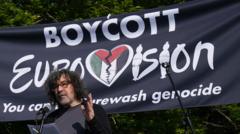
Ireland is skipping the Eurovision Song Contest. For a nation that holds a record-tying seven wins and practically treats the competition as a national pastime, this isn't just a minor programming change. It's an absolute bombshell.
If you tune into the grand final in Vienna expecting the usual high-camp Irish entry, you're going to find a total media blackout instead. National broadcaster RTÉ isn't even airing the show. They're broadcasting an old Eurovision-themed episode of Father Ted in its slot.
While casual viewers assume this is just a sudden, dramatic outburst over global politics, the truth runs much deeper. This isn't a hasty walkout. It's a calculated, historically significant boycott that has been brewing behind the scenes for over two years, driven by a toxic mix of geopolitical fury and systemic voting scandals.
The Real Reason Ireland Walked Away
The headline reason is clear. Ireland, along with Spain, the Netherlands, Slovenia, and Iceland, pulled out of the 2026 contest in direct protest against Israel's continued participation. The ongoing war in Gaza has made Israel's presence an incredibly polarizing issue across Europe, but the public pushback in Ireland has been uniquely intense.
Irish artists and fans have spent months piling immense pressure on RTÉ. The general consensus across the country was simple: if Russia was banned in 2022 following the invasion of Ukraine, the same rules should apply here. When the European Broadcasting Union (EBU) refused to bar Israel from the 2026 lineup, the Irish broadcaster decided that staying in the game was no longer tenable.
But public sentiment is only half the story. The breaking point actually happened behind closed doors during the EBU's winter meetings, when a second major issue came to light.
The App Store Vote Rigging Scandal
You can't talk about Ireland's exit without talking about what happened to the voting system. A massive investigation by the New York Times revealed that the Israeli government ran a highly organized, state-sponsored soft power campaign during the previous two tournaments.
The EBU allows people to vote up to 20 times per phone number. Investigators found that targeted tech campaigns systematically manipulated this loophole, pushing massive block votes to swing the public leaderboard. European broadcasters, including Spain's RTVE and Ireland's RTÉ, demanded a full forensic audit of the 2025 public vote.
They wanted answers, but the EBU tried to sweep the controversy under the rug. Instead of addressing the state-level influence directly, the EBU merely tweaked the rules for 2026, cutting the maximum votes per person from 20 down to 10. For Ireland and its allies, this half-measure was an insult. The absolute refusal to investigate past results destroyed any remaining trust in the competition’s integrity.
A Ghost Town in Vienna for Irish Fans
The impact of this boycott isn't just theoretical. It has completely decimated the local fan culture. On any normal Eurovision week, you can spot hundreds of Irish flags waving in the host city's arena. Irish fans are legendary for traveling in massive numbers, bringing unmatched energy to the host city.
This year? The Irish Eurovision Fanclub confirmed that instead of the usual 800-plus diehard fans making the trip to Austria, only about 40 actually showed up.
Local bars across Dublin and Cork that usually hold massive, packed screening parties are completely turning off their screens. The financial hit to the event is massive too. Spain and the Netherlands are traditionally the fifth and sixth largest financial contributors to the entire production. Losing them alongside a legacy powerhouse like Ireland has put the EBU in a brutal financial squeeze.
The Breakdown of the Eurovision Illusion
The EBU has clung to its favorite rule for decades: "Eurovision is a non-political event."
Honestly, that argument is completely dead. It's impossible to pretend a show is purely about music when national broadcasters are funded by state taxes and inevitably mirror their home country's foreign policy. You can't separate the art from the arena anymore.
To fill the massive gaps left by the boycotting nations, the EBU scrambled to bring back former participants like Bulgaria, Romania, and Moldova. But swapping out iconic, legacy Western European pop acts for hasty replacements doesn't fix the core rot. The contest is fundamentally ill-equipped to handle modern geopolitical warfare and digital voting manipulation.
What This Means for the Future of the Contest
If you love the glitter, the key changes, and the friendly European rivalry, this whole situation is incredibly depressing. But staying away was the right move for Ireland. By refusing to broadcast the show, RTÉ sent a clear message that integrity matters more than television ratings.
If you're wondering how to handle the lack of Irish representation this weekend, here's what you should do next:
- Skip the official stream: Support the local media blackout by avoiding the official Eurovision YouTube and television broadcasts.
- Watch the alternatives: Tune into RTÉ's alternative programming or check out Slovenia’s Voices of Palestine documentary series to see how other boycotting nations are handling the slot.
- Keep the pressure on the EBU: The only way Ireland returns in 2027 is if the EBU implements true independent voting audits and fixes its broken neutrality framework.
The era of Eurovision pretending the outside world doesn't exist is officially over.