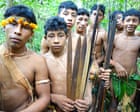
Every few years, grainy drone footage or a blurry photo hits the news cycle, showing an isolated Brazilian tribe stepping out of the Amazon rainforest and into the modern world. People immediately jump to one of two conclusions. Either they romanticize it as some magical encounter with a lost civilization, or they treat it like a straightforward charity case where outsiders just need to walk in and hand over medicine and clothes. Both reactions miss the reality on the ground.
When uncontacted Indigenous groups make contact with river communities, loggers, or government patrols, it isn't a curious stroll out of the woods. It's almost always a distress signal. These groups live in voluntary isolation because their ancestors survived massacres, enslavement, and epidemics brought by outsiders during the rubber boom and subsequent waves of Amazonian colonization. If they step onto a riverbank near a settled village, something has pushed them out of their territory.
Why Uncontacted Indigenous Groups Leave the Forest
To understand what's happening in the Brazilian Amazon, you have to drop the word "uncontacted" in its literal sense. Anthropologists and organizations like Survival International and Brazil's Indigenous affairs agency, FUNAI, use terms like "isolated" or "uncontacted" to mean tribes that avoid sustained peaceful contact with mainstream society. They know we exist. They hear planes overhead, see boats on the rivers, and find the plastic trash and metal tools left behind by invaders.
They choose to stay hidden for survival. When an isolated group suddenly emerges near a settled community—like the well-documented cases of the Mashco Piro across the border in Peru or various isolated subgroups in Brazil's Javari Valley and Acre state—it usually comes down to three immediate pressures.
- Illegal resource extraction: Wildcatter gold miners (garimpeiros), illegal loggers, and poachers push deeper into protected territories every dry season. They cut trails, scare off game animals with chainsaws and gunfire, and poison rivers with mercury.
- Narcotrafficking routes: Remote border regions like the Javari Valley sit along major cocaine smuggling corridors between Peru, Colombia, and Brazil. Armed traffickers move through Indigenous lands without regard for federal boundaries, violently displacing anyone in their path.
- Climate extremes and food scarcity: Severe droughts in the Amazon basin—such as the historic low water levels recorded in 2023 and 2024—dry up smaller tributaries, kill fish populations, and disrupt fruiting cycles in the forest canopy.
When their hunting grounds shrink and armed men patrol their creeks, isolation stops being safe. Stepping out to the edge of a settled village becomes a calculated gamble for food, metal tools, or simple safety from hostile intruders.
The Deadliest Threat Isn't Always Bullets
If you've ever studied the history of the Americas, you already know what happens next, yet modern observers still underestimate how fast it unfolds. The single greatest danger to an isolated Brazilian tribe during first contact isn't violence. It's the common cold.
Because these communities have lived apart from global populations for generations, they have zero acquired immunity to everyday pathogens. Influenza, measles, chickenpox, and even mild respiratory viruses that give you or me a miserable weekend can wipe out half a tribe within months.
History isn't subtle about this. During the construction of the Trans-Amazonian Highway in the 1970s, forced and poorly managed contacts devastated groups like the Parakanã and the Panará. In many documented cases across the Amazon basin, mortality rates topped 50% within the first few years after sustained contact. People didn't just die from the initial fever; they died because everyone in the village got sick at the exact same time. Nobody was healthy enough to fetch water, tend fires, or harvest manioc. Starvation and dehydration finished what the virus started.
That's why Brazil adopted its landmark "no-contact" policy in 1987, spearheaded by veteran sertanista Sydney Possuelo. Before 1987, FUNAI actively sought out isolated tribes to "pacify" them and clear land for infrastructure. Possuelo flipped the entire doctrine on its head. The agency realized that the only reliable way to keep isolated Indigenous peoples alive was to demarcate their land, kick out invaders, and leave them completely alone unless they initiated contact themselves.
What Actually Happens During an Emergency Contact
When an isolated group does emerge, the situation turns into a high-stakes public health and logistical operation within hours. You can't just send in well-meaning journalists, missionaries, or local politicians. Every single person who approaches the perimeter is a potential biological vector.
Proper emergency protocols—developed by FUNAI's General Coordination of Isolated and Recently Contacted Indians (CGIIRC) alongside Brazil's Special Secretariat for Indigenous Health (SESAI)—rely on strict quarantine and minimal footprint rules.
Strict Quarantine and Medical Screening
Any government worker, doctor, or Indigenous interpreter entering the area must undergo rigorous medical screening and quarantine beforehand. Even a mild cough disqualifies a team member from deploying. Once on site, teams establish a sanitary cordon to prevent local villagers, curious onlookers, or opportunistic missionaries from rushing in with used clothing—which can carry pathogens—or processed foods like sugar and salt that disrupt traditional diets.
The Role of Linguistic Relatives
Communication isn't guesswork. FUNAI relies heavily on neighboring, already-contacted Indigenous groups who speak closely related languages—often from the Panoan or Arawakan language families. These Indigenous collaborators act as interpreters and mediators. They understand the social etiquette of the forest, recognize signs of fear or aggression, and can explain to the emerging group why outsiders are wearing masks or keeping their distance.
Territorial Sweep and Enforcement
While health teams manage the immediate encounter, enforcement units have to figure out why the tribe left the forest. That means deploying patrols—often backed by federal police or military support—to locate and destroy illegal mining dredges, logging camps, or clandestine airstrips inside the territory. If you don't remove the threat that pushed them out, the tribe remains trapped on the margins of settled towns, dependent on handouts and exposed to constant disease risk.
Why Politics and Funding Make or Break Survival
On paper, Brazil has some of the strongest legal protections for isolated Indigenous peoples anywhere in the world. The 1988 Federal Constitution explicitly recognizes Indigenous peoples' original rights to the lands they traditionally occupy. Brazil officially tracks over 100 confirmed and unconfirmed records of isolated groups—the highest concentration on the planet.
Laws don't patrol rivers. Boots, boats, and fuel do.
Over the past decade, enforcement in the Brazilian Amazon has swung wildly depending on who holds power in Brasília. Between 2019 and 2022, budget cuts, hollowed-out environmental agencies, and political rhetoric encouraging resource extraction triggered a surge in invasions across Indigenous territories. The Yanomami humanitarian crisis exposed what happens when illegal gold miners are allowed to operate unchecked—malaria exploded, mercury poisoned entire river systems, and malnutrition tore through remote communities.
Even after federal operations resumed in 2023 and 2024 to expel miners and rebuild FUNAI's field posts (known as Ethno-Environmental Protection Fronts), the structural challenges haven't vanished. Criminal networks adapt fast. When federal forces clear miners out of one river basin, those same operators pack up their dredges and move into neighboring territories where monitoring stations are understaffed.
Misconceptions That Hurt Indigenous Rights
When headlines about an emerging tribe go viral, public debate usually gets bogged down in bad assumptions. Clearing those up matters because public pressure directly influences whether governments fund protection bases or slash their budgets.
Myth 1 They are "stone age" relics frozen in time.
Nothing could be further from the truth. Isolated tribes aren't living museums. They are contemporary societies with complex agricultural systems, deep botanical knowledge, and deliberate political strategies. Choosing isolation is an active, informed decision based on centuries of collective memory regarding colonial violence.
Myth 2 Leaving them alone denies them modern medicine and education.
Isolated communities generally maintain robust health as long as their forests remain intact and free of outside pathogens. Forcing integration doesn't give them a higher quality of life; historically, it lands them in poverty on the fringes of rural frontier towns, stripped of their land and autonomy.
Myth 3 A few drones or satellites can protect them.
Satellite imagery from organizations like Global Forest Watch and Brazil's space agency INPE is incredible for spotting deforestation and illegal airstrips early. Satellites can't confiscate chainsaws or arrest armed loggers. Remote monitoring only works when paired with funded, staffed field bases physically stationed at river chokepoints.
How to Follow and Support Indigenous Territorial Protection
Watching news of an isolated Brazilian tribe emerging from the forest can feel frustrating when you're thousands of miles away, but attention and accountability actually move the needle in Amazonian policy. International scrutiny has repeatedly forced Brazilian administrations to reverse budget cuts and deploy federal police to threatened territories.
If you want to stay informed or support efforts that actually respect Indigenous autonomy, focus on organizations that work directly with local Indigenous federations rather than top-down charity groups:
- Follow frontline Indigenous organizations: Look up UNIVAJA (Union of Indigenous Peoples of the Javari Valley) and APIB (Articulation of Indigenous Peoples of Brazil). They publish direct field updates on territorial invasions and government response times.
- Support established advocacy and research watchdogs: Groups like Survival International and Instituto Socioambiental (ISA) maintain verified databases on isolated tribes and lobby governments to enforce land demarcation laws.
- Be critical of viral "first contact" media: Whenever you see sensationalized videos claiming to show "untouched tribes," check whether the footage was taken ethically from a safe distance or obtained by trespassers violating Brazil's no-contact protocols.
Protecting isolated tribes doesn't require rescuing them or bringing them into the modern world. It requires keeping the modern world's chainsaws, mercury, and viruses out of their forest so they can survive on their own terms.