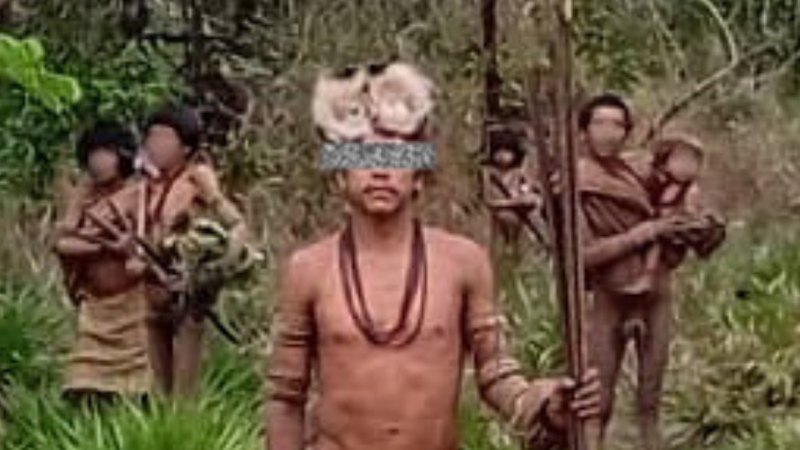
When footage of an uncontacted Indigenous group stepping out of the Brazilian rainforest goes viral, the internet usually reacts with awe. People treat it like a cinematic discovery. They're wrong.
In reality, a rare encounter with isolated Indigenous people in the Brazilian rainforest almost never happens by accident, and it's rarely good news. Indigenous rights advocates and field researchers call these moments a "crisis moment" for a reason. When an uncontacted group emerges from the deep canopy to interact with outsiders, it usually means something catastrophic is happening inside their territory.
Illegal gold miners, loggers, drug traffickers, or aggressive land grabbers are pushing them out. Sometimes, a deadly respiratory virus is already tearing through their village, forcing survivors to seek help from settled communities nearby.
Why Uncontacted Tribes Suddenly Appear
Let's clear up a massive misconception right away. "Uncontacted" doesn't mean these communities have zero awareness of the modern world. They hear the roar of overhead planes. They find discarded plastic bottles along riverbanks. Many of them carry generational trauma from violent rubber booms and massacres in the 19th and 20th centuries.
They choose isolation as a survival strategy.
So when members of an isolated group—like the Mashco Piro near the Peru-Brazil border or groups living along the Javari Valley—walk up to a river settlement, they're making a calculated, desperate move. You don't abandon decades of intentional avoidance unless the threat inside the forest outweighs the terrifying unknown outside it.
Here is what typically forces them out of the trees:
- Territorial encroachment. Illegal loggers and garimpeiros (wildcat gold miners) carve roads deep into protected zones, scaring away game animals and poisoning rivers with mercury.
- Resource scarcity. Extreme droughts in the Amazon basin—which have grown noticeably worse in recent years—dry up smaller tributaries, cutting off fish supplies and forcing nomadic groups toward major rivers where outsiders live.
- Violent clashes. Armed criminal networks operating in border regions regularly shoot at isolated Indigenous people to clear land for illicit crops or mining camps.
When a group approaches a riverbank village, the locals often feel an understandable human urge to offer food, clothes, or tools. They film the interaction on their phones. Within hours, those clips hit social media, framed as a heartwarming cross-cultural moment.
It isn't heartwarming. It's a biological time bomb.
The Deadly Reality of First Contact
If you've studied the history of the Americas, you already know what happens next. Isolated Indigenous populations lack acquired immunity to common pathogens that you and I shrug off in a weekend.
A simple cold. Measles. Influenza. Even a mild viral infection passed through a shared t-shirt or a handshake can wipe out 50% or more of an uncontacted tribe within months.
Brazil's Indigenous affairs agency, FUNAI, learned this lesson the hard way during the mid-20th century. During the construction of the Trans-Amazonian Highway in the 1970s, state-sponsored "pacification" teams actively sought out isolated groups to clear paths for infrastructure. Thousands of Indigenous people died from epidemics shortly after those forced contacts.
That tragedy led to a radical policy shift in 1987. Brazil adopted a strict no-contact policy, establishing specialized Ethno-Environmental Protection Fronts to monitor isolated groups from a distance without intervening—unless the group faces imminent physical destruction.
What Happens During a Crisis Response
When an encounter occurs today, FUNAI's specialized teams—alongside organizations like Survival International and the Observatório dos Direitos Humanos dos Povos Indígenas Isolados e de Recente Contato (OPI)—treat it like a biohazard emergency.
First, field agents have to establish a quarantine perimeter immediately. Nobody enters the area without medical screening and vaccinations.
Second, they deploy linguists who speak related Indigenous languages. Trying to communicate with an isolated group is extraordinarily delicate work. A misunderstood gesture can trigger panic, violence, or a hasty retreat back into the forest—carrying newly contracted viruses with them.
Third, medical teams from SESAI (Brazil's Special Secretariat of Indigenous Health) set up rapid-response field clinics. If an epidemic has already started, doctors must treat symptoms on the spot while trying to prevent the sick from scattering deeper into the jungle.
How Many Isolated Groups Actually Live in Brazil
Nobody knows the exact number, and anyone claiming absolute precision is guessing.
FUNAI officially recognizes 114 records of isolated Indigenous groups across the Brazilian Amazon. Out of those, roughly 28 have been officially confirmed through direct sightings, abandoned camps, or aerial monitoring, while the remaining dozens are still under active investigation.
Most of these populations live in remote, densely forested regions:
- The Javari Valley near the borders of Peru and Colombia, which holds the highest concentration of uncontacted peoples on Earth.
- Rondônia and Mato Grosso, where isolated groups survive on shrinking islands of forest surrounded by massive soy farms and cattle ranches.
- The Yanomami Indigenous Territory in Roraima and Amazonas, where tens of thousands of illegal miners caused a massive humanitarian and health crisis over the past several years.
Because these groups move constantly to hunt, gather, and avoid detection, tracking them requires painstaking non-invasive methods. Field scouts look for broken twigs bent at specific angles, distinct footprint patterns, abandoned palm-leaf shelters, and leftover campfire ash. They use satellite imagery to watch for sudden clearings or illegal airstrips creeping toward known migration corridors.
The Political Tug-of-War Over Amazon Protection
Protecting uncontacted tribes isn't just an anthropological challenge. It's a brutal political fight.
Under Brazilian law—specifically the 1988 Constitution—Indigenous peoples have original rights to the lands they traditionally occupy. Yet enforcing those boundaries across millions of hectares of dense rainforest takes massive funding, helicopters, armed federal police, and sustained political will.
When enforcement drops, invasions spike. Between 2019 and 2022, defunding of environmental and Indigenous protection agencies left FUNAI protection bases abandoned or understaffed. Illegal miners and loggers flooded into restricted territories. Although enforcement operations resumed aggressively in 2023 and 2024—expelling thousands of miners from Yanomami land and dismantling illegal barges—the criminal networks haven't vanished. They've simply adapted, shifting operations to quieter tributaries and partnering with transnational drug cartels.
There's also a persistent ideological push from agribusiness lobbyists and conservative lawmakers in Brasília to weaken land demarcation rules. Proposals like the Marco Temporal thesis—which argues Indigenous groups shouldn't claim lands they weren't physically occupying on October 5, 1988—pose an existential threat to nomadic, isolated tribes whose entire survival depends on seasonal movement across vast territories.
Why Viral Footage Makes Everything Worse
When a video of an isolated group circulates online, it creates an immediate second wave of danger.
Sightseers, sensationalist YouTubers, and reckless missionaries start looking for ways to reach the area. Some missionaries actively target uncontacted groups, viewing them as the "final frontier" for religious conversion. In recent years, authorities have had to intercept unauthorized foreign missionaries attempting to charter boats and planes into restricted zones in the Javari Valley.
Even well-meaning journalists can ruin a delicate containment operation. Chartering a small plane to fly low over an isolated village for dramatic aerial photos causes immense psychological terror for people who have never seen an aircraft up close. It often forces the community to abandon their crops, scatter into unfamiliar territory, and walk straight into the path of rival groups or armed loggers.
What You Should Actually Do When These Stories Break
You can't personally patrol the Javari Valley, and flying to Brazil to "help" is the worst possible idea. Still, public attention—when channeled properly—actually moves the needle in Brasília.
Stop sharing unverified viral clips that expose the exact GPS coordinates or river landmarks of isolated communities. Criminals and intrusive tourists actively monitor social media to locate vulnerable groups.
Instead, verify information through reputable Indigenous-led coalitions like the Articulation of Indigenous Peoples of Brazil (APIB) or the Coordination of the Indigenous Organizations of the Brazilian Amazon (COIAB). Support frontline legal defense funds and independent investigative journalism outlets like Repórter Brasil and InfoAmazonia, which document illegal supply chains linking gold and timber back to international markets.
Demand supply-chain transparency from companies buying Brazilian beef, soy, timber, and gold. Until the global market stops rewarding illegally cleared Amazonian land, isolated Indigenous peoples will keep getting pushed out of the trees—and the next "rare encounter" will be another preventable tragedy.