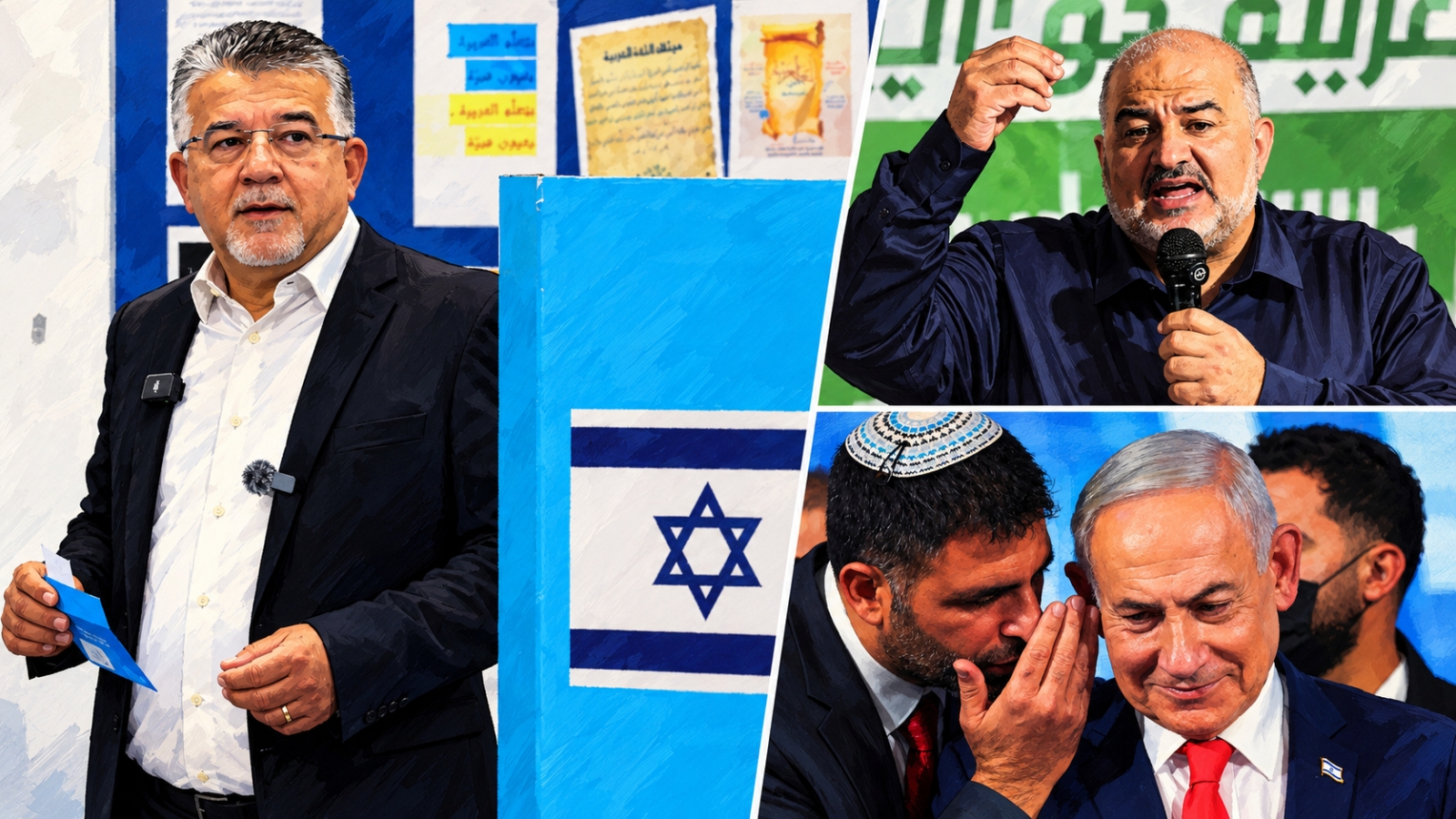
Most international coverage treats Israel’s Arab political parties like a single, unified voting bloc. They aren't. Not even close.
If you lump these factions together, you'll completely miss how Israeli coalition math actually works. Roughly 21 percent of Israel’s population consists of Arab citizens, yet their political representation is fractured across secular nationalists, pragmatic Islamists, and Arab-Jewish communists. Understanding who these groups are, what they actually demand, and why they hold the keys to almost every Knesset deadlock requires looking past Western headlines. You might also find this connected coverage interesting: Why Populism Keeps Slipping Into the Socialism of Fools.
For decades, these parties sat permanently on the opposition benches. No prime minister wanted them in a ruling coalition, and most Arab leaders refused to join one. Then came 2021, when Mansour Abbas shattered seventy years of political precedent by taking his Islamist Ra'am party into the government. Everything changed overnight.
Why Israel's Arab Parties Matter So Much Right Now
Israel uses a proportional representation system with a 3.25 percent electoral threshold. To form a majority government in the 120-seat Knesset, a prime minister needs at least 61 seats. Because the Jewish electorate is bitterly divided between pro-Netanyahu and anti-Netanyahu camps, neither side can easily reach 61 without help. As reported in detailed coverage by NPR, the results are worth noting.
That puts Arab parties in the kingmaker seat. Even when they don't join a government, simply crossing the 3.25 percent threshold alters the math. If one Arab faction falls just short of that threshold, hundreds of thousands of votes vanish into thin air. The opposing bloc instantly gains seats without earning a single extra ballot.
Turnout is the real wild card. When Arab voter participation drops below 50 percent, right-wing coalitions usually cruise to victory. When turnout surges past 60 percent, forming a purely right-wing government becomes nearly impossible. Every election cycle, campaign strategists in Tel Aviv and Jerusalem obsess over turnout numbers in Nazareth, Umm al-Fahm, and Rahat.
Meet the Four Main Factions
To understand the internal friction, you have to look at the four distinct movements that dominate Arab politics in Israel. They used to run together under an umbrella alliance called the Joint List, which briefly won 15 seats in 2020. That unity didn't last. Ideological rifts tore the alliance apart, leaving distinct parties with vastly different strategies.
Ra'am (The United Arab List)
Led by Mansour Abbas, a dentist from the northern town of Maghar, Ra'am is the political wing of the Southern Branch of the Islamic Movement. They're socially conservative, religiously devout, and intensely pragmatic.
Abbas made a calculated bet. Instead of waiting for a comprehensive Israeli-Palestinian peace deal before addressing domestic issues, he decided to work directly with whoever sits in the prime minister's chair. His strategy focuses on extracting immediate budgets for Arab municipalities, fighting organized crime, and securing housing permits. Critics call him a sellout. His supporters say he's the only one actually bringing money back to neglected communities.
Hadash
Hadash is the Democratic Front for Peace and Equality. It's the only major party in the Knesset that explicitly defines itself as a joint Arab-Jewish movement. Rooted in the Israeli Communist Party, Hadash pushes a hard-left socioeconomic agenda alongside a two-state solution to the Israeli-Palestinian conflict.
Led by figures like Ayman Odeh and Ofer Cassif, Hadash rejects religious conservatism. Their base includes secular Arab intellectuals, working-class voters in the Galilee, and a small fraction of radical left-wing Jewish Israelis. They're fiercely critical of Israeli military policies, which makes them toxic to mainstream Zionist parties when coalition negotiations begin.
Ta'al
Ta'al, the Arab Movement for Renewal, is essentially a vehicle for one of the sharpest parliamentarians in Israeli history, Ahmad Tibi. A former advisor to Yasser Arafat, Tibi is a master of Knesset procedure and Hebrew media.
Ideologically, Ta'al sits somewhere between Hadash and the nationalists. Tibi emphasizes Palestinian national identity while simultaneously fighting relentlessly for civil equality inside Israel. Because Ta'al is relatively small on its own, it almost always runs on a joint ticket with Hadash to guarantee passing the electoral threshold.
Balad
Balad is the National Democratic Assembly, currently led by Sami Abu Shehadeh. They're secular pan-Arab nationalists, and they take the hardest line against the Israeli establishment.
While other parties push for equal rights within the existing framework, Balad demands that Israel stop defining itself as a Jewish state altogether. They want Israel transformed into a "state of all its citizens," stripping away its Zionist character and symbols. Unsurprisingly, Balad refuses to recommend any Zionist candidate for prime minister, let alone join a governing coalition.
What Arab Voters Actually Want
Foreign journalists love framing Israeli elections exclusively around the Palestinian conflict. If you actually talk to voters in Arab towns across Israel, you'll hear a very different set of priorities. According to consistent polling by the Israel Democracy Institute, domestic survival issues dwarf foreign policy for the average Arab citizen.
Stopping Violent Crime
This is the number one issue. Period. Over the past decade, organized crime syndicates have terrorized Arab cities and villages, fueled by illegal weapons and predatory loan sharks. Hundreds of Arab citizens are murdered every year, and the police clearance rate for these crimes remains abysmally low compared to murders in Jewish cities. Voters want state intervention, police reform, and real security on their streets.
Housing and Zoning Permits
Since 1948, the Israeli government has built hundreds of new Jewish towns and cities, while creating almost no new Arab municipalities. Existing Arab towns are hemmed in by state land, unable to expand their zoning boundaries. Young couples are forced to build homes without permits, leaving tens of thousands of families living under the constant threat of state demolition orders.
Budget Equality and Infrastructure
Arab local councils receive significantly less state funding per capita than neighboring Jewish municipalities. The gaps show up everywhere. Schools are overcrowded, public transit is sparse, and industrial zones that generate local property taxes are rare. In 2021, Ra'am secured a five-year, 30-billion-shekel economic development plan to close these gaps, though subsequent governments have frozen or redirected parts of those funds.
The Nationality Law and Civil Status
In 2018, the Knesset passed the Nation-State Basic Law, which declared that the right to national self-determination in Israel belongs exclusively to the Jewish people. It also downgraded Arabic from an official language to one with "special status." Arab leaders across the political spectrum view this law as a constitutional slap in the face that formalizes second-class citizenship. Repealing or amending it remains a core demand.
The Coalition Dilemma
Here's the catch-22 facing every Arab politician in Israel. If they stay in the opposition, their constituents suffer from neglected budgets and unchecked crime. If they join a government, they risk legitimizing military actions in the West Bank or Gaza that their voters despise.
Mansour Abbas experienced this exact nightmare during his stint in the 2021–2022 Bennett-Lapid government. Every time tensions flared at the Al-Aqsa Mosque in Jerusalem or violence erupted in the West Bank, Ra'am faced immense pressure from the Arab street to collapse the coalition. Abbas held on for a year, arguing that abandoning the government would only hand power back to hardline right-wingers who wouldn't give Arab towns a single shekel.
Meanwhile, Hadash and Balad argue that Abbas's approach is an illusion. They believe that as long as the occupation of Palestinian territories continues, true civil equality inside Israel is impossible. You can't separate the national struggle from the civic struggle, they insist.
Why the Threshold Game Decides Elections
When watching Israeli election results roll in, ignore the early exit polls and look straight at the electoral threshold. Because Israel uses the Bader-Ofer method for distributing surplus votes, any party that gets 3.24 percent of the vote gets zero seats.
In the November 2022 election, Balad split from Hadash-Ta'al at the last minute. Balad won roughly 138,000 votes, falling just short of the 3.25 percent cutoff. Those 138,000 anti-Netanyahu votes were completely wiped off the board. Had Balad stayed united with Hadash-Ta'al, the anti-Netanyahu bloc would have prevented Benjamin Netanyahu's right-wing coalition from reaching its 64-seat majority.
Political strategists know this. Right-wing operatives often quietly root for Arab parties to run on three separate tickets, hoping at least one fails to cross the threshold. Conversely, center-left leaders constantly beg Arab factions to form technical blocs just to ensure no votes are wasted.
How to Read Israeli Election Coverage Smarter
Next time an Israeli election hits the news cycle, don't fall for lazy generalizations about "the Arab vote." Pay attention to three specific metrics on election night.
First, check the overall Arab turnout percentage by 8:00 PM local time. Anything under 50 percent signals a likely victory for the Israeli right. Second, look at whether the parties are running united or split. Three separate Arab lists almost guarantees wasted votes and a weaker Knesset presence. Third, watch Mansour Abbas's rhetoric during the final week of campaigning. Whether he signals openness to joining a coalition or retreats into opposition tells you immediately whether a centrist government is even mathematically possible.