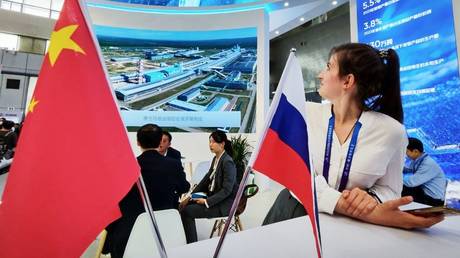
Western analysts love a good villain origin story. For years, the prevailing narrative out of Washington and Brussels painted the relationship between Moscow and Beijing as a marriage of pure convenience. We were told it was a shallow transaction, a temporary alignment of two autocracies that would inevitably crack under the weight of historical grievances and mutual suspicion.
That view is dangerously outdated. In other news, read about: The Edge of the Gray Zone.
As Russian President Vladimir Putin lands in Beijing for his latest high-level summit with Xi Jinping, the reality of the Russia China foreign policy alliance looks less like a temporary pact and more like a permanent structural shift in global politics. Bilateral trade between the two powers shattered records, hitting $227.9 billion. This isn't just about buying cheap oil or trading microchips. It's about a shared, deeply held conviction that the American-led global order must be dismantled.
To understand where their foreign policy interests align, you have to look past the diplomatic pageantry. The partnership isn't a formal military alliance like NATO, and it doesn't need to be. Instead, it operates on a highly coordinated, flexible framework designed to squeeze Western influence out of Eurasia and the Global South. BBC News has analyzed this important topic in extensive detail.
The Shared Obsession with Multipolarity
The core driver of the Russia China foreign policy alignment isn't love; it's a shared enemy. Both Beijing and Moscow view US grand strategy as an existential threat to their domestic regimes and regional ambitions.
For Xi, Washington's network of Asian alliances—like regular naval drills in the South China Sea—looks like a deliberate containment strategy. For Putin, NATO expansion and Western sanctions are attempts to reduce Russia to a second-tier power.
Their response is a coordinated push for what they call a "multipolar world."
Step into the halls of the United Nations Security Council, and you see this alignment in action. Russia and China function as a diplomatic tag-team. When Western nations introduce resolutions targeting authoritarian regimes, human rights abuses, or unilateral annexations, Moscow and Beijing systematically deploy their veto power or abstain in unison. They aren't just shielding each other; they're rewriting the rules of international diplomacy to ensure state sovereignty always trumps Western concepts of universal human rights.
This ideological defensive wall extends to regional security platforms. They've weaponized groups like the Shanghai Cooperation Organisation (SCO) and the expanded BRICS bloc to build an alternative ecosystem. These forums explicitly exclude Western nations, offering countries in Africa, Latin America, and the Middle East a diplomatic and economic alternative to the G7 or the International Monetary Fund.
Securing the Eurasian Heartland
Geography dictates destiny, and right now, geography is forcing these two historical rivals into a tight embrace. The long shared border, once a flashpoint for military skirmishes during the Cold War, is now a zone of deep strategic cooperation.
Consider what this border security gives both nations. It frees up military resources. Russia can commit the vast majority of its conventional forces to its western frontier without worrying about a knife in the back from Asia. China can focus its naval and air assets on the first island chain, Taiwan, and the Pacific, secure in the knowledge that its northern land border is entirely safe.
Furthermore, the alignment is supercharging a network of land-based trade routes that are completely immune to Western naval power. The alignment between China’s Belt and Road Initiative and Russia’s Eurasian Economic Union is moving fast. Today, more than 70% of China-Europe freight trains roll directly through Russian territory.
This infrastructure provides Beijing with a critical insurance policy. If a conflict over Taiwan prompts a US naval blockade of the Strait of Malacca, China can still import resources and export goods across the Eurasian heartland via rail lines and highways controlled by Moscow.
The Energy and Technology Lifeline
You can't run a superpower ambitions on shared ideology alone. You need fuel, cash, and hardware. The economic complementarity between Russia and China is almost too perfect, creating a closed-loop system that shrugs off Western sanctions.
Russia holds the world’s largest natural gas reserves; China is the world's largest energy consumer. Since the West cut off Moscow from European energy markets, China stepped in as the ultimate buyer of last resort. Nearly half of all Russian hydrocarbon exports now head to the Chinese market. Russian crude oil flowing into Chinese independent refineries reached roughly 2.2 million barrels per day.
Pipeline Diplomacy
The energy architecture is hardening into concrete and steel. The Power of Siberia 1 pipeline is maxing out its contractual capacity, pumping billions of cubic meters of gas straight into China's northern industrial hubs.
While negotiations over the massive Power of Siberia 2 pipeline through Mongolia face intense haggling over pricing, the strategic intent is obvious. It aims to redirect gas from fields in western Siberia—fields that historically supplied Germany and France—straight into the Chinese energy grid.
Technology for Resources
The trade flow isn't a one-way street. In exchange for oil and gas, China provides the industrial and technological scaffolding keeping Russia's economy and defense sectors afloat.
With Western aerospace, automotive, and semiconductor giants exiting the Russian market, Chinese brands moved in to fill the vacuum. Chinese microchips, advanced machine tools, and optical components are vital for Russia's domestic manufacturing. Beijing insists it doesn't supply lethal weapons to Moscow, but its massive supply of dual-use technology gives Russia the industrial capacity to sustain its defense industrial base indefinitely.
The Fractures in the Armor
It is a mistake to view this axis as a flawless, monolithic bloc. Deep anxieties simmer beneath the surface, and an experienced eye can spot the fault lines where Russian and Chinese long-term goals begin to diverge.
The most glaring issue is the massive power asymmetry. Russia used to be the senior partner in the communist bloc; today, it's undeniably the junior partner. Moscow’s total economic dependence on Beijing gives China immense leverage, a reality that rubs the Kremlin’s nationalist ego the wrong way. Look no further than the stalled Power of Siberia 2 negotiations. Beijing knows Russia has no other major buyers, so it's squeezing Moscow for rock-bottom prices, refusing to subsidize the pipeline construction costs.
There is also a quiet, persistent undercurrent of mistrust. Internal security documents leaked from Russia's domestic security agencies hint that elements within the Kremlin still view long-term Chinese economic expansion as a latent threat, particularly regarding Chinese migration and influence in the resource-rich Russian Far East.
Regional friction points persist in Central Asia. Historically, Moscow viewed former Soviet republics like Kazakhstan, Uzbekistan, and Kyrgyzstan as its exclusive geopolitical backyard.
Today, China’s massive infrastructure investments are eclipsing Russian influence in these states. While the two powers manage this friction by dividing labor—Russia provides the security muscle while China provides the economic capital—the arrangement grows more fragile as Beijing’s regional clout expands.
How to Track the Axis Moving Forward
If you want to understand where this relationship is heading, stop listening to the generic joint statements about "friendship without limits." Watch the hard data points instead.
Keep a close eye on the percentage of bilateral trade settled in national currencies. Right now, Russia and China have effectively de-dollarized their mutual trade, executing almost all transactions in yuan and rubles. This protects their economic core from Washington's financial sanctions and creates a parallel financial system that operates entirely outside the SWIFT network.
Watch the frequency and location of their joint military exercises. It's no longer just about token drills in the Sea of Japan. Look for combined naval patrols pushing into the Arctic Ocean, where both nations share an interest in opening up the Northern Sea Route as an alternative to Western-controlled maritime shipping lanes.
The Western strategy of trying to drive a wedge between Moscow and Beijing is failing because it misunderstands the depth of their structural alignment. They don't need to agree on everything. They just need to agree that the current global status quo is unacceptable. As long as Washington treats both powers as simultaneous adversaries, the strategic gravity pulling Russia and China together will remain irresistible. Take a hard look at your supply chains, monitor the shifting trade corridors through Central Asia, and stop waiting for this axis to fall apart on its own. It's built to last.