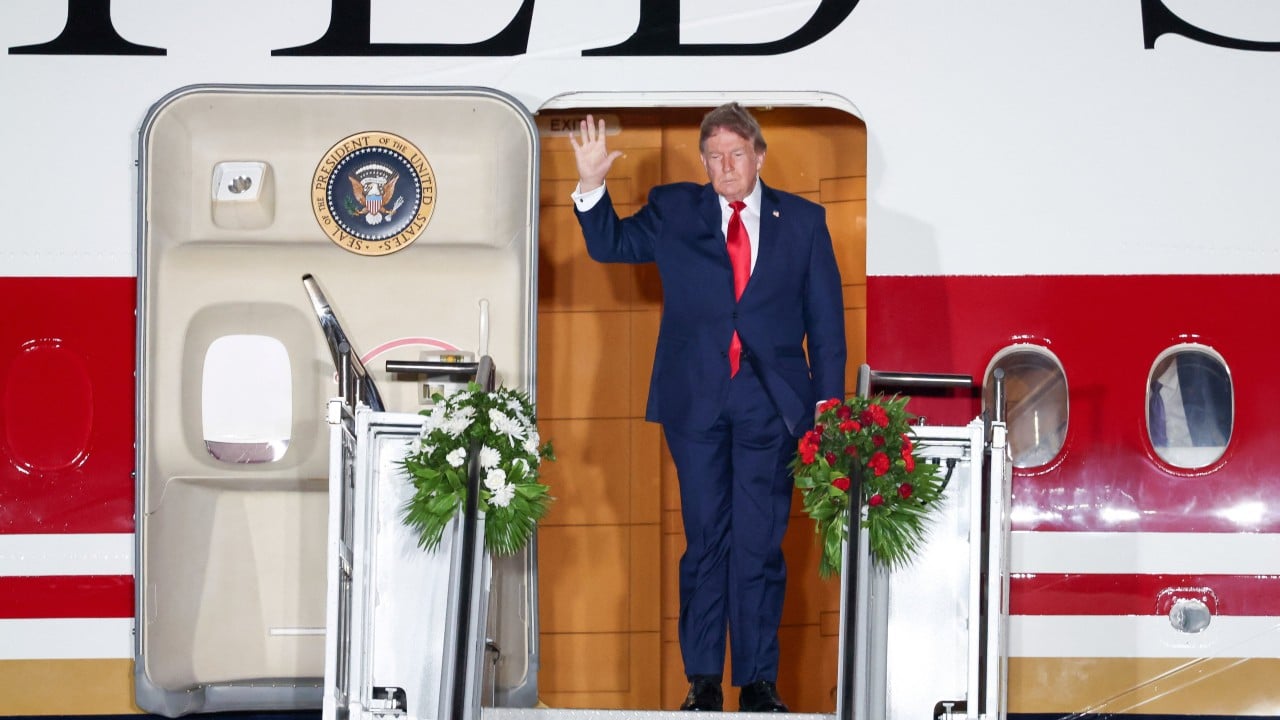
Air Force One touches down on the tarmac in Asia, and the cable news chyrons immediately start screaming about World War III or a sudden grand bargain. Every single time a U.S. president flies across the Pacific to sit down with the leaders of Russia and China, the media coverage turns into a breathless sports broadcast. They treat diplomacy like a heavyweight prize fight. Someone wins, someone loses, and the scoreboard updates before the plane even refuels.
That's not how any of this actually works.
When Donald Trump lands in Asia ahead of high-stakes talks with Russian President Vladimir Putin and Chinese President Xi Jinping, the real story isn't about who shakes hands harder or who gets the better photo-op at an international summit. It's about three leaders playing completely different games on the exact same board. If you're watching the press conferences for clues, you're looking at the wrong screen. Having spent years tracking diplomatic summits and analyzing the economic data that actually moves markets behind the scenes, I can tell you the public theater is almost entirely designed to distract you from the real leverage being traded in closed-door rooms.
The Reality Behind Trump’s Asia Diplomacy
Most people assume diplomatic summits are where big decisions get made. They aren't. By the time a U.S. president steps off the stairs in Tokyo, Seoul, Singapore, or Beijing, mid-level bureaucrats and cabinet secretaries have already spent months hashing out the fine print.
So why make the trip at all?
Because Trump operates on personal leverage, and both Xi and Putin know it. Unlike traditional politicians who rely heavily on State Department talking points and multilateral consensus, Trump prefers bilateral, transactional deal-making. He wants to look the other guy in the eye, gauge his weak spots, and cut a deal that he can sell back home as an immediate win.
The mainstream press loves to frame Trump landing in Asia as a chaotic wildcard moment. That misses the point entirely. His unpredictability isn't a bug in his foreign policy—it's his primary negotiating tool. When neither Moscow nor Beijing knows whether Washington is about to slap another round of punitive tariffs on their exports or offer a sudden compromise on sanctions, they have to show up to the table ready to deal.
Yet there's a massive catch here. Unpredictability cuts both ways. While it keeps adversaries off balance, it also makes traditional U.S. allies in the Indo-Pacific—like Japan, South Korea, and the Philippines—extremely nervous. Every time Trump sits down with Xi or Putin, officials in Tokyo and Taipei hold their breath, wondering if their security guarantees are about to become bargaining chips in a trade dispute or a ceasefire negotiation.
What Vladimir Putin Actually Wants From the Meeting
Let's strip away the cable news noise around the U.S.-Russia dynamic. When Putin agrees to sit down with Trump on neutral Asian turf, he isn't looking for a warm reset in relations. Moscow and Washington have fundamentally conflicting interests in Europe, the Middle East, and the Arctic. Putin knows that.
What Putin actually wants is recognition and relief.
First, he wants the visual proof that Russia isn't isolated. Western sanctions and diplomatic boycotts have pushed Moscow heavily into Beijing's orbit, turning Russia into something of a junior partner to China. Putin hates that dependency. Standing next to the American president at a major Asian forum sends a clear message to the rest of the world—especially to the Global South—that Russia remains a central power broker that Washington can't simply ignore.
Second, Putin is looking at the economic ledger. Sanctions haven't collapsed the Russian economy, largely because Moscow rerouted its oil and gas exports to China and India. Still, the long-term strain on Russian technology imports, banking infrastructure, and industrial growth is real. According to data from the International Monetary Fund, Russia's war-driven spending has created severe labor shortages and persistent inflation pressures that can't be sustained forever.
Putin's calculation is simple:
- Test whether Trump is willing to trade sanctions relief for compromises on European security.
- Exploit any visible friction between Washington and its NATO allies.
- Buy time while keeping Russian energy flowing into Asian markets.
He isn't going to give away core strategic assets because of a friendly dinner. Anyone telling you otherwise doesn't understand how the Kremlin operates.
Xi Jinping’s Economic Tightrope in the Pacific
While Putin plays a geopolitical survival game, Xi Jinping is staring at a massive domestic spreadsheet. You can't understand Xi's approach to Trump without looking at the structural slowdown inside China's economy.
For years, Beijing relied on real estate development and massive infrastructure spending to hit its growth targets. That model broke. With local governments drowning in debt and domestic consumer confidence remaining sluggish, China has doubled down on manufacturing and exports—specifically electric vehicles, solar panels, and batteries—to keep its factories running.
Enter Trump and his tariff threats.
The United States remains the ultimate consumer market of last resort. Even though China has diversified its trade toward Southeast Asia and Latin America, losing access to American buyers—or facing universal baseline tariffs—would hammer Chinese manufacturing margins at the worst possible time. The Peterson Institute for International Economics has documented extensively how supply chain shifts are already eating into China's share of U.S. imports, with countries like Vietnam and Mexico picking up the slack.
Xi doesn't want a full-blown trade war right now. He wants stability. His goal during these Asian talks is to manage the rivalry without looking weak to his domestic audience.
The Taiwan Factor Nobody Wants to Blink On
Of course, economics is only half the conversation. The elephant in every room in Asia is Taiwan.
Beijing views Taiwan as a breakaway province and refuses to rule out taking it by force. Washington maintains its longstanding policy of "strategic ambiguity," selling defensive weapons to Taipei while officially recognizing Beijing. Whenever Trump and Xi meet, Taiwan sits right at the center of the table.
Xi wants Trump to explicitly state that the U.S. opposes Taiwanese independence, hoping to drive a wedge between Washington and Taipei. Trump, meanwhile, has repeatedly questioned the cost of defending an island thousands of miles away while criticizing Taiwan's dominance in the global semiconductor industry. That rhetoric terrifies defense planners in Washington. If Xi walks away from their meeting believing the U.S. wouldn't intervene in a crisis, the risk of a miscalculation in the Taiwan Strait skyrockets.
The Tripolar Trap Washington Rarely Admits
Here is the part most political commentators completely miss: the U.S. is no longer dealing with Russia and China separately.
Over the past few years, Moscow and Beijing have built what they call a "no-limits" partnership. They conduct joint naval patrols in the Pacific. They trade in yuan and rubles to bypass the U.S. dollar. China buys discounted Russian crude, and Russia buys Chinese machine tools and dual-use electronics.
When Trump lands in Asia to meet both leaders, he is stepping into a coordinated diplomatic front. Putin and Xi routinely compare notes before and after talking to American officials. If Trump offers Putin a concession to pull Russia away from China—a strategy some foreign policy realists call a "reverse Nixon"—it almost certainly won't work. Putin knows American presidents change every four or eight years, whereas China is his permanent neighbor with a 2,600-mile shared border. He isn't going to betray Beijing for a temporary handshake in Asia.
Honestly, the idea that Washington can easily split Moscow and Beijing is pure nostalgia. The geopolitical reality in 2026 is much messier than it was in 1972.
Why Asian Allies Are Watching From the Sidelines
While the cameras follow Trump, Putin, and Xi, the real power players determining the long-term outcome of this trip are sitting in the waiting rooms.
Countries like Japan, South Korea, Singapore, India, and Vietnam don't want to choose between Washington and Beijing. They rely on the U.S. military for security and Chinese supply chains for economic growth. It's a brutal balancing act.
When Trump arrives in the region, these nations are looking for answers to three specific questions:
- Will the U.S. demand massive new payments for hosting American troops?
- Are broad tariffs going to hit Asian allies just as hard as they hit China?
- Is Washington actually committed to staying in the Indo-Pacific long-term?
If Trump treats Asian allies like freeloaders during this trip, he hands Xi Jinping a massive diplomatic victory without Beijing having to lift a finger. Southeast Asian nations in particular are pragmatic. If Washington looks unreliable or overly protectionist, they will quietly drift closer to Beijing's economic orbit, regardless of how tough Trump sounds in his press conferences.
How to Read the News Coming Out of This Summit
If you want to know what actually happened once Air Force One leaves Asia, ignore the cable news panels and watch three concrete indicators over the next sixty days.
Watch the currency and commodity markets first. If Trump and Xi make genuine progress on trade, you'll see an immediate reaction in the offshore Chinese yuan and agricultural futures like soybeans. If the talks were just empty pleasantries, the markets won't budge.
Track semiconductor and tech export controls. Talk is cheap, but export licenses are real. Look at whether the U.S. Commerce Department tightens or pauses restrictions on advanced chips and manufacturing equipment heading to China. That tells you whether Beijing actually offered meaningful concessions behind closed doors.
Monitor troop deployments and joint exercises. If Washington and Moscow reach any real understanding on European or global security, it will show up in military posture changes, not joint statements. Similarly, watch whether the U.S. Navy maintains its regular freedom-of-navigation transits in the South China Sea immediately after the summit.
Diplomacy at this level isn't a movie with a neat ending. It's a continuous grind of leverage, economic pressure, and calculated ambiguity. Keep your eyes on the policy shifts that follow the handshakes, because that's where the real story lives.