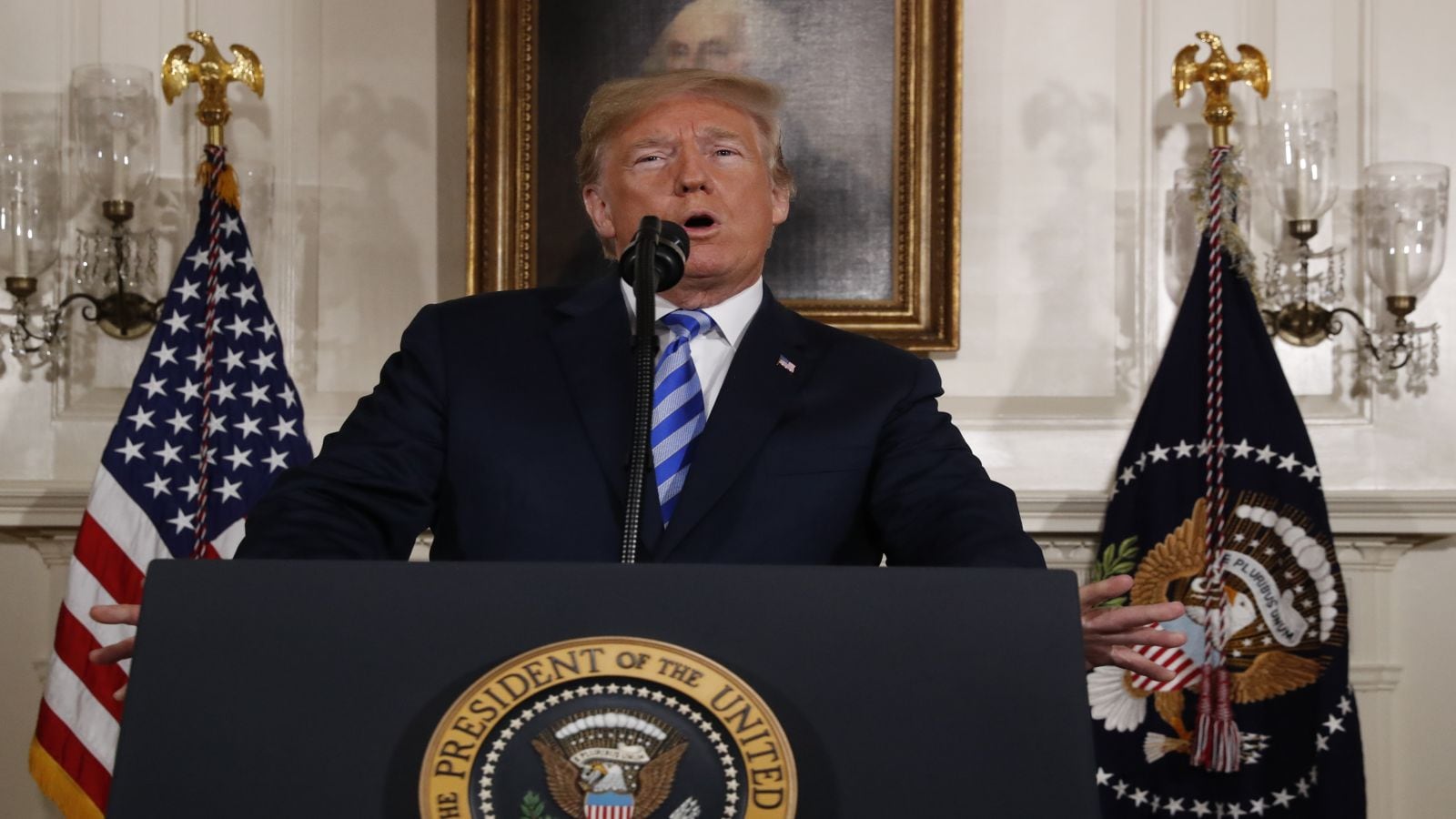
Standing on the White House South Lawn in late October 2026, President Donald Trump boiled nearly nine months of Middle East warfare down to a deceptively simple question: "Do we want to finish it off or just want to let it wither?"
On the surface, it sounds like a classic binary choice. Either the Pentagon launches a massive, decisive knockout blow to end the conflict fast, or Washington leans back, holds the naval blockade, and lets Tehran slowly bleed out economically. Meanwhile, you can find similar developments here: Why Rapid White House Press Shop Exits Are a Strategic Feature Not a Bug.
Except geopolitics rarely works like a light switch.
If you look closely at what's actually happening in the Persian Gulf, on Capitol Hill, and inside closed-door diplomatic channels in Doha and Muscat, you realize the "quick end versus slow wither" framing misses the real story. Trump isn't just picking between two neat military options. He's navigating a shrinking political clock, a $48.3 billion war bill, an Israeli government pushing for renewed strikes, and an Iranian leadership that has every reason to drag things out. To understand the bigger picture, check out the excellent report by USA Today.
The Reality Behind Letting the Conflict Wither
When Trump talks about letting the war "wither," he isn't describing a passive ceasefire. He's talking about economic suffocation.
Since mid-July 2026—following an earlier two-month blockade window in the spring—the U.S. Navy and Air Force have enforced a strict maritime blockade targeting ships entering or leaving Iranian ports. Oil from Arab Gulf producers is still moving through the Strait of Hormuz under U.S. Navy escorts, which is why Trump told reporters on October 23 that Washington is "getting everything we want".
Meanwhile, Iran's economy is taking a hammering.
By September 2026, the maritime chokehold had pushed Iranian inflation to roughly 70 percent. Trying to reroute trade overland or across the Caspian Sea has turned into a logistical nightmare—higher freight costs, border bottlenecks, and severe shortages of industrial spare parts. To plug those gaps, U.S. Central Command stood up Task Force Iron Gate out of Tampa to choke off sanctioned transfers across Iran's land borders and the Caspian. The Treasury Department and CENTCOM also froze roughly $350 million in Iranian cryptocurrency assets.
Secretary of State Marco Rubio spelled out the administration's core logic during a November speech to the Federalist Society. The economic pain inflicted on the regime is already so severe, Rubio argued, that Washington doesn't necessarily need a massive new bombing campaign to break Tehran's leverage.
Honestly, on paper, the "wither" strategy looks attractive if you're sitting in the West Wing. You keep American troops out of large-scale ground combat, keep global oil flowing enough to prevent a total price shock, and let compound economic pressure force Tehran to the table.
There's just one catch. A cornered adversary doesn't sit quietly while you starve its economy.
Why a Quick Knockout Blow Is Harder Than It Sounds
If letting the conflict wither carries risks, why not "finish it off" quickly?
In Washington policy circles, "finishing it off" usually points to one of two military escalations. The first is a targeted strike on deeply buried nuclear infrastructure—specifically Pickaxe Mountain in central Iran, a fortified site Trump has repeatedly warned he's watching closely. The second is a sweeping aerial campaign against remaining Iranian energy, missile, and industrial infrastructure.
David Schenker, who served as assistant secretary of state for Near Eastern affairs during Trump's first term, noted that hitting a high-value nuclear site like Pickaxe Mountain could give Trump a plausible off-ramp. He could declare major damage done to Iran's nuclear ambitions, pursue a limited arrangement restoring normal transit in the Strait of Hormuz, offer narrow sanctions relief, and kick deeper nuclear talks down the road.
Sounds clean, right? In practice, military analysts and intelligence officials see massive friction.
- War termination takes two sides. As Bradley Bowman at the Foundation for Defense of Democracies put it, once you start a fistfight, you can choose to stop throwing punches, but you can't force the other guy to stop swinging. Even if U.S. bombers hit Pickaxe Mountain tomorrow, Tehran still holds asymmetric cards across the region.
- Intelligence doubts on regime behavior. U.S. intelligence assessments have questioned whether renewed air strikes would actually change Tehran's fundamental negotiating posture rather than simply hardening its resolve.
- Retaliation isn't hypothetical. Just look at mid-November 2026. After a U.S. fighter jet struck an Islamic Revolutionary Guard Corps missile launch site on Qeshm Island in the Strait of Hormuz, Iran widened its retaliatory fire—launching drones and strikes toward U.S. assets in Bahrain and a U.S. air base in Kuwait. Iranian commanders and Supreme Leader Ayatollah Mojtaba Khamenei have explicitly warned that any return to full-scale hostilities would remove geographical limits on Iranian missiles, putting Gulf energy infrastructure, European bases, and undersea internet cables in the crosshairs.
You can drop bunker-busters in an afternoon. You can't guarantee the war ends the next morning.
The Domestic Clock Running Against the White House
Any serious look at Trump's Iran strategy has to account for what happened on November 3, 2026.
Voters handed Democrats control of Congress in the midterm elections, and economic frustration tied to the Iran conflict played a starring role in the Republican losses. Even Vice President J.D. Vance acknowledged the political toll the war took on the GOP before Trump directed him to pivot away from Iran diplomacy and focus on domestic policy.
That election result completely reshaped the calendar.
Right now, Trump operates in a lame-duck congressional window before newly elected Democrats take their seats in January 2027. On November 19, the outgoing Republican-led Senate blocked a war-powers measure aimed at curbing the conflict. Once January arrives, a Democratic majority will have far more institutional leverage to scrutinize Pentagon spending, hold hearings, and complicate military operations.
And the price tag is already drawing sharp questions on Capitol Hill.
According to Pentagon deputy comptroller Arthur Miller, the war had cost the U.S. military $48.3 billion as of November 13, 2026—roughly 26 to 27 percent higher than earlier Congressional Budget Office projections. Worse, Miller told lawmakers that the $48.3 billion tally covers operations and munitions replacement, not the repair bill for U.S. bases across the Middle East hit by Iranian missiles and drones. Both Democratic Senator Richard Blumenthal and Senate Armed Services Chair Roger Wicker have pressed the Pentagon to finally release those facility damage numbers.
At the same time, energy markets remain jittery. Brent crude dipped below $95 a barrel right after the midterms—a two-month low—precisely because traders bet that election backlash would deter Trump from ordering massive new strikes on Iranian oil infrastructure. A sudden escalation would send pump prices right back up, handing Democrats an instant political weapon heading into 2027.
Allied Pressure and the 2027 Pivot
If you watch Trump's public statements from day to day, you can practically see him pulling in opposite directions.
In a November Fox News interview, he vowed to "finish it off—soon" and insisted he wants a lasting agreement that a future president couldn't easily undo. Days later, speaking to an Israeli television network and Axios on November 19, he shifted gears—saying he wasn't "rushing into any decision" and might wait until 2027 to decide his next move.
Behind closed doors, heavy lobbying is driving that tension.
Israeli Caretaker Prime Minister Benjamin Netanyahu has pushed hard for either joint U.S.-Israeli strikes or a green light for Israel to hit Iran's rebuilding missile and nuclear sites before Tehran recovers its production capacity. Mossad chief Roman Gofman even traveled to Washington in mid-November to meet with CIA Director John Ratcliffe and make the intelligence case for acting before the new year.
Meanwhile, regional mediators in Qatar and Oman are trying to keep backchannel talks alive in Doha, even as sporadic drone and missile exchanges test the fragile pause. Trump's APEC summit meetings in Shenzhen with Chinese President Xi Jinping and Russian President Vladimir Putin also add a major-power layer, since Beijing and Moscow hold sway over sanctions enforcement and diplomatic cover for Tehran.
What Actually Matters If You Are Tracking This Conflict
Most cable news coverage treats every off-the-cuff remark from the White House lawn as a permanent policy shift. That's a mistake. When public rhetoric swings wildly between "locked and loaded" and "we've got time," watch actions instead of soundbites.
Watch the Maritime and Financial Chokepoints
The true barometer of the "wither" strategy isn't press conferences—it's ship transits and Task Force Iron Gate enforcement. As long as the U.S. Navy maintains its carrier presence and intercepts blockade runners without triggering sustained Houthi or IRGC shutdowns of the Red Sea and Strait of Hormuz, Washington holds economic leverage. If tanker seizures or undersea cable disruptions spike, the status quo breaks.
Track the January Congressional Handover
Pay close attention to Pentagon budget disclosures and war-powers votes between now and January 2027. Any major unilateral U.S. strike is far easier for the White House to execute before the new Congress is seated than after. Once January hits, funding battles and oversight hearings will narrow Trump's room to maneuver.
Separate Legal Reality From Political Slogans
Trump says he wants a deal that "supersedes" future presidents. In U.S. constitutional law, only a formal treaty ratified by two-thirds of the Senate carries that kind of durability—something virtually impossible to pass in a polarized Congress. Any realistic settlement coming out of Doha or Muscat will be an executive arrangement, meaning its survival depends on concrete verification mechanisms on the ground rather than a signature in Washington.
Trump's dilemma isn't really a choice between ending the war fast or letting it fade away. Both paths carry steep, unavoidable costs—and right now, Washington is trying to buy time while figuring out which price it's actually willing to pay.


