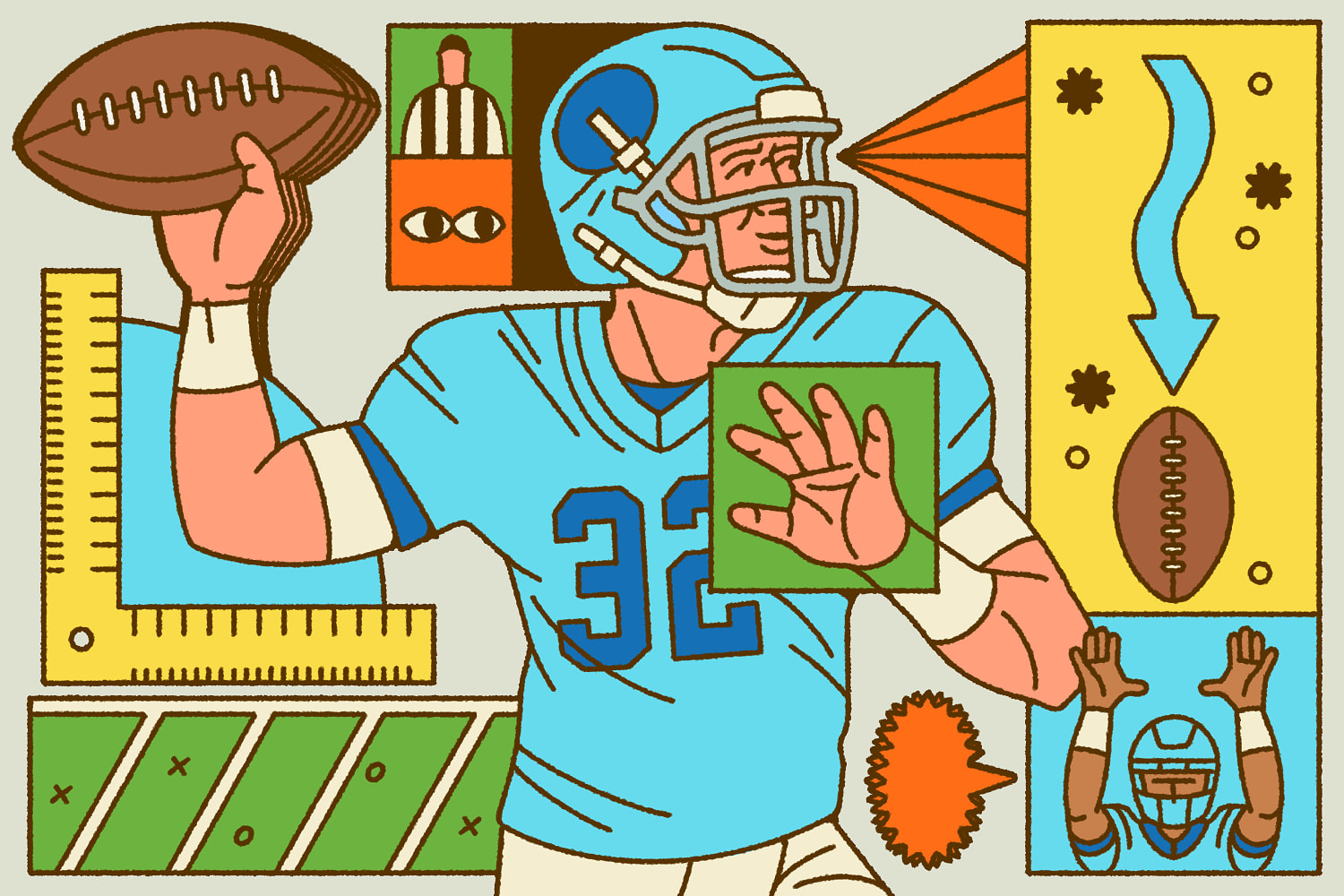
In the high-stakes environment of the NFL scouting combine, physical measurements serve as the baseline for risk mitigation and ceiling projection. While on-field performance provides a record of past success, anthropometric data—specifically hand size and wingspan—functions as a predictive tool for technical proficiency and physical limits. These metrics are not mere curiosities; they are foundational inputs in the mathematical model of a "prototypical" athlete, designed to filter out prospects whose physical constraints may lead to performance bottlenecks at the professional level.
The Biomechanical Logic of Hand Size
The emphasis on hand size is often dismissed by casual observers as an obsession with minutiae. However, for quarterbacks and ball-carriers, hand span dictates the physics of ball security and control. The official measurement—taken from the tip of the thumb to the tip of the pinky with the hand fully extended—determines the surface area available to grip the Wilson Duke football, which has a circumference of roughly 21 inches at its widest point.
Grip Strength and Kinetic Transfer
A larger hand allows for more points of contact on the ball's surface. This increased surface area results in greater frictional force, which is critical during the high-velocity arm action of a deep pass. When a quarterback with sub-9-inch hands attempts to drive the ball through wind or rain, the lack of a secure grip can lead to "wobble" or a loss of RPMs (revolutions per minute). This isn't just about accuracy; it is about the physics of the spiral. A tighter spiral maintains its velocity longer due to reduced drag.
The Fumble Variable
Ball security is a direct function of hand size. Data across multiple NFL seasons suggests a correlation between smaller-than-average hands and a higher frequency of "lost" fumbles. In a league where a single possession often determines the outcome of a game, a quarterback who cannot consistently secure the ball during a strip-sack becomes a liability. Scouts use the 9-inch threshold not as a guarantee of success, but as a threshold for acceptable risk.
Wingspan as a Force Multiplier
Wingspan, or "reach," is the distance between the tips of the middle fingers when arms are extended horizontally. In the context of the NFL, wingspan is frequently more indicative of success than raw height. For offensive and defensive linemen, reach is the primary determinant of "first contact" proficiency.
The Lever Principle in the Trenches
Football in the trenches is a game of levers. If an offensive tackle has a wingspan of 82 inches while the opposing defensive end has a wingspan of 78 inches, the tackle possesses a significant mechanical advantage. By landing his hands on the defender's chest first, the tackle can dictate the defender’s movement and prevent him from getting into his "frame." This extra four inches of reach functions as a buffer, allowing the tackle to maintain distance and leverage without sacrificing his center of gravity.
Catch Radius and the Boundary
For wide receivers and tight ends, wingspan defines the "catch radius"—the three-dimensional space around a player where they can successfully retrieve a pass. A receiver with an 80-inch wingspan can reach balls that are mathematically impossible for a defender with a 74-inch wingspan to deflect, even if they have the same vertical leap. This creates a margin of error for the quarterback. A "large" catch radius effectively turns inaccurate passes into completions, transforming the efficiency of the entire offensive unit.
The Limitation of Isolated Metrics
While these measurements are critical, they do not exist in a vacuum. The utility of hand size or wingspan is modulated by two secondary factors: functional strength and reactionary speed. A massive wingspan is useless if the athlete lacks the pectoral and tricep strength to lock out their arms upon contact. Similarly, large hands do not compensate for poor processing speed or a slow release.
The Prospect Profile Bottleneck
The NFL scouting community utilizes a "profile" system. If a prospect falls below the 25th percentile in a key metric like hand size, they must perform in the 90th percentile in a compensatory trait (such as 40-yard dash time or completion percentage) to maintain their draft grade. This creates a bottleneck effect. The "prototypical" prospect is one who meets the baseline thresholds across all anthropometric categories, thereby minimizing the number of variables the coaching staff must "fix" or work around.
Positional Thresholds and Market Value
The NFL market assigns specific dollar values to these physical traits. The "Left Tackle Premium" is driven largely by the scarcity of humans who possess both the 300-pound mass and the 34-inch arm length required to negate elite edge rushers.
- Quarterbacks: The 9-inch hand threshold is a historical benchmark. While outliers like Joe Burrow (9 inches) have succeeded, those below this mark face intense scrutiny regarding cold-weather performance and fumble rates.
- Offensive Tackles: Arm length of 33 inches is generally considered the "floor." Prospects with shorter arms are often moved to the interior (guard or center), where the space is more confined and reach is less of a factor.
- Edge Rushers: Length is equated with the ability to "disengage." A defender who can keep a lineman's hands off his chest is more likely to execute a successful pass-rush move.
Quantifying the Unseen
The shift toward data-driven scouting has led to the adoption of the "Relative Athletic Score" (RAS), which aggregates these measurements into a single 0-10 scale compared to historical peers. This allows front offices to see exactly how a prospect’s wingspan or hand size stacks up against the "All-Pro" average.
However, the data shows that physical traits are better at predicting a player's floor than their ceiling. A player with massive hands and an elite wingspan may still fail due to a lack of "football IQ" or poor work ethic. Conversely, a player with sub-optimal measurements will always be fighting an uphill battle against the laws of physics. They must be technically perfect to overcome the leverage disadvantages inherent in their frame.
Strategic Asset Allocation
NFL franchises must decide how to weight these physical "red flags" against on-field production. The most successful teams treat anthropometric data as a filter rather than a definitive answer. If a prospect has short arms but elite tape, the strategy is not to ignore the arms, but to project how those short arms will be exploited by professional-grade talent.
The move toward "positionless" defenders and hybrid offensive weapons has slightly relaxed some of these rigid benchmarks, but the core principles of leverage and ball control remain unchanged. In a game of inches, the length of a thumb or the reach of an arm is often the difference between a touchdown and a turnover.
Front offices should prioritize prospects who fall within one standard deviation of the "elite" physical profile while demonstrating superior cognitive processing. The physical traits provide the capacity for greatness, but the technical application determines the realization of that capacity. Teams that overvalue measurements at the expense of "game speed" often find themselves with a roster of high-ceiling athletes who cannot execute a playbook. The optimal strategy remains the identification of "high-floor" physical specimens who possess the neurological wiring to leverage their natural mechanical advantages.