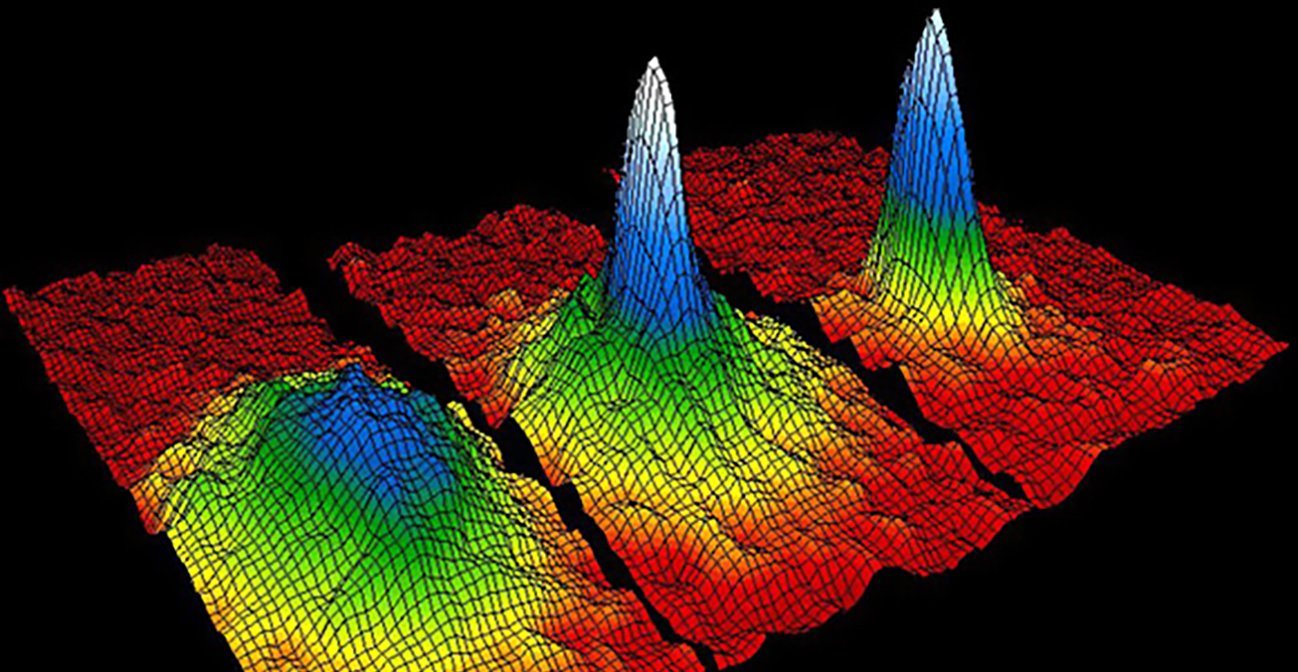
The transition from microscopic quantum mechanics to macroscopic classical reality represents the most significant friction point in modern physics. Anthony J. Leggett’s career was defined by the systematic dismantling of the assumption that quantum effects must dissipate at the scale of human observation. By providing the theoretical framework for the superfluidity of Helium-3 ($^3\text{He}$), Leggett did more than solve a low-temperature anomaly; he established the parameters for how trillions of atoms can act as a single, coherent quantum entity. This shift moved quantum mechanics from a theory of the "small" to a theory of the "organized," providing the foundational logic for contemporary quantum computing and topological materials.
The Tri-Phase Complexity of Helium-3
To understand Leggett’s 2003 Nobel Prize-winning work, one must first identify the structural failure of existing models in the early 1970s. While Helium-4 ($^4\text{He}$) becomes a superfluid through Bose-Einstein Condensation—where atoms with integer spin simply "overlap" into the lowest energy state—Helium-3 atoms are fermions. They possess half-integer spin and, by the Pauli Exclusion Principle, refuse to occupy the same state.
Leggett’s breakthrough involved identifying the mechanism of Cooper pairing within a neutral liquid. Unlike superconductors, where electrons pair via lattice vibrations, Helium-3 atoms pair via magnetic interactions (spin fluctuations). This creates a vastly more complex order parameter than seen in previous superfluids.
The Cooper pairs in $^3\text{He}$ possess both internal spin ($S=1$) and orbital angular momentum ($L=1$). This internal structure results in multiple distinct superfluid phases, primarily labeled A and B:
- The A-Phase (Anisotropic): Characterized by "equal-spin pairing." This phase breaks rotational symmetry, behaving like a liquid crystal where the pairs align along a specific axis.
- The B-Phase (Isotropic): A more robust state where the pairing is symmetric across all directions.
- The A1-Phase: Occurring only in high magnetic fields, representing a unique state where only one spin species contributes to the superfluid density.
Leggett’s specific contribution was the development of the "Leggett equations," which utilized the concept of Spontaneously Broken Spin-Orbit Symmetry (SBSOS). He proved that the tiny magnetic interactions between nuclei—normally ignored as negligible—could be amplified by the collective motion of the superfluid to produce measurable nuclear magnetic resonance (NMR) shifts. This was the first definitive proof that the entire macroscopic volume of the liquid was participating in a singular quantum wave function.
The Caldeira-Leggett Model and Decoherence Functionalism
The second pillar of Leggett’s legacy addresses why we do not see quantum effects in everyday life. The "Schrödinger's Cat" paradox is often treated as a philosophical curiosity, but Leggett treated it as a boundary condition problem. He sought to quantify the exact point where a quantum system loses its coherence due to interaction with its environment.
The Caldeira-Leggett model treats a quantum system (like a particle in a potential well) as being coupled to a "bath" of an infinite number of harmonic oscillators. This "bath" represents the environment—air molecules, thermal fluctuations, or even the materials of a measuring device.
The Dissipation Mechanism
In this framework, the environment acts as a sink for information. As the quantum system moves, it "drags" the environment with it, creating a friction-like effect known as quantum dissipation. The model demonstrates that:
- Coupling Strength: Even weak coupling to a massive environment causes the phase relationship between quantum states to decay exponentially.
- Scale Dependency: The more "macroscopic" the system, the more environmental degrees of freedom it touches, making the "decoherence time" $(\tau_d)$ nearly instantaneous.
This work provided the mathematical justification for why quantum computers are so difficult to build. A qubit must be isolated enough to prevent decoherence but accessible enough to be manipulated. Leggett’s math defines the "error budget" for every superconducting circuit currently being tested by firms like IBM and Google.
Testing the Limits of Realism
Leggett remained a vocal critic of the "shut up and calculate" interpretation of quantum mechanics. He proposed a rigorous distinction between two worldviews:
- Macrorealism: The belief that a macroscopic object which has two or more states available to it must at all times be in one or the other.
- Quantum Superposition: The belief that the object exists in a linear combination of those states until measured.
To settle this, he formulated the Leggett-Garg Inequality. Much like Bell’s Inequality tests for "local realism" at the atomic scale, the Leggett-Garg Inequality tests for "macrorealism" over time.
The experiment involves measuring a single system at different times. If macrorealism holds, the correlation between these measurements must fall within a specific numerical bound. Experiments on SQUIDs (Superconducting Quantum Interference Devices) have repeatedly violated these bounds, proving that even macroscopic currents involving billions of electrons can exist in a state of quantum superposition. This validates the possibility of large-scale quantum hardware but deepens the mystery of the "transition" to the classical world.
Structural Implications for Quantum Engineering
The transition from Leggett’s theoretical proofs to industrial application follows a direct causal chain. By defining how $^3\text{He}$ maintains order through complex pairing, he laid the groundwork for Topological Superconductors.
The A-phase of Helium-3 is a "topological" state. In these states, the bulk of the material might be an insulator or a standard fluid, but the edges or surfaces host "Majorana fermions"—particles that are their own anti-particles. In a computational context, these particles allow for "Topological Quantum Computing," where information is stored not in the state of a single particle (which is prone to flipping/errors), but in the "braiding" of these particles. Because you cannot "un-braid" something through a small local disturbance, these computers would be naturally immune to the decoherence Leggett spent his life quantifying.
The Logic of Macroscopic Quantum Phenomena (MQP)
Leggett’s work forces a re-categorization of physical systems based on "Coherence Length" $(\xi)$ and "Particle Number" $(N)$.
- Microscopic (Low $N$, High $\xi$): Standard atomic physics.
- Macroscopic Classical (High $N$, Low $\xi$): Standard engineering, where $h$ (Planck’s constant) is effectively zero.
- Macroscopic Quantum (High $N$, High $\xi$): The Leggett Regime. Superfluids, Superconductors, and Bose-Einstein Condensates.
The bottleneck in current technology is moving more systems into the third category. The primary constraint is not just temperature, but the "Spectral Density" of the environment—the specific way the surroundings "listen" to the system.
Strategic Vector for Quantum Materials Development
The trajectory of condensed matter physics is moving toward the "Leggett Limit," where we attempt to maintain quantum correlations across larger distances and at higher temperatures. Based on Leggett's framework, the development path for the next decade must prioritize:
- Phase-Space Engineering: Utilizing the anisotropic properties of $^3\text{He}$-like states in solid-state systems to create "directional" quantum channels.
- Environment Noise Spectroscopy: Instead of trying to eliminate the "bath" (which is physically impossible), engineers must map the spectral density of the environment to find "quiet" frequencies where decoherence is minimized.
- Non-Equilibrium Dynamics: Moving beyond the static phases Leggett mapped into systems that maintain macroscopic coherence while being driven by external energy sources (Time Crystals and Floquet Lead-Systems).
The fundamental challenge is no longer whether quantum mechanics applies to the large scale—Leggett proved it does—but rather how to suppress the environmental coupling he so precisely defined. The immediate strategic requirement for quantum hardware developers is the transition from "passive isolation" to "active environment decoupling" based on the Caldeira-Leggett dissipation constants.