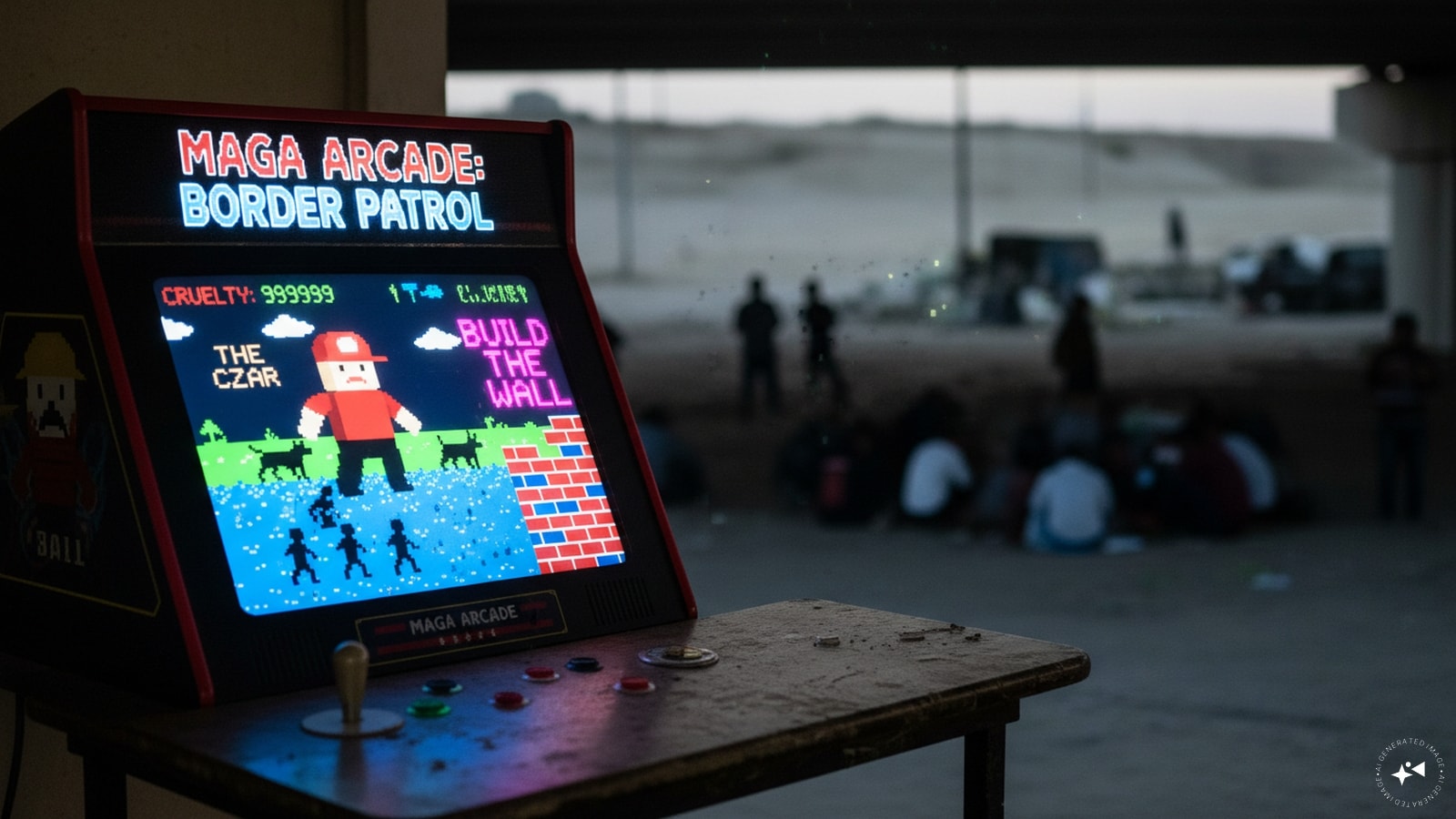
The glow of an arcade cabinet is usually a warm invitation. It promises neon escapism, a safe digital theater where quarters buy temporary heroism against space invaders, rampaging gorillas, or abstract geometric demons. You step up, wrap your hands around a well-worn joystick, and tap buttons until your thumbs ache. But inside the belly of executive power during the Trump administration, the cabinets hummed with a different kind of code.
They did not feature pixels of outer space. They featured pixels of policy.
Consider the atmosphere of a modern political campaign. It is loud. It is saturated. It is desperate for the currency of attention. When political operatives seek to imprint complex, polarizing ideologies onto the public consciousness, they rarely rely on white papers or dense legislative summaries. They look for the vernacular of the street. They look for the arcade.
Reports emerged detailing how the Trump White House introduced custom arcade games into its orbit—interactive digital experiences where players could simulate the physical exclusion of human beings. In these virtual environments, players did not rescue princesses or navigate dungeons. They engaged in the mechanics of border enforcement, tasked with stopping virtual migrants from crossing a digital line and stacking bricks to build a colossal barrier.
To understand why this happened, we have to look past the initial shock value of the headline. We have to examine how political theater metastasizes into digital play.
Think about the way an arcade game is designed. It must be immediate. It must distill complex, systemic friction down to binary outcomes. Win or lose. Success or failure. Good guy or bad guy. When you translate a debate as fraught and historically layered as immigration into an eight-bit or sixteen-bit interactive loop, you perform a radical act of reduction. You strip away the courtroom hearings. You strip away the family separations, the labor economics, the geopolitical instability of Central America, and the desperate nocturnal crossings under barbed wire.
In their place, you install a points system.
Imagine standing in a carpeted room of a government annex or a campaign bullpen, illuminated by the flickering phosphor glow of a screen. A digital figure appears at the edge of the display. Your thumb twitches on a red plastic button. You press it. The figure stops, or turns back, or a score ticks upward. A satisfying chime plays, echoing the same auditory reward loop found in a game of Pac-Man or Tetris.
That chime is the engine of the entire operation. It turns a human crisis into a dopamine hit.
For decades, political communication has relied on print, television, and radio. These mediums are inherently observational. You read an editorial; you watch a cable news segment; you listen to a stump speech. You remain an audience member, separated by the proscenium arch of the media apparatus. But video games demand participation. They require the user to enact the ideology. You cannot simply watch the wall go up; you must build it, brick by virtual brick, feeling a simulated sense of construction and completion.
This is not an accident. It is the logical evolution of political marketing in a fractured media ecosystem. When public discourse is flooded with noise, the loudest, most visceral caricature wins. By gamifying immigration enforcement, political architects bypassed the rational, deliberative parts of the human brain and went straight for the competitive, reactive core.
Let us be entirely clear about the mechanics here. We are not talking about a casual smartphone app developed by an independent hobbyist in a basement. We are talking about the intersection of state power and gamified ideology. When the machinery of the executive branch aligns with the aesthetics of amusement arcades, the message sent to supporters is unmistakable: this is a game we are winning.
The strategy taps into a deep, primal human impulse: the defense of the perimeter. Anthropologists have long noted our tribal inclinations to draw lines in the dirt, to separate the in-group from the out-group, to secure the hearth against the unknown elements outside. By translating that ancient impulse into a coin-op format, the campaign weaponized nostalgia. It took the comforting cultural touchstones of youth—arcades, high scores, friendly competition—and fused them with an exclusionary political platform.
Yet, the dissonance of this imagery is staggering. The United States immigration system is governed by agonizingly slow administrative courts, labyrinthine federal statutes, and human lives hanging in the balance of a judge's final decree. It is defined by exhaustion, legal limbo, and profound suffering on both sides of the political divide. To reduce this monumental humanitarian and legal challenge to a high-score table is to perform a kind of moral flattening.
When you play a game, the stakes are ultimately artificial. If your character dies, you drop another quarter. If you fail to build the wall in time, you hit the reset button. But real-world policy does not have a reset button. When borders are closed, when asylum seekers are turned away, when communities are fractured, the consequences do not reset when the machine goes dark at closing time.
The introduction of these cabinets reveals something profound about the changing nature of political persuasion in the twenty-first century. We have entered an era where governance is increasingly subservient to entertainment value. If an idea cannot be packaged into a viral meme, a soundbite, or an interactive minigame, it struggles to survive in the attention economy.
We must ask ourselves what happens to our collective empathy when the most complex moral dilemmas of our time are turned into leisure activities. When the exclusion of human beings becomes high score material, the boundary between policy and cruelty begins to blur. The arcade cabinet becomes a mirror reflecting a culture that has learned to gamify its own anxieties.
The lights on the marquee flash. The digital crowd cheers. Another quarter drops into the slot. And somewhere out in the vast, complicated, breathing world beyond the screen, the real human story continues, untouched by the high scores, waiting for a kind of attention that no machine can ever calculate.