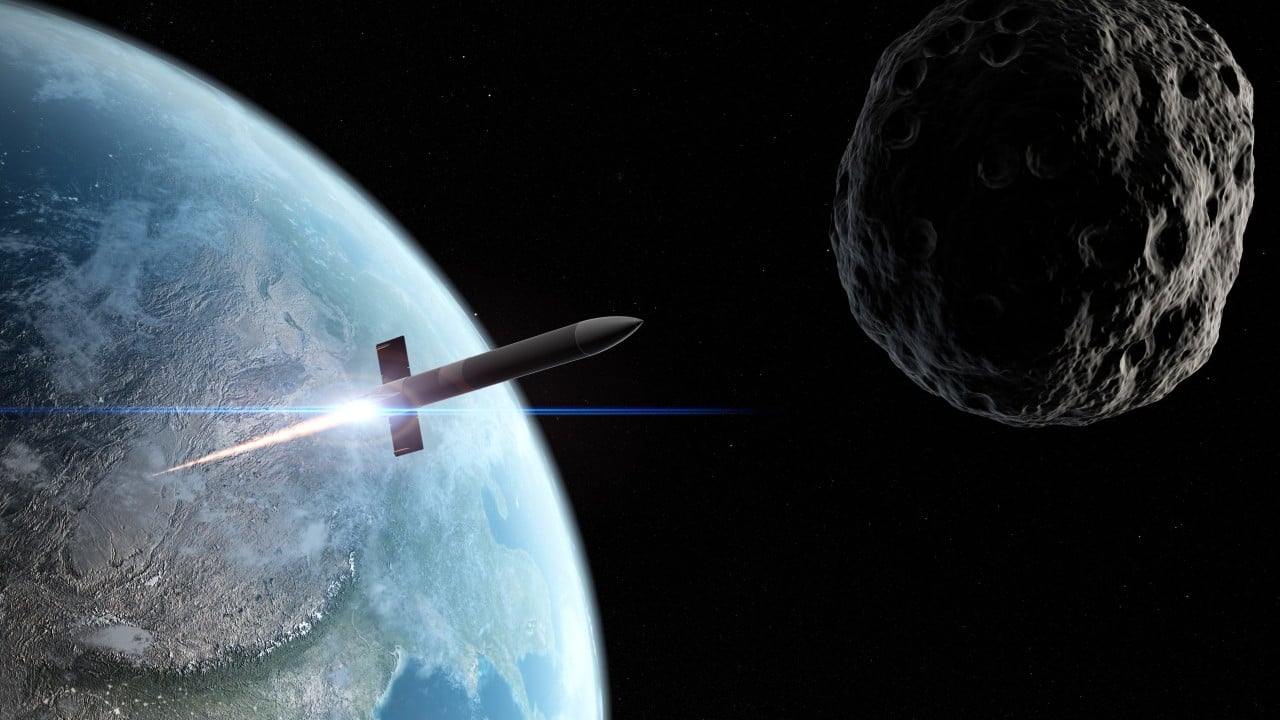
When an asteroid with sufficient kinetic energy to alter civilization trajectories approaches Earth, traditional deflection strategies face a fundamental constraint: time. Kinetic impactors, such as the architecture demonstrated by NASA's Double Asteroid Redirection Test, rely on momentum transfer over long observational baselines. If discovery occurs years or decades before a projected intersection, low-energy pushing or pulling mechanisms suffice. When lead times collapse to months or weeks, kinetic deflection fails due to momentum insufficiency. Under those conditions, high-yield nuclear explosives remain the sole technological intervention capable of delivering the required energy density to disrupt or divert an incoming body.
Recent structural modeling by Chinese aerospace researchers introduces a revised methodology for evaluating nuclear mitigation. Instead of treating surface detonations or subsurface burying as isolated variables, the computational framework maps energy deposition mechanics against asteroid internal structure, momentum dispersion, and debris re-accumulation thresholds. This analysis deconstructs the physical constraints governing nuclear asteroid interception, detailing why conventional assumptions regarding explosive yields fail when applied to porous rubble piles. Discover more on a similar issue: this related article.
The Physical Constraint of Internal Porosity
The primary engineering variable in planetary defense is not the mass of the asteroid, but its internal cohesion. Astronomical observations confirm that many near-Earth objects exceeding one hundred meters in diameter are not monolithic rock formations. They are gravitationally bound aggregates of boulders, dust, and empty space, commonly designated as rubble piles.
When a nuclear device detonates near or on a rubble pile, the energy transfer mechanism differs fundamentally from atmospheric or terrestrial detonations. A monolithic asteroid transmits shockwaves through a continuous crystalline or sedimentary matrix, allowing a surface blast to fracture the body evenly or impart uniform momentum. A rubble pile absorbs and dampens shock propagation. The high-pressure plasma and X-ray flux encounter internal void spaces that act as mechanical shock absorbers, dispersing thermal and kinetic energy locally rather than globally. Additional journalism by Wired highlights related views on the subject.
This structural reality invalidates simple scaling laws derived from underground nuclear testing on Earth. On Earth, a multi-megaton yield creates a predictable crater and seismic displacement because the medium is dense and continuous. In a porous asteroid, the same yield risks a localized vaporization event that creates a massive crater without moving the center of mass of the greater body. The explosion vents through the path of least resistance—typically outward through the surrounding regolith—leaving the dense core structurally intact while ejecting surface material harmlessly into space.
The Three-Phase Energy Deposition Framework
To overcome internal dampening, recent computational models simulate a multi-stage energy deposition process. This framework categorizes the interception mechanics into three distinct physical phases: thermal X-ray ablation, shockwave propagation, and momentum coupling.
Phase One: X-Ray Ablation and Surface Vaporization
Upon detonation of a thermonuclear device at a standoff distance of several hundred meters, the primary output consists of soft X-rays. These photons strike the sunlit face of the asteroid, instantly superheating the surface regolith to temperatures exceeding tens of thousands of Kelvin. This material transitions immediately into an expanding plasma plume.
The efficiency of this phase depends entirely on the standoff distance. If the device is too close, the blast destroys the spacecraft before complete energy release occurs, or it vaporizes too small an area, creating an asymmetric blow-off hole. If the device is too far, the energy density of the X-ray flux drops below the threshold required to vaporize the target material effectively, reducing momentum transfer.
Phase Two: Internal Shockfront Attenuation
As the plasma plume expands outward, it exerts a reactive rocket-like thrust on the remaining asteroid body. Simultaneously, a mechanical shockwave penetrates inward. The mathematical modeling demonstrates that the success of this phase relies on matching the shock front velocity to the acoustic impedance of the asteroid material. If the asteroid possesses high porosity, the shockwave fractures internal weak points, causing the body to undergo catastrophic fragmentation rather than controlled acceleration.
Phase Three: Fragment Re-Accumulation Dynamics
The most critical blind spot in early nuclear defense concepts was the assumption that breaking an asteroid apart eliminates the threat. Detailed gravitational modeling proves otherwise. If a nuclear detonation shatters a five-hundred-meter asteroid into thousands of smaller fragments, but fails to impart a velocity differential high enough to clear Earth's orbital path, the fragments will re-accumulate under their mutual gravity within weeks or months.
The resulting reconstituted body may have a altered shape, but its trajectory remains an intersection hazard. Therefore, any viable nuclear interception strategy must calculate the escape velocity of the debris field. The energy yield must exceed the gravitational binding energy of the target by a specific margin to ensure that the fragments achieve hyperbolic trajectories away from the Earth-Moon system.
Comparative Mechanics of Interception Modalities
| Interception Mode | Primary Energy Transfer Mechanism | Failure Mode | Optimal Target Profile |
|---|---|---|---|
| Surface Contact Detonation | Direct mechanical shock and crater excavation | Localized venting; structural containment by porosity | Monolithic iron-nickel bodies |
| Standoff X-Ray Ablation | Thermal radiation and surface plasma blow-off | Insufficient standoff optimization; low momentum coupling | Porous rubble pile aggregates |
| Subsurface Buried Charge | Containment cavity expansion and seismic momentum push | Premature drilling failure; unpredictable anchoring in loose regolith | Medium-sized carbonaceous chondrites |
Evaluating these modalities reveals why standoff detonation consistently outperforms direct surface contact or subsurface excavation in computational models. Drilling into an asteroid of unknown composition introduces an unmanageable mechanical variable. The anchoring mechanisms required to keep a drill stable in zero-gravity environments against a rotating, loose-surfaced body remain technologically unproven at mission scale. Standoff ablation bypasses the mechanical anchoring problem entirely, utilizing photon-matter interactions to generate uniform thrust across the face of the target.
The Trajectory Correction Window and Interception Timing
The utility of a nuclear interceptor is bounded by a strict temporal window. Operating too early offers diminishing returns because positional uncertainties in the asteroid's orbit compound over long arcs, making precise targeting difficult. Operating too late compresses the required velocity change to values beyond current technological limits.
To achieve a displacement distance equal to the radius of Earth plus a safety margin of several thousand kilometers, a deflecting force must be applied years in advance if the momentum change is small. When utilizing a multi-megaton nuclear device, the required warning time drops significantly due to the magnitude of the impulse delivered in seconds. However, this high-impulse approach introduces a secondary hazard: the prompt radiation belt and electromagnetic pulse generated by high-altitude or deep-space detonations, which require careful trajectory planning to avoid damaging orbital infrastructure or lunar assets.
The calculations establish that for an asteroid detected with less than six months of lead time, kinetic impactors are rendered obsolete. Nuclear standoff ablation remains the sole physics-backed mechanism capable of imparting the necessary delta-v to alter the semi-major axis of the inbound body sufficiently.
The Cost Function of Yield Optimization
Deploying nuclear payloads in deep space introduces severe mass constraints imposed by launch vehicle payload capacities. The cost function of planetary defense is governed by the mass ratio between the delivery system and the explosive payload, balanced against the required explosive yield.
Scaling up the yield does not scale linear effectiveness. Beyond a certain threshold, excess energy is wasted in expanding high-temperature plasma into empty space rather than coupling with the target surface. The optimization problem requires tuning the thermonuclear package to maximize the soft X-ray conversion efficiency while minimizing total mass to fit within heavy-lift launch architectures.
Furthermore, geopolitical and international regulatory frameworks currently prohibit the deployment of nuclear weapons in outer space under the Outer Space Treaty of 1967. While provisions exist for emergency exemptions in the face of an existential planetary impact threat, the absence of pre-deployed systems means any response would rely on rapid-assembly and emergency launch protocols. This operational reality creates a structural vulnerability: planetary defense readiness is currently bottlenecked not by the underlying physics, but by institutional latency and regulatory prohibition against space-based nuclear deterrence.
Operational Deployment Protocol
- Ephemeris Verification and Characterization: Execute radar and optical observations over multiple orbital arcs to determine mass, rotation rate, spectral class, and internal porosity bounds.
- Payload Integration and Trajectory Matching: Mate the optimized thermonuclear interceptor to a high-thrust propulsion bus, calculating an intercept trajectory that positions the spacecraft at the calculated standoff distance relative to the sunlit hemisphere.
- Stand-Off Deployment and Timing Sequence: Execute terminal guidance corrections to station-keep at the precise distance required for optimal X-ray flux absorption, synchronizing detonation with the asteroid's rotational phase to maximize symmetrical momentum transfer.
- Post-Detonation Trajectory Tracking: Deploy secondary reconnaissance satellites to measure the resulting debris dispersion velocity, gravitational binding recovery rates, and final center-of-mass orbital displacement to determine if secondary mitigation is required.