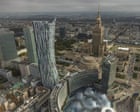
Poland has crossed the $1 trillion nominal GDP mark while continuing to outpace the sluggish European Union average. For decades, the standard story of Poland's economy followed a neat, triumphant arc from Soviet-era scarcity to Western-style prosperity. Yet that comfort-food narrative misses what is actually driving the numbers right now—and why the next phase will be far harder than the catch-up years.
Look closely at the mechanics of Polish growth in 2025 and 2026. Real GDP growth has hovered around the mid-3% range, beating larger euro-area peers even as Germany stumbles and broader European momentum cools. Unemployment sits near historic lows around 3%. Real wages have climbed, domestic consumption has carried heavy weight, and tens of billions of euros in European Union recovery and structural funds are flowing into infrastructure and investment. On paper, it looks like a textbook vindication of market reform and European integration.
In practice, however, Warsaw is running into the ceiling of its old playbook. Cheap labor is gone. Demographics are tightening. Defense spending and social commitments have widened public deficits, putting Poland under an European Union excessive deficit procedure with marching orders to bring the shortfall below 3% of GDP by 2028. Meanwhile, corporate adoption of artificial intelligence still trails the EU average by a wide margin. Poland is no longer just a fast-growing newcomer catching up to the West; it is an upper-middle-to-high-income economy forced to compete on productivity, capital allocation, and security resilience.
How Shock Therapy Built the Foundation
To understand where Poland stands today, you have to strip away the nostalgia surrounding 1989 and look at the sheer ruthlessness of the transition. Under Soviet-aligned central planning, Polish factories produced goods nobody wanted at prices divorced from reality. Shelves were empty, inflation spiraled, and state enterprises operated as social welfare sponges rather than commercial businesses.
When Poland launched its shock therapy reforms at the start of the 1990s, policymakers ripped off the bandage all at once. Prices were freed, the currency was stabilized, trade barriers fell, and state monopolies faced sudden competition. The immediate cost was brutal. Output dropped sharply in the early years, unemployment surged, and millions of households felt the whiplash of market discipline.
Yet that early pain bought something priceless: institutional credibility and speed. Poland became the first post-communist state to return to its pre-1989 wealth level by the mid-1990s. Private enterprise took root faster than in neighbors that hesitated over privatization or currency stability. By the time Poland joined NATO in 1999 and the European Union in 2004, it already had a functioning market core ready to absorb Western capital and plug into continental supply chains.
- Single-market access turned Polish factories, logistics hubs, and engineering teams into natural extensions of German and Western European industry.
- EU cohesion and recovery funds financed highways, rail lines, municipal upgrades, and broadband that private capital alone would have built far more slowly.
- A pragmatic private sector proved agile enough to pivot from basic assembly toward business services, manufacturing components, and digital engineering.
Anyone who has watched Central Europe over the past thirty years knows how easy it was for outsiders to underestimate Poland. For years, commentators treated Polish growth as a temporary convergence bounce—a statistical catch-up that would fade once wages rose. Instead, Poland notched nearly three decades of uninterrupted expansion and proved that disciplined macroeconomics paired with European integration can compound over generations.
The End of the Cheap Labor Advantage
That convergence success has created its own trap. For a long time, international investors came to Poland because skilled engineers, factory workers, and back-office specialists cost a fraction of their counterparts in Frankfurt, Munich, or Paris. That era is effectively over.
Nominal and real wages have risen sharply over the past decade, with major hubs like Warsaw seeing dramatic salary gains that have lifted living standards while driving up domestic costs. Polish workers no longer want to stay at the bottom of the value chain, and employers can no longer rely on low labor costs as a competitive moat.
Catch-up growth is a ladder, not a permanent engine. Once a country climbs close to the regional pack, every extra percentage point of growth has to be earned through productivity, innovation, and smarter capital—not simply moving workers from low-output farms and state plants into higher-output jobs.
Consider a hypothetical example of a mid-sized Polish precision-metal manufacturer that expanded rapidly in the 2010s by exporting components to German automakers. Ten years ago, its edge rested on dependable delivery and unit labor costs well below Western Europe. Today, union and market wage pressures have squeezed margins, energy costs remain sensitive to broader European shifts, and customers demand tighter automation and lower emissions. If that factory simply keeps doing what worked in 2014, its margins erode. To survive, it has to invest in automated cells, specialized tooling, and higher-margin engineering—investments that cost more upfront and demand sharper management.
Across the broader economy, this shift shows up in how growth is generated. Recent expansion has leaned heavily on domestic consumption, public investment, and EU disbursements rather than effortless export windfalls. When external demand in key European trading partners softens, domestic spending can cushion the blow for a while. Over the long run, though, a relatively small-to-medium open economy cannot rely solely on internal consumption and fiscal stimulus without risking inflation, current-account strain, or public debt pressure.
Defense Spending, Fiscal Strain, and Geopolitics
Few countries in Europe have felt the strategic shock of Russia's full-scale invasion of Ukraine as immediately or intensely as Poland. It shares a border with Ukraine, sits on NATO's eastern flank, and absorbed millions of displaced Ukrainians while becoming a vital logistics artery for military and humanitarian support.
In response, Warsaw embarked on one of the most aggressive military buildups in the NATO alliance. Buying modern air defenses, artillery, armor, aircraft, and digital command systems from the United States, South Korea, and domestic suppliers is not merely a security choice; it is a massive fiscal commitment.
Here is where the honest analyst has to separate military urgency from economic magic. Defense spending protects sovereignty and deters aggression, which has undeniable economic value in a dangerous neighborhood. Yet heavy military procurement often flows heavily toward foreign hardware manufacturers in the near term, creating fiscal outlays today while generating domestic industrial spillovers only gradually—and only if local firms actually win offset, maintenance, and manufacturing roles.
| Growth Pillar | What Helped Poland Get Here | The Catch Right Now |
|---|---|---|
| EU Funds & Integration | Massive infrastructure buildout and frictionless access to European markets | Funding cycles taper or shift, and Brussels enforces fiscal deficit rules |
| Labor Market | Skilled workforce, low unemployment, and immigrant inflows cushioning supply | Aging population shrinks native cohorts while wage growth tests competitiveness |
| Public Spending & Defense | Strong state support for security, families, and strategic projects | Wide budget deficits and heavy debt-service or bond-market exposure |
| Industrial & Tech Base | Deep manufacturing roots and strong regional outsourcing presence | Lagging enterprise AI adoption and lingering energy transition costs |
At the same time, Poland's public finances face competing claims. Social transfers, healthcare, public-sector pay, energy relief measures, and defense modernization all draw from the same fiscal well. Keeping deficits contained while funding security and EU co-financing requires discipline that is politically unpopular in any democracy. Even when EU instruments offer low-cost loans or grants for defense and recovery, debt is still debt, and interest costs eventually bite.
There is also a financial-sector nuance worth watching. Polish banks have held high shares of sovereign bonds relative to European peers, partly shaped by tax rules on bank assets that policymakers have moved to revise. When banks are heavily tied to government debt, credit expansion to private businesses can feel more constrained than ideal—precisely when private companies need capital to modernize.
Energy Transition and the Productivity Test
No story about Poland's transformation is complete without talking about energy. For decades, coal was both an economic crutch and an environmental anchor around the neck of Polish industry. Relying heavily on domestic coal gave Poland a sense of physical fuel security during the Soviet era and early post-communist years, even as air pollution exacted a steep public health toll and carbon pricing steadily raised costs.
Breaking away from Russian fossil fuels—through liquefied natural gas terminals, pipelines, interconnectors, and renewables—was a major strategic achievement. Yet the transition remains expensive and delicate. Regulated household tariffs and temporary tax relief can smooth price spikes in the short run, but phasing out support measures, managing grid upgrades, and preparing for stricter carbon rules such as the EU's ETS2 framework keep energy costs firmly on the economic agenda.
For energy-intensive industries like chemicals, glass, cement, metals, and heavy manufacturing, power prices are not an abstract line item; they decide whether a plant stays competitive in Europe or loses market share to rivals with cheaper energy. Cheaper, cleaner, and more reliable power is therefore one of the clearest prerequisites for sustaining industrial growth.
Why Technology Adoption Matters More Than Hype
Poland has built a strong reputation in software development, IT services, and business outsourcing. Walk through Warsaw, Krakow, Wroclaw, or Gdansk and you will see modern glass office towers, global tech centers, and a deep pool of capable engineers.
Still, having talented programmers or service centers is not the same as broad-based technological diffusion across traditional industries. Enterprise adoption of artificial intelligence in Poland has lagged the EU average. Many small and medium-sized enterprises remain cautious about upfront software costs, data readiness, or regulatory complexity.
Closing that gap does not require chasing every shiny tech trend. It requires practical execution: helping mid-sized factories use predictive maintenance, automating routine administrative workflows in logistics and retail, and pairing university engineering talent with commercial scale-up capital. Countries rarely jump to the top tier of global wealth on low-margin subcontracting alone; they get there by owning higher-value intellectual property, brands, and complex systems.
Demographics and the Talent Equation
Even the best economic policy runs head-on into arithmetic. Like much of Europe, Poland faces an aging population and low birth rates that gradually shrink the pool of young entrants into the labor market.
For years, migration helped ease labor shortages—first workers from Ukraine and neighboring countries, alongside returning Poles drawn home by rising wages and improved quality of life. That inflow has been vital in keeping unemployment low without choking off economic activity. Yet migration politics are sensitive, demographic headwinds are structural rather than cyclical, and higher participation among older workers, women, and underutilized groups will matter just as much as border policy.
What Separating Myth From Reality Means for Decision-Makers
The biggest mistake observers make about Poland today is swinging from one extreme to another—either treating it as an unstoppable miracle immune to gravity, or writing it off because of deficits, aging, and geopolitical risk. Neither view holds up.
Poland has earned its seat at Europe's economic table through decades of hard choices, institutional anchoring, and entrepreneurial grit. Reaching a $1 trillion economy is a genuine milestone, especially for a country that spent the late twentieth century digging out from under a command economy.
Now the test changes. Sustaining strong growth toward the end of the decade and into the 2030s requires turning EU funds into lasting productivity gains, bringing fiscal deficits back within sustainable bounds, accelerating grid and energy modernization, and pushing digital and AI tools into everyday businesses. The easiest part of catching up to the West is already behind Poland; the real measure of its transformation will be how well it leads when the training wheels come off.